
 German (DE)
  English (US)
  Spanish (ES)
  French (FR)
  Hindi (IN)
  Italian (IT)
  Russian (RU)
  5 hours ago
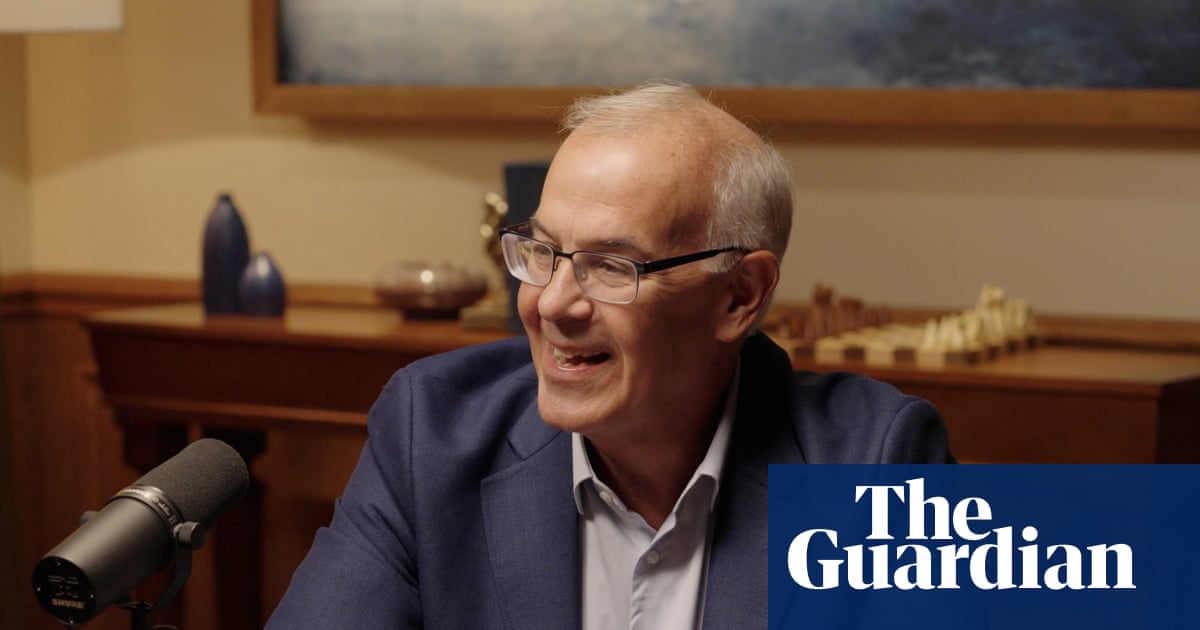
David Brooks knows there are plenty of podcasts out there. But as the veteran commentator prepares to launch his own, he believes there is still space for someone to tackle the big moral questions facing us all.
Brooks, who left the New York Times in February after 22 years and joined the Atlantic magazine full-time as a staff writer, hopes to fill that market gap with a new video podcast called The Permanent Questions, funded in part by Yale University, that will air weekly starting on Sunday.
Here he talks about the dehumanization of culture, the need to discuss morals, why he left the Times and why we need more pro-Trump voices in the mainstream media.
This interview has been edited for clarity and conciseness.
What inspired you to host this video podcast?
I’ve thought this for a long time that there’s a weird market failure in media – that we have a ton of podcasts about politics, tech, business, health, sports, but not enough about the big humanistic questions that get covered in a liberal arts education.
And I think that’s part of a wider dehumanization of our culture that all the things that sort of ennoble the human spirit, we are doing less of it, like reading, religious services, conversation, friendship, that sort of stuff.
I wanted to do it mostly because, personally, I had great teachers in college and they really changed my life, and I wanted to have that kind of conversation again. I thought it’d be fun. Other people would want to have these kinds of conversations. So that was a selfish reason. But then socially, I just think at a time of great technological advance, doing something very humanistic, having conversations like the one we just taped, which was: “Do humans have souls?” I think they do, and the guy I interviewed thinks they don’t, so we just had an argument. But I needed this, and I think the culture needs to ask the big questions again.
While you are most well-known for your lengthy career as a political columnist for the Times, you have said that you plan to move away from politics as your primary focus. Do you anticipate that the podcast will therefore stay away from the Trump administration?
Yeah, I will probably steer clear of the Trump presidency except for as it shows up in the wider cultural thing. So if you look at the pieces I’ve written for the Atlantic, the big pieces are like, “How the Ivy League broke America” and “Was the nuclear family a mistake?” Those are all sort of sociological and cultural pieces, and so we’ll do a lot of that kind of stuff. And then my books are all in that avenue too. So I think we’ll probably steer clear of Trump just because there’s no shortage of Trump commentary in the world.
Do you think there’s basically an oversaturation of political podcasts these days?
I’ve long believed that American culture as a whole is overpoliticized and undermoralized, which is to say that we follow every little political scandal, whether we’re going to remember it in two days or not. And so the big questions of life, like: how do you sit with someone who’s just lost a child or a spouse? … somehow those are weirdly underaddressed. I thought the podcast world was saturated 10 years ago – that is clearly proven to be wrong. And so I don’t know if I would say it’s saturated, but it’s well-supplied with political podcasts.
How did you come to the decision to leave the Times?
I am of the generation that thinks, ‘Well, you go to the New York Times, there’s no place else. That’s it. That’s your terminus point.’ And so I never even considered leaving the Times. But once I gave myself permission – basically I got called by the president of Yale University who asked me to take on the project and that sort of opened the door, and I thought there are a number of reasons, but I’ve been there 22 years. I got another 10 years probably [of] a full-time career. And if I end it with just having been at the same job for 32 years, I’ll be a little disappointed in myself.
Are there new skills you have had to learn to host a video podcast rather than writing a column?
The big one is reading prompter and talking into camera. I’ve always spoken from notes and it turns out when you speak from notes on a podcast, it looks kind of impersonal. So I’ve got to learn to read the prompter without sounding like a robot, and so far I have not achieved that. And for the other part, it’s just having a conversation. I think the art form is being friendly and confrontational at the same time. And I’ve noticed this in the last year or two that podcast hosts, especially [New York Times video podcast hosts] Ezra Klein and Ross Douthat, they were getting more challenging of the guests. It wasn’t just an interview any more. It was: we will have an argument, and I think that’s made them all better. And so I’m not naturally a super-confrontational guy, but I’m trying to learn how to be confrontational. Also, I notice when I listen to other podcasters, they have to really listen hard. They have to be able to respond to what the person says rather than just going to the next question on the sheet, and that’s a skill.
Douthat, your former Times colleague on the opinion side, recently left the publication to join CBS News as a 60 Minutes correspondent. Are you hopeful for his transition to television?
I’m hopeful. I think he’s a great podcast host, so if he does that kind of interview and they let him … Ross and I are friends, obviously, but I actually haven’t spoken to him since he left the Times. I think the big shift there is moving from – the Times’ audience is a certain thing, and the CBS audience, I imagine, is a somewhat different thing. And so making that shift, I think that’ll be interesting.
Do you think newspapers, particularly on their opinion pages, have struggled to find voices that can represent the full range of political perspectives, particularly on the conservative side?
When I was hired at the Times, Gail Collins, who hired me, said, “We think you’re as conservative as our readers can stand.” And it was a good line, and there’s some truth to that. You have to be kind of conservative, but kind of able to write to the Times audience. And it helped in my case that I was not a Southern Baptist from Texas, but a New York Jew from the Lower East Side. So culturally, I was already right there.
I’ll say this about media generally: I think we all know we need to hire more pro-Trump voices, but to be a journalist, you have to cross a certain professionalism threshold, like knowing how to do the basic job – the craft. And a lot of people who are on the pro-Trump side reject that whole epistemology, if you want to put it that way. They reject the whole idea of doing journalism the way I was taught to do journalism. They’re much more like, ‘Screw you, and the whole epistemological train you walked in on.’ I think it’s been hard for organizations to find someone who is a) pro-Trump, and b) just an outstanding journalist. There are such people – I think the Times has a contributing writer, Chris Caldwell, who used to be with me at the Weekly Standard. I think he clearly checks both boxes. But I think in general, it’s proven hard to find people in that, maybe because people who have more Trump views or have more working-class views, they’ve thought, ‘Ah, journalism, not for me. That’s enemy territory.’
If you have no Trump voices, you’re basically telling 40% of America, “Your voices aren’t worth hearing.” … I think it’s just bad for the country if “the media” seems to be either you’re part of the coastal elite, or you’re Candace Owens and Tucker Carlson. There’s got to be ground in the middle there.










Comments