
 German (DE)
  English (US)
  Spanish (ES)
  French (FR)
  Hindi (IN)
  Italian (IT)
  Russian (RU)
  4 hours ago
“For the last two years, everything has implied getting rid of me,” Lonnie Bunch III, the Smithsonian Institution’s secretary, said on Thursday. Following an unremitting pressure campaign from Donald Trump and his administration, Bunch, the founding director of the National Museum for African American History and Culture (NMAAHC), announced his retirement on 9 September.
Bunch insisted, however, that the pressure “was not part of my calculus”, and that his decision to step down was driven by having completed his personal checklist of goals: “First of all, I promised I’d stay a secretary for five years; It’s been eight.” Furthermore, he said that he realized that he wanted to stay through the country’s semiquincentennial celebrations and for the 10th anniversary of the NMAAHC, a museum for which he led the creation.
But there is no ignoring the withering criticism coming from the Trump administration. In March 2025, Trump issued an executive order entitled “Restoring Truth and Sanity to American History”, charging that the Smithsonian “has, in recent years, come under the influence of a divisive, race-centered ideology”. Two months later, the president fired Kim Sajet, director of the National Portrait Gallery, part of the Smithsonian, calling her “a highly partisan person, and a strong supporter of DEI, which is totally inappropriate for her position”. And that July, the White House released a 162-page report called “Saving America’s Story”, which concluded that the Smithsonian, “under its current leadership and current interpretive ideology, cannot be trusted to tell America’s story”.
Bunch, who is 73, called the criticisms “mischaracterizations” and said, “I think some of this is not understanding how history is done.” He continued: “Not that I’m sort of a progressive narrative guy, but I do believe that America has been made better by struggling with many of these issues.”
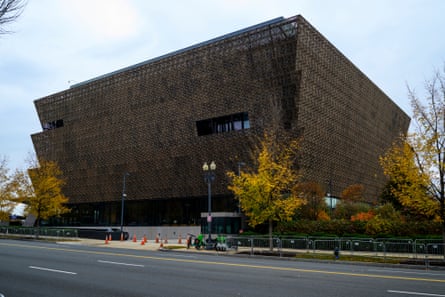
However, he admitted to having one “fundamental red line”: erasing no one’s history, as he is person who comes “from a community whose histories have been erased”. Bunch said of this line: “There is no way I crossed it.” Some critics had, however, accused the museum of toning down and editing some exhibits due to pressure from the White House. However, Bunch replied to that criticism defiantly: “Any of the changes we made in the Smithsonian were our call.”
But in addition to the narrative attacks came funding threats. White House officials sent Bunch a letter last December reminding him that funds appropriated to the Smithsonian were only available for use “in a manner consistent with” Trump’s executive order. It went on to assert that “the American people will have no patience for any museum that is diffident about America’s founding or otherwise uncomfortable conveying a positive view of American history”. Then last month, the secretary of the interior, Doug Burgum, sent a letter to the board of regents pointing out that in addition to congressional appropriations for the Smithsonian, the institution “enjoys support from executive departments and agencies” that “cannot in good conscience continue to support the Smithsonian under current leadership”.
Although Bunch said he didn’t leave because of the pressure – in fact, he believes that if Kamala Harris had been elected in 2024 instead of Trump, he would still be “contemplating” an exit – he admits the pressure took a toll. “There are people who are brilliant that can compartmentalize,” said Bunch, “not me.” But he had to get over his own righteous obstinacy, a stubborn refusal to be pushed. “My sense is: you want me to go, be nice,” he continued. “You want me to stay, poke me in the eye.”
As he put it, “I just thought, ‘Don’t I deserve a little grace?’” Though after consulting with his family, who said to him, “What else do you have to give?”, he made his decision to leave.
The Smithsonian is governed by a 15-member board of regents, including members of Congress; the vice-president, JD Vance; and the chief justice of the supreme court, John Roberts, who also serves as the institution’s chancellor. Bunch not only said that he felt supported by the board and considered himself “fortunate” to work with it, but he also had particular praise for Roberts, saying: “The chief has been really, in a kind of quiet, understated way, supportive of me, and I’m very grateful for that.”
Roberts, in a statement, praised Bunch’s “wisdom, vision and leadership”.
When reflecting on whether there were things he would have done differently in his ongoing fight for the Smithsonian and its mission, Bunch admitted that he was prone to second-guessing himself, which had been a lifelong trait. “I still remember every pass I ever dropped playing high school football,” he joked. Bunch wrestles with whether there are times when he should have spoken up more – or less – but “on the whole”, he said, “I thought I did a pretty good job”.
Retirement would be understandable at this point in his career, including 38 years of service at the Smithsonian, but he has no intention of assuming a sidelined life. There is a vitality in him that is now in search for the next phase. “I hope that somebody will let me teach somewhere, somebody will let me write op-eds, and obviously I’ve got a bunch of books to write about this period,” Bunch said.
He is confident that the Smithsonian will survive this period of pressure, “This too shall pass,” he said. For Bunch, the questions are about impact and the long-range struggle for the museum system. He hopes the Smithsonian’s museums continue to be places where people can come from around the world and say: “I’m not afraid of the truth, I’m not afraid of my past and I’m not afraid of ambiguity.”














Comments