
 German (DE)
  English (US)
  Spanish (ES)
  French (FR)
  Hindi (IN)
  Italian (IT)
  Russian (RU)
  12 hours ago
5 minutes ago
James GallagherHealth and science correspondent

 Getty Images
Artificial intelligence has been used to develop a "fundamentally new" type of vaccine that could protect against large swathes of viruses and prevent pandemics, say researchers.
The team at the University of Cambridge say it is the first time a vaccine's key component has been designed entirely by AI and then trialled in people.
The vaccine was engineered to work on all coronaviruses which would include all Covid variants and viruses that infect animals, but could start the next pandemic.
The work is still in the early stages, but the team is already developing separate vaccines that could tackle flu and Ebola.
Vaccines teach our bodies how to spot an infection to increase our chances of fighting it off.
But some viruses are adept at changing their appearance – or mutating – so vaccines can quickly go out of date. It's why Covid and winter flu vaccines need to be regularly updated.
"We're always behind," said Prof Jonathan Heeney, from the University of Cambridge, adding "what we're trying to do is get ahead of the curve" and so far ahead they could protect against new outbreaks or pandemics.
 Getty Images
Vaccines played a crucial role in the pandemic, but needed to be designed from scratch and then updated as the virus mutated
Normally vaccines are designed using a current strain of a virus.
The Cambridge researchers took known genetic codes – the instruction manuals of life – from a range of coronaviruses that had been recorded by surveillance programmes hunting for potential viral threats.
These genetic codes were analysed by an artificial intelligence. It then designed a "super-antigen" that could train the immune system in such a way it gave protection against the whole family of viruses – even if they mutated or a new infection jumped from animals to people.
Antigens are the critical components of vaccines as this is what the immune system learns to attack.
Heeney said this was the first time an antigen designed by AI had been trialled in people. He said the technology was "surprising all of us" and it was "amazing what we can do with it for the good of humanity".
Heeney told BBC News: "This is about making vaccines that protect us, not just from today's viruses, but protect us from what can cause the next outbreak or disease.
"This is a fundamental shift in how we prepare for pandemics."
 Getty Images
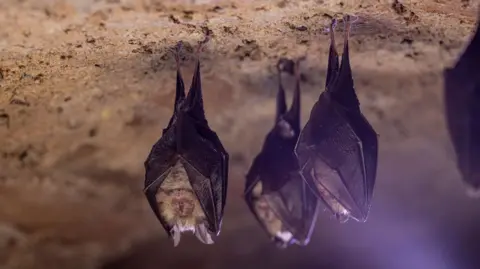
Bats are one source of coronaviruses
The trials, in 39 people, were designed to assess if such vaccines were safe. A second study – involving around 200 people – will give a greater understanding of how well it is training the immune system.
The findings detailed in the Journal of Infection said the impact on the immune system was "modest", but they are still generating excitement.
Prof Saul Faust, who performed some of the trials at the University of Southampton, said the AI design "definitely has potential" and was "really exciting".
He told the BBC: "What's really interesting is the technology is an awful lot better at designing vaccines for potential pandemics when viruses are changing."
The Cambridge team are already performing animal research on universal seasonal flu vaccines that would not need to be adapted every year and an H5N1-bird flu vaccine, in case the virus that is currently devastating bird populations became a human pandemic.
They are also looking at a vaccine for viral haemorrhagic fevers, which would include Ebola species. The current outbreak in the Democratic Republic Congo is being caused by a species that does not have a vaccine developed for it yet.
Prof Andy Pollard, the director of the Oxford Vaccine Group, was not involved in the study, but said this approach was generating compelling evidence in animal research.
"It's fascinating data and people wouldn't have predicted they'd be able to generate these immune responses," he told BBC News.
The real test, he says, is what happens in the human trials as our immune systems are different to laboratory mice as ours have been shaped by years of infections.
More broadly he said artificial intelligence was going to be a "game changer" for vaccine research and that AI tools had the potential to predict how the immune system respond would respond to a vaccine making development much faster and would "save lives".
Prof Marian Knight, scientific director for National Institute for Health and Care Research, said: "The remarkable success of this AI-designed 'super-antigen' trial marks a pivotal leap forward in our ability to deliver broad, lasting viral protection."












Comments