
 German (DE)
  English (US)
  Spanish (ES)
  French (FR)
  Hindi (IN)
  Italian (IT)
  Russian (RU)
  21 hours ago

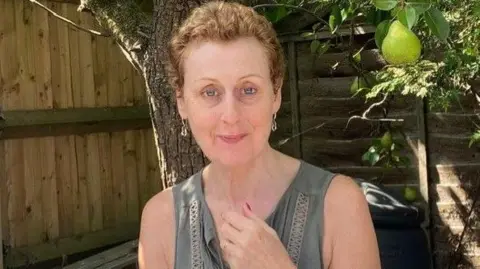 Patricia Hill
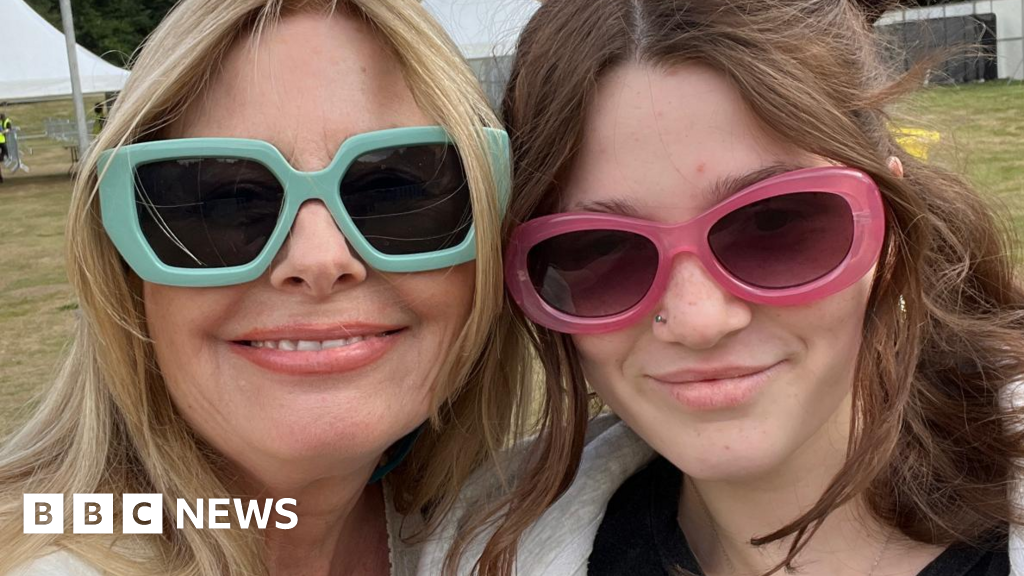
Patricia says the drug has enabled her to go to the theatre and visit family
A breakthrough drug for ovarian cancer that is kinder on the body and extends lives is now available on the NHS.
The drug, called mirvetuximab soravtansine, is a known as a "biological missile" as it delivers chemotherapy drugs direct to the cancerous tissue rather than to the whole body - reducing debilitating side-effects.
Patricia Hill, 64, said the treatment was allowing her to do things – like visiting family and going to the theatre - that were impossible on conventional chemotherapy.
Up to 400 patients a year in England could benefit from the new treatment – the first for hard-to-treat ovarian cancer in 20 years.
There are nearly 7,750 cases of ovarian cancer in the UK each year.
Patricia, from north London, was diagnosed in 2023 and had multiple rounds of chemotherapy. She started on mirvetuximab in January this year.
She said the difference was like night and day, and the therapy had given her "a lot of my life back".
She felt less tired and sick than when treated with standard chemotherapy, so felt "a lot better" and describes the drug as a "bit of a game changer".
The new drug has allowed her to see shows in London's West End, dine out at restaurants, attend the Chelsea Flower Show and visit family in Ireland.
"It actually opens up a lot of possibilities - you can actually go and do a lot more than you would normally do."
The drug – mirvetuximab – extends lives too, from 12.8 months on chemotherapy to 16.5 months on the therapy, on average.
But crucially it improves quality of life. It has fewer side-effects, women are able to keep their hair and it is given by a drip every three weeks, instead of weekly with conventional chemotherapy.
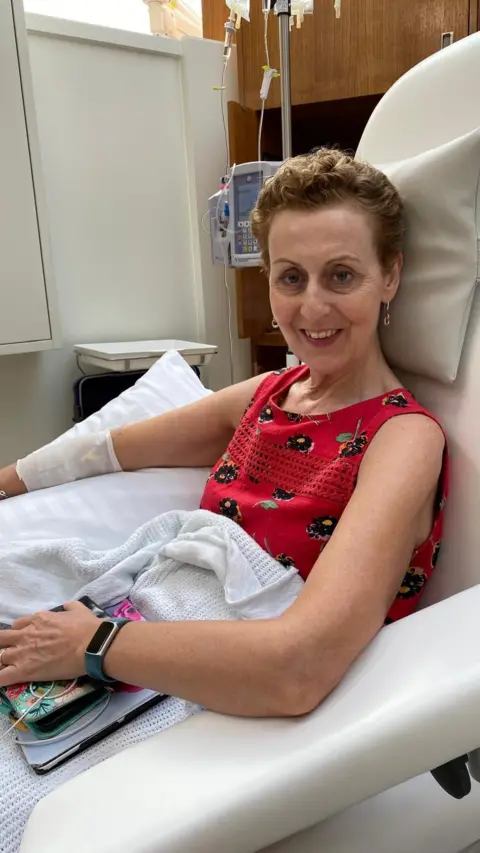 Patricia Hill
Patricia having her infusion of the drug
The drug is an advanced form of chemotherapy that hits cancer with a bigger dose, while reducing side-effects.
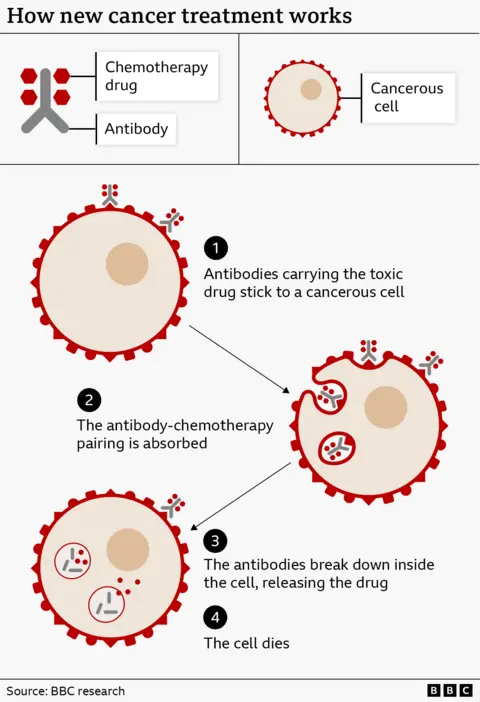
It is made from a deadly chemotherapy drug that has been fused to an antibody, similar to the ones the body uses to fight infection.
However, these antibodies have been designed to spot markings - called folate receptor alpha - that appear on the outside of some ovarian cancer cells.
So they travel to cancerous cells, stick to the surface and are then absorbed. Once inside they release their toxic payload, to kill the cancer.
This is the reason why this type of therapy is also known as a 'Trojan horse' therapy, after the Greek myth.
About 30-40% of cancers which do not respond to chemotherapy have these markings.
Jenny Green, 71 from Hertfordshire, was diagnosed in 2017 and was part of the clinical trials that proved the drug worked.
She said: "I seem to have tolerated it very well, with hardly any side effects at all. That's been amazing!
"I had a scan that showed my cancer nodules were shrinking, and my bloods were coming back into range - which is all pretty good to hear."
The drug has been approved by the medicines watchdog, the National Institute for Health and Care Excellence (NICE), in ovarian, peritoneal and fallopian tube cancer if chemotherapy no longer works and the cancers have the right markings.
NHS England says it will pay for the drug. Wales and Northern Ireland normally follow the same rules, while Scotland makes its own decisions.
Dr Rowan Miller, who ran the clinical trials at UCLH, said she was "really excited" this drug was coming to the NHS after a 20-year search for better medications.
"Finally, there's a drug that's available, that improves survival for this group of patients and in addition, the patients get on with the treatment well and find it easier to manage than standard chemotherapy," she told me.
Prof Ruth Plummer, NHS national clinical lead for cancer drugs, said it was the "most significant breakthrough" in treating these hard-to-treat ovarian cancers "in over two decades" and added she was "delighted" it was available on the NHS.
Victoria Clare, chief executive officer at Ovacome, the UK's ovarian cancer support charity, said: "This decision has the potential to make a real difference to those who are able to access this treatment. We are delighted."
Mirvetuximab soravtansine has been developed by the pharmaceutical company AbbVie.
Rachel Downing, head of policy and external affairs at Target Ovarian Cancer, said the drug becoming available on the NHS was "a hugely important moment" for women with platinum-resistant ovarian cancer and their families, "who have faced limited effective treatment options for far too long".











Comments