
 German (DE)
  English (US)
  Spanish (ES)
  French (FR)
  Hindi (IN)
  Italian (IT)
  Russian (RU)
  3 hours ago
The US has been accused of “shameless exploitation” over a health financing agreement with Zambia worth more than $1bn (£740m), amid warnings that the country is getting a raw deal from the Trump administration.
A leaked draft of a five-year memorandum of understanding (MOU) between the two countries, seen by the Guardian, reveals that Zambia may accept terms worse than health financing agreements the US has reached with 16 other African countries.
The terms include a commitment to give Washington access to its health data for 10 years – far longer than other countries have negotiated. Zambia’s deal also predicates any health financing on an even more covert arrangement that could open up the country’s mining industry to US interests.
Asia Russell, director of the HIV advocacy organisation Health Gap, said: “These terms are vastly worse than other deals. [The US] is conditioning life-saving health services on plundering the mineral wealth of the country.
“It’s shameless exploitation, which is immoral. It’s also dangerous – when health programmes are treated like a bargaining chip by a rapacious administration, everyone suffers,” she said.
The Trump administration is pursuing these bilateral global health deals after dismantling most of the federal development agency, USAID.
The new strategy channels health financing directly to governments, rather than through aid organisations, while also requiring increased investments from partner countries.
In Zambia’s case, Washington is offering $1.012bn in health funding in exchange for Lusaka’s commitment to hire 40,000 new health workers and contribute an additional $400m in health services over five years, while improving the health sector’s performance, according to the leaked draft. The country’s 2026 budget for health services is roughly $1.3bn.
If Zambia faltered on any of these fronts, Washington could terminate the agreement and withdraw its funds.
Julius Kachidza, chair of Zambia’s Civil Society Self-coordinating Mechanism, supports much of what the MOU is trying to accomplish, such as improved services and increased domestic financing, but worries that if the country were to fall short of the set terms, then the entire health system would be put at risk.
“I’m a person living with HIV,” he said. “If the HIV programme in Zambia is distorted or it’s disrupted or it’s derailed, I’ll be the first casualty, as well as hundreds of thousands of other people.”
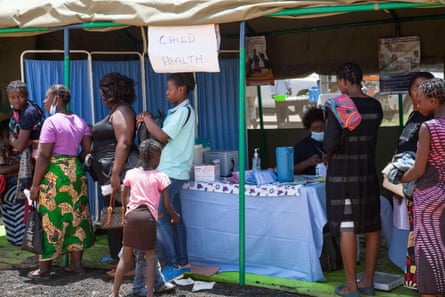
Civil society groups are pressing to amend the agreement. The MOU includes a clause that the entire process will be terminated if an agreement is not reached by 1 April.
For advocates, their foremost demand is stripping out any data-sharing requirements from the deal.
Josiah Kalala, director of the Chapter One Foundation, a human rights organisation, said: “This is essentially our Zambian government signing away the right to access health data of its citizens to another country.”
Zambia is also preparing to give Washington information on any new or emerging pathogens within its borders over the next 25 years.
Other countries have committed to sharing data, but on less exacting terms. None of the publicly available MOUs include 25-year pledges to sharing pathogen data. Kenya limited sharing of its health data to seven years but is still facing a legal challenge.
Kachidza said Zambian activists would also consider going to court over the agreement.
In early December, the US embassy in Zambia confirmed that the health financing agreement was contingent on “collaboration in the mining sector and clear business-sector reforms” that would improve US economic access to the country.
The MOU also commits the Zambian government to monthly briefings with the US embassy on trade and investment efforts between the two countries, with a goal “of expanding US commercial investment in Zambia”.
Kachidza described the situation as like “being held hostage”.
A US state department spokesperson declined to discuss details of the MOU, but wrote in a statement: “The administration believes that American foreign assistance must demonstrably advance American national interests and use taxpayers’ dollars efficiently.”
On 15 February, Zambia’s health minister, Elijah Muchima, denied that health financing was linked to mining concessions. “The conditions that are on that MOU relate to how the money will be utilised,” he said on television.
“If there are other external conditions attached, I am personally not part of that,” he said. The Zambian president, Hakainde Hichilema, fired Muchima three days later without explanation.
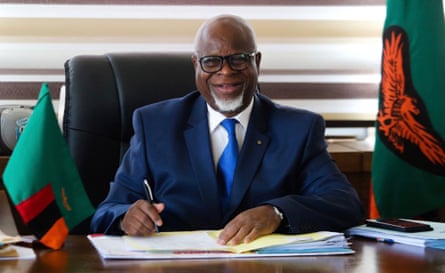
Activists fear Zambia is being set up to fail, though Oliver Kaonga, a Zambian health economist, said it might be possible for the government to meet the new funding obligations. However, Zambia’s spending remains constrained, with more than a third of its 2026 budget being spent on debt repayments. “The starting point would be about, ‘can we mobilise resources better?’” he said.
The US is offering Zambia less health aid under the MOU than before. Washington had committed $367m to Zambia for HIV services alone last year. The total health funding for 2026 is $320m under the draft MOU, which would cover programmes such as disease surveillance and treatment of malaria, TB and HIV.
The overall US commitment of $1.012bn over five years is lower than the $1.5bn agreement that Muchima announced in November 2025. The US state department, whose Bureau of Global Health Security and Diplomacy has been negotiating the agreements, did not respond to a Guardian request for clarification.
As its funding declines, Zambia is still expected to improve against performance targets, such as increasing the number of people enrolled in HIV treatment and reducing maternal mortality, or risk losing US support.
Kalala suspects the Zambian government is going ahead with the agreement despite the risks partly because of its “major concern about the sudden loss of funding to the health sector and the political fallout that might cause”.
Zambia’s Ministry of Health did not respond to requests for comment.
In Zambia, civil society groups finally secured a meeting with the health ministry on 3 February. But the two-hour briefing only addressed some components of the MOU, while multiple participants said officials warned them against considering legal action around the data-sharing provisions. Officials refused to clarify whether the MOU funding was tied to economic concessions.
Advocates have presented a list of demands, alongside the removal of data-sharing, including a seat on the steering committee that will monitor progress.
Kalala is also spearheading an access-to-information request to make public the latest version of the MOU and the bilateral agreement.
“Once we get sight of the agreement and the compact, we’ll even be able to see if we can challenge the constitutionality of some of the provisions,” he said. “We have to get it right at the beginning.”







Comments