
 German (DE)
  English (US)
  Spanish (ES)
  French (FR)
  Hindi (IN)
  Italian (IT)
  Russian (RU)
  3 hours ago
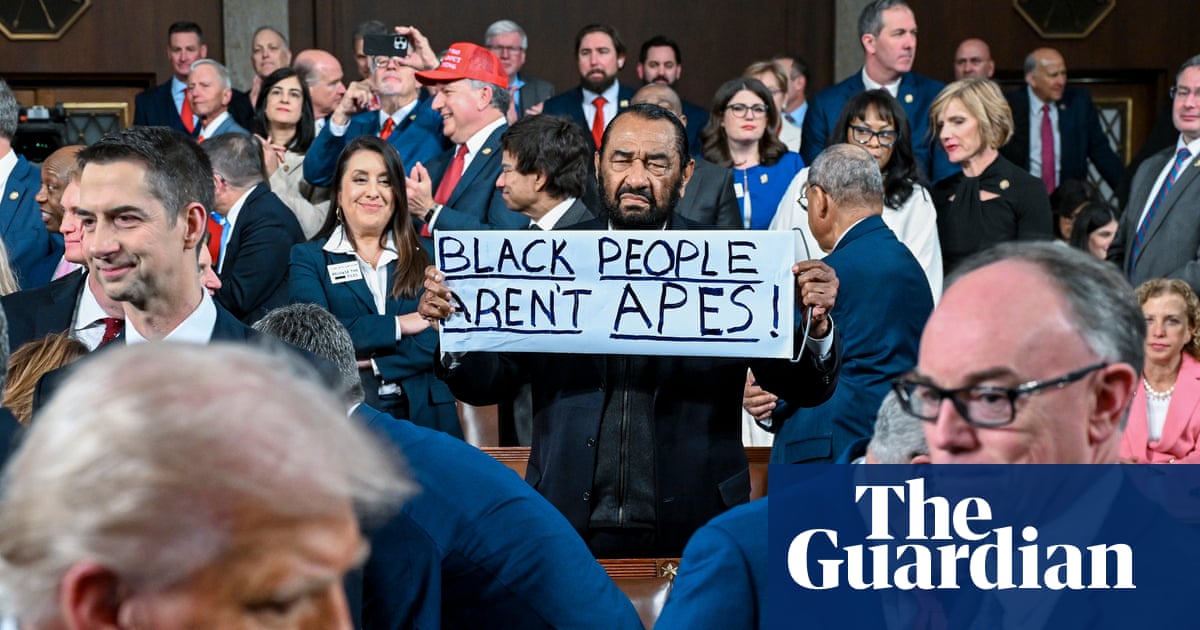
Donald Trump once again railed against imagined fraud in America’s elections on Tuesday during the State of the Union address.
“They want to cheat,” he said of Democrats. “They have cheated. And their policy is so bad that their only way to get elected is to cheat. And we’re going to stop it.”
Trump has put action to his long-debunked claims this year, with FBI agents seizing 2020 election documentation in Fulton county, Georgia, and the Department of Justice pursuing voter data from state elections officials across the country.
The incumbent party usually faces losses in midterm elections. Since the second world war, the president’s party has lost an average of 26 seats in the House, and an average of four seats in the Senate. Those results in 2026 would flip both chambers.
“I think he understands – and I’m pretty confident that he knows this – that they’ll lose the midterms and lose them significantly,” said Representative Joe Morelle of New York, the ranking Democrat on the House administration committee, which governs voting laws in Congress. “So, in true Donald Trump fashion, the question then is, ‘well, how do I rig the results?’”
Trump appears poised to go to extraordinary lengths to protect his administration from the consequences of a possible Democratic majority in Congress this year. Some of those moves are already in play, from the aggressive and unusual redistricting plans enacted by Republican-controlled states to Trump’s advocacy for passage of election reforms by Congress. But Democrats are left to imagine what else an increasingly authoritarian administration may attempt, given its seeming contempt for political precedent and legal norms.
Here are some ways Trump might try to influence – or obstruct – the midterm elections:
States adopt voting restrictions
Trump called for the passage of the Save America Act in the State of the Union. The law would require states to turn over their voter data to the Department of Homeland Security for inspection, restrict the use of mail-in ballots, impose voter ID at the polls and proof of citizenship at registration. The bill must overcome a Democratic filibuster in the Senate, making its passage highly unlikely.
But states are free to adopt its provisions, though they would almost certainly face constitutional challenges at the state and local level.
The Institute for Responsive Government notes that Republicans in more than half of state legislatures have introduced legislation to restrict mail-in ballots, only a few – Arizona, Kansas, Mississippi, Tennessee, Utah and West Virginia – are under active consideration.
Trump issues an executive order imposing voter ID and proof of citizenship
In the absence of congressional action on the Save America Act, Trump has suggested that he may issue an executive order of some kind to enforce its measures. In comments to Dan Bongino, Trump said he wanted to “nationalize” elections. “We should take over the voting in at least many – 15 places. The Republicans ought to nationalize the voting,” he said.
His first attempt at using executive authority to impose his will on elections landed in court with a thud; a lawsuit by the League of Women Voters resulted in summary judgment blocking the order last year.
The constitution places the power to administer elections in the hands of states, with some authority to issue regulation for federal elections with Congress. The president has no authority over elections.
“From tamper-evident envelopes to ballot tracking and signature verification, mail voting includes multiple safeguards,” the Institute for Responsive Government wrote. “Ballots are stored securely and handled under strict chain-of-custody rules, sent only to registered voters whose identities are confirmed through state and federal databases.
Republicans accuse elections officials of crimes
While speaking at Davos shortly after the raid in Fulton county, Trump said “people will soon be prosecuted for what they did,” without elaborating.
When FBI agents raided Fulton county’s elections office in January, looking for 2020 election documents, they served a warrant in a criminal investigation. The affidavit supporting the warrant application argued that if “deficiencies” identified in any of the previous reviews of the 2020 election “were the result of intentional action, it would be a violation of federal law regardless of whether the failure to retain records or the deprivation of a fair tabulation of a vote was outcome determinative for any particular election or race”.
The county has strongly contested the FBI’s case, arguing that the FBI based its affidavit on claims that had already been found to be untrue and had relied on partisan skeptics of questionable credibility. But the Fulton county chairman, Robb Pitts, suggested in comments following the raid that he believed it was possible that he or others might be targets of arrest by the Trump administration.
The federal government seizes voting machines or ballots
Tulsi Gabbard, director of national intelligence, has been working for months on an investigation into voting machines and foreign election interference. Gabbard and the FBI induced Puerto Rico to turn over some of its voting machines and software images for analysis last year.
Rightwing conspiracists have suggested that Venezuela may have tampered with elections infrastructure in 2020. Evidence supporting that claim has been scant – and Gabbard’s office denied looking for a Venezuela connection. But before the Trump administration removed the conservative activist Ed Martin from his post as deputy associate attorney general leading a justice department team examining the department’s alleged “weaponization”, he shared an X post predicting that the deposed Venezuelan leader Nicolás Maduro could “plead to lesser charges by proffering evidence that the 2020 election was stolen”.
Gabbard’s investigation may create a pretext for Trump to order voting machines to be blocked as a matter of national security.
“If the FBI is now claiming authority to take election materials under the guise of fraud investigations, it’s not hard to imagine it trying to do so while the 2026 midterm votes are being counted,” wrote Jasleen Singh of the Brennan Center for Justice. “Trump demanded as much in 2020, and his then–attorney general rejected that as unlawful. But the current attorney general and other administration officials might be more pliant and ready to do whatever Trump asks, regardless of what the law says.”
Legal experts say it would be difficult to overcome the constitutional challenges to such an act.
“The president does not have the authority to regulate elections, including voting equipment guidelines,” Singh wrote. “And though certain federal agencies have authority to offer technical assistance or issue guidelines for voting equipment, none has authority to take exclusive custody of voting equipment for inspection.”
Federal agents occupy cities and surround polls.
A few weeks into the surge of ICE agents in Minneapolis, the attorney general, Pam Bondi, sent the Minnesota governor, Tim Walz, a letter describing conditions that would lead to the end of the operation. Among those conditions: turn over voter data.
“[A]llow the Civil Rights Division of the Department of Justice to access voter rolls to confirm that Minnesota’s voter registration practices comply with federal law as authorized by the Civil Rights Act of 1960. Fulfilling this common sense request will better guarantee free and fair elections and boost confidence in the rule of law,” Bondi wrote.
Voter lists have little to do with immigration enforcement. The Minnesota state attorney, Lindsey Middlecamp, described Bondi’s letter as a “ransom note”.
While the prospect of deliberately provocative actions by federal agents around elections may seem far-fetched, the Trump confidant Steve Bannon responded to Trump’s call to “nationalize” elections with even more strident language.
“We’re going to have ICE surround the polls come November,” he said on his podcast the next day. “We’re not going to sit here and allow you to steal the country again … and you can whine and cry and throw your toys out of the pram all you want, but we will never again allow an election to be stolen.” A day later, he went further, calling for troops to be sent to the polls under the Insurrection Act.
A number of federal statutes expressly bar federal agents or troops from going to voting locations.










Comments