
 German (DE)
  English (US)
  Spanish (ES)
  French (FR)
  Hindi (IN)
  Italian (IT)
  Russian (RU)
  2 hours ago

Before she sat down to speak with the Guardian, Zattura Sims-El leaned over to plug a table lamp into the wall.
“I keep everything in this house unplugged when I’m not using it, because I heard that as long as it’s plugged into the wall, it’s costing you,” she said. “The only things I don’t unplug are my stove, my dishwasher, my refrigerator and my washing machine.”
The 76-year-old resident of Baltimore, Maryland, adopted the habit in an attempt to rein in her utility costs. Despite her efforts, her monthly gas and electricity bills last year always topped $500, and one month reached $975.
“It’s obscene,” said Sims-El, who has lived in her home for 46 years. “How is anyone supposed to keep up with this?
During his 2024 campaign, Donald Trump repeatedly promised that, if elected, he would halve Americans’ energy bills within a year of returning to the White House. He has thoroughly failed to meet that pledge, a Guardian analysis has found.
“Trump is a liar, and that’s something I know from the bottom of my heart,” Sims-El said when asked about the president’s promise.
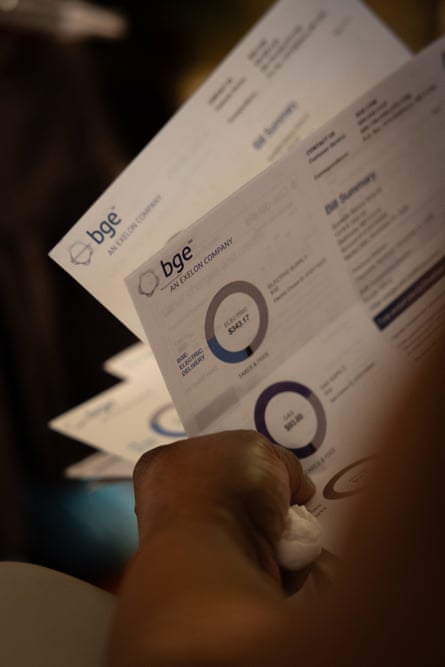
The average US household paid nearly $116 more for electricity in 2025 than the year before, a 6.7% increase, according to data from the Energy Information Administration. Gas prices rose as well, jumping 5.2% on average, federal data shows.
“If they keep rising, who is going to be able to pay their bills?” Sims-El asked. “Certainly not me, not anyone except the super-wealthy.”
Sacrifices
Sims-El said she has had to make lifestyle changes to cope with her energy costs. While she used to buy her groceries at a Giant supermarket nearby, she now drives to multiple stores each week to hunt for bargains – a process that can take hours.
Halfway across the country, Samantha Lott, a resident of Denton, Texas, has found herself tailoring her shopping habits to cope with rising energy costs, too. Last year, after Lott was diagnosed with endometriosis, her doctor suggested she adopt an anti-inflammatory diet. But the cost of energy has made it impossible to afford “anything but the basic groceries that I can find deals on”. And there’s an even more difficult sacrifice she now finds herself making: cutting back on medical appointments.
“It’s really hard, because I have to choose: do I go to the doctor this month and get the follow-up appointment I need, or do I pay for electricity?” she said. “The copay is $70 for an appointment, but I need that $70 to pay my bills.”
Liz Jacob, the lead staff attorney and energy insecurity coordinator at the Sugar Law Center for Economic and Social Justice in Detroit, Michigan, said she has seen many clients pushed to make those kinds of choices, “cutting back on food, toys, resources for their kids and everything they can”. With both gas and electricity prices so high, said Jacob, some are forced to choose between the two utilities.

“Some folks make the choice to cut off their gas service and just keep electric in the winter, using space heaters to heat their rooms that they’re frequenting because they can’t afford to heat the whole house,” she said. “Other folks talk about cutting off their electric service and just going with gas because they need heat, though they then don’t have any access to light in their homes.”
Datacenters and gas exports
One driver of 2025’s soaring energy bills was the nationwide proliferation of datacenters for artificial intelligence. In October, PJM – the grid operator covering 13 mid-Atlantic and midwest states as well as the District of Columbia – called datacenters the “primary reason” for the increased price of power. In July, Trump rolled out a scheme to streamline permitting for datacenters, semiconductor manufacturing facilities and fossil fuel infrastructure.
“They’re going to strain the grid with these datacenters, which are massive developments,” said David Jones, a 45-year-old resident of south Baltimore. “Why should we have to take on the price of that?”
Jones, who lives in Baltimore’s industrial Curtis Bay neighborhood, said his monthly bills in 2025 were “at least $100” more than they were the previous year.

Amid growing outrage over steep power bills, the president last week announced that he is pressing tech companies to foot the bill for the rising costs associated with their datacenters.
“We are the ‘HOTTEST’ Country in the World, and Number One in AI,” Trump posted on Truth Social. “Data Centers are key to that boom, and keeping Americans FREE and SECURE but, the big Technology Companies who build them must ‘pay their own way.’”
On Friday, Trump officials also met with current and former governors of east coast states to discuss the energy demands of the AI datacenter boom, then released a plan to urge PJM to make deals with technology companies to ensure that they foot the bill for upping the country’s power supply.
But Trump has not backed away from his unabashedly pro-fossil fuel agenda, which has also pushed up energy costs. His administration’s efforts to increase liquefied natural gas (LNG) exports, for instance, cost US households a combined $12bn in the first nine months of 2025, according to a December report from the consumer advocacy organization Public Citizen.
Jones cast his vote for Trump in the 2024 election because he felt the US needed a “businessman” in office, and because he could not bring himself to vote for Joe Biden. He still has a fondness for the president, he said. But he believes Trump has been too influenced by donors from big tech and the fossil fuel industry.
“His ‘drill, baby, drill’ agenda does a disservice to Americans,” he said. “I know he means well … but if I would have known about a lot of things that he’s done, as far as energy and things like that, I probably wouldn’t have voted for him.”
Reached for comment, White House spokesperson Taylor Rogers said federal officials “will continue to aggressively implement President Trump’s energy dominance agenda because cheaper energy can unleash unprecedented growth in every facet of our economy”.
“Blue states are stubbornly choosing Green Energy Scam policies that are making electricity bills unaffordable,” she said in an email. “Meanwhile, GOP-led states are successfully lowering energy costs for their residents by embracing President Trump’s commonsense ‘DRILL, BABY, DRILL’ agenda.”
Aid cut
As the Trump administration has presided over rising electricity and gas costs, White House officials have also made it more difficult for Americans to access energy aid.
Last year, the administration eliminated tax credits for cost-cutting home energy-efficiency upgrades. It also attempted to eliminate the Low Income Home Energy Assistance Program (LIHEAP), which helps 6 million low-income Americans with their energy bills each year.
The program survived, but has been significantly hampered after the administration laid off the entire LIHEAP staff. The cuts and a record-breaking government shutdown caused unprecedented delays in getting energy assistance aid to low-income households.
“Detroit is not even taking aid applications right now because there’s so much backlog from that time,” said Jacob. “They have so many applications to process that they’re not taking new applications.”
Angie Shaneyfelt, a 52-year-old resident of Curtis Bay, Baltimore, has seen her bill shoot up rapidly this year, from less than $300 in December 2024 to $400 last month.

Toward the end of last year, she applied for funding from a LIHEAP-funded Maryland program after receiving a gas and electric cutoff notice over a past-due balance. Her application was quickly denied.
“They said that because of the volume of applications – by the time they got to me the funds would be gone,” she said. “The only place I was able to find aid was from a church … and it wasn’t easy. Just finding aid that is available is a full-time job.”
Shaneyfelt averted the cutoff but is still struggling to keep up with her bills, especially because she lost her husband in February. She is considering taking up a second job, even signing up to deliver food with DoorDash last month.
“I’m not young, and I already work full-time, and I think working more would bust my body down,” she said. “But what am I going to do?”
More work hours would give Shaneyfelt even less time with her 13-year-old twin daughters, but with another gas and electric rate hike planned for next month, she may be forced to bring in more income.
“I’ve already slimmed back so much stuff,” she said. “And now I have to give up my time with my family?”
-
The Guardian receives support for visual climate coverage from the Outrider Foundation. The Guardian’s coverage is editorially independent



















Comments