
 German (DE)
  English (US)
  Spanish (ES)
  French (FR)
  Hindi (IN)
  Italian (IT)
  Russian (RU)
  1 hour ago
Weeks after Donald Trump’s first shock election win, bosses from across corporate America were scrambling to enter the president’s orbit.
Business leaders ranging from the General Motors boss, Mary Barra, to Disney’s chief, Bob Iger, quickly signed up to a new advisory council in 2016 to help shape the aggressively pro-growth policies of this new populist politician. Among them was the head of America’s largest bank: Jamie Dimon, the chair and chief executive of JP Morgan.
Dimon’s name alone was a boon to Trump’s nascent political credibility. Easily the biggest name on Wall Street, Dimon – now 69 and paid $43m last year – was feted for steering JP Morgan through the 2008 banking crisis and on to enviable financial success.
Rumours were also swirling that the executive would be tapped to serve in Trump’s administration. And while Dimon, a lifelong Democrat, reportedly turned down an offer to lead the US Treasury department, the pair continued to be on surprisingly good terms. “I’d try to help any president of the US because I’m a patriot,” Dimon told shareholders. Even Vanity Fair commented on Dimon’s “unbridled optimism” despite the new president’s growing list of gaffes.
A decade on, the pair’s relationship has hit rock bottom.
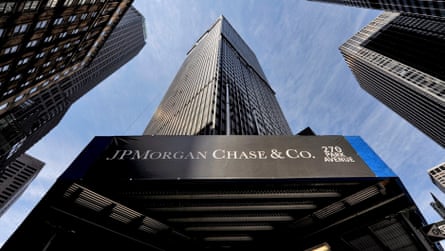
Trump on Thursday took aim at his one-time ally, launching a $5bn (£3.7bn) lawsuit against JP Morgan and Dimon over claims the bank had unfairly closed his accounts for political reasons after the 6 January Capitol riots in 2021. JP Morgan said that while it closed accounts that created legal or regulatory risk for the bank, the lawsuit itself “has no merit”.
While this may not be the absolute end of the relationship between the billionaires, there were signs their once-affable relationship could become rocky even from the start of Trump’s first term.
Back in 2017, months after Trump’s first inauguration, Dimon said he had disagreed with, but tolerated, Trump’s controversial decision to pull the US out of the Paris climate agreement. But he drew a line after Trump failed to denounce white supremacists who took part in a violent and fatal rally in Charlottesville, Virginia, in the summer of 2017.
The economic advisory council, which counted General Motors, Walmart, and Disney bosses among its top brass, quickly disbanded in response. “It is a leader’s role, in business or government, to bring people together, not tear them apart,” Dimon said.
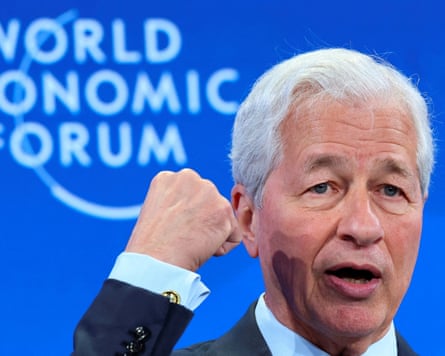
Personal tensions between the pair also escalated. Dimon, addressing speculation over his own presidential ambitions, told a panel in New York in late 2018: “I think I could beat Trump … because I’m as tough as he is, I’m smarter than he is.” He added: “And by the way, this wealthy New Yorker actually earned his money. It wasn’t a gift from daddy.”
Regret for his comments did not appease Trump, who responded online that Dimon did not have the “aptitude or ‘smartness’ & is a poor public speaker & nervous mess”.
Still, the two had common ground. Despite their personal friction, Dimon made positive sounds about Trump’s tax cuts and nascent China trade deal, just months before the ground was laid for this week’s big lawsuit. But the shocking Capitol riots prompted swift condemnation from bosses including Dimon – and, Trump claims, resulted in the unfair closure of his JP Morgan bank accounts. The row is reminiscent of the dispute between Nigel Farage and NatWest in the UK, which ultimately led to the departure of the bank’s chief executive, Alison Rose.
Those simmering tensions boiled over into Trump’s second presidential run. “Highly overrated Globalist Jamie Dimon, the CEO of JPMORGAN, is quietly pushing another non-Maga person, Nikki Haley, for President,” Trump said in a post on Truth Social in late November 2023. “I’ve never been a big Jamie Dimon fan … I guess I don’t have to live with him any more, and that’s a really good thing.”
But until this month, the war of words between Trump and Dimon seemed to be on pause. Despite market turmoil triggered by Trump’s unpredictable trade and tariff policies, banks such as JP Morgan have been largely appeased. The president’s bonfire of regulation was widely welcomed, as was capitulation to Wall Street’s longstanding campaign for looser capital rules.
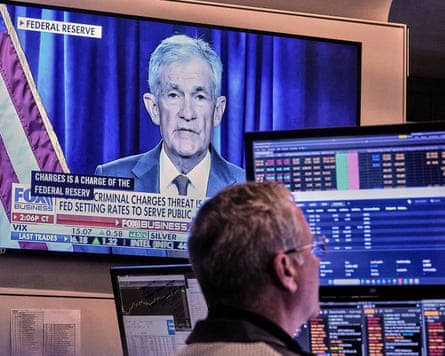
However, Trump’s sustained attacks on the chair of the Federal Reserve, Jerome Powell – which have culminated in a highly controversial Department of Justice criminal investigation – proved a step too far.
Dimon publicly backed Powell earlier this month, telling reporters that the widely condemned investigation was putting the central bank’s independence at risk. “And anything [that] chips away at that is probably not a great idea, and in my view, will have the reverse consequences. It’ll raise inflation expectations and probably increase [interest] rates over time,” he said.
Policies that threaten JP Morgan’s profit margins, such as Trump’s plans for a 10% cap on US credit card interest rates, have also drawn Dimon’s ire.
But Trump has continued to throw blows: “I think it’s fine what I’m doing,” Trump said. He called Powell “a bad Fed person” who had “done a bad job” and again called for lower rates.
“Jamie Dimon probably wants higher rates. Maybe he makes more money that way,” Trump said.
At the World Economic Forum in Davos this week, Dimon warned that AI could cause civil unrest and was critical of Trump’s interest rates cap proposal, calling the idea a potential “economic disaster”.
He also suggested that the US had become less reliable under Trump. “If you said to me: ‘Has America become unreliable?’ No,” Dimon said at an event. “It’s just, you had total reliance, and now it’s less reliable.” A day later, Trump launched his lawsuit.












Comments