
 German (DE)
  English (US)
  Spanish (ES)
  French (FR)
  Hindi (IN)
  Italian (IT)
  Russian (RU)
  2 hours ago
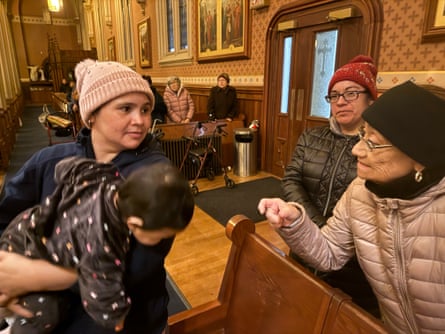
Inside St Peter’s Catholic church in San Francisco’s Mission District, families took refuge from a chilly December night to celebrate a mass in honor of immigrant rights.
A choir sang hymns. A majestic Christmas tree stood sentinel at the entrance.
“All of us, in one way or another, are pilgrims on this earth,” Father Moisés Agudo preached in Spanish from the pulpit.
In a pew to the left of the altar, Roxana held the glowing screen of a cell phone in front of her 10-month-old daughter. Below a thick thatch of dark hair, the baby stared intensely at the image of her father in an orange jumpsuit, calling in from a Texas detention center.
“Look, it’s your daddy,” Roxana cooed.
The nightly video calls are the only contact Roxana has had with her partner, Joel, since federal immigration agents picked him up outside their San Francisco apartment in June.
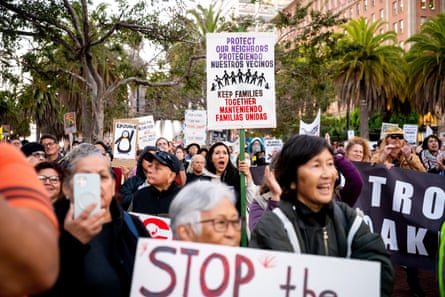
They’re one of many families across the US facing the holidays without loved ones who have been swept up in Donald Trump’s immigration crackdown. While a threatened surge of Customs and Border Protection agents in the Bay Area this fall never materialized, immigrant residents here have been detained at court hearings, mandatory check-ins with Immigration and Customs Enforcement and targeted raids. More than 120 people have been arrested at ICE’s San Francisco office or in the city’s immigration court since late May, according to the local news outlet Mission Local, which is tracking the detentions. Religious leaders chained themselves to the doors of the ICE office last week to protest the detentions.
As the holiday season approached, a time that emphasizes family togetherness, activists brought meals to people with detained relatives and organized legal support. The Catholic church held immigrant rights masses, like the one in San Francisco, across the state on the Feast of St Juan Diego – the humble Indigenous farmer to whom, legend has it, the Virgin of Guadalupe chose to appear.
Families with missing loved ones say the community support has been a balm in a holiday season that feels anything but normal.
“My family isn’t the same this Christmas,” said Roxana. “You could say that it’s broken.”
Both from Honduras, she and Joel met in San Francisco. Roxana had recently arrived, fleeing gang violence in their home country, while Joel had first come to the United States as a teenager. (Like other immigrants and family members interviewed for this story, they asked the Guardian to use their first names only because of concerns about retaliation by the Department of Homeland Security.)
“His life was here,” Roxana said.
The two moved in together during the Covid pandemic. By 2023, they had found a bright two-bedroom apartment in a building near Lake Merced, and they both worked in maintenance, big enough for a growing family that included Roxana’s two teenage children and Joel’s adult daughter. This year, baby Briana arrived.
Joel and the baby quickly developed a close bond, Roxana said, and he put her to bed each night. He took a second job at a restaurant and saved money to take the family on trips to Lake Tahoe and Santa Cruz.
But all that ended one morning in June, when immigration agents approached Joel as he was heading to his car to go to work. Roxana said she has not been told why Joel was detained, but suspects it is related to an arrest several years ago for driving under the influence, for which he completed court-mandated classes. The family cannot afford legal representation for Joel, she said, and they expect him to be deported. Roxana is pursuing asylum in the US, where she is legally allowed to work and her children attend school.
For now, the separation feels indefinite.
“I had never imagined that something like that could happen to my dad,” said Joel’s daughter, Yeili, 20, who witnessed the arrest and still struggles to talk about it.
It took the family three days to discover that he’d been sent to a detention center. The first night, Roxana says, her baby daughter refused to sleep until she gave her a shirt with Joel’s smell on it.
Six months later, Joel’s absence hangs over the family’s apartment. Roxana couldn’t bring herself to put up a Christmas tree, so her 15-year-old son did. Her sister, who moved in with her five-year-old daughter after Joel was detained, helped decorate. The three adult women in the family pool their earnings from housecleaning jobs, plus donations from community members, to pay the apartment’s $3,100 monthly rent.
Roxana has coped with the stunning shift in her family’s circumstances by pouring herself into her work with Faith in Action, a faith-based community group that organizes for affordable housing and protections for immigrants.
She first encountered the group at her son’s school. Most of the members were Catholic and Roxana was evangelical, but she liked the way the group was organizing immigrant parents to advocate for themselves, instead of waiting for politicians to solve their problems.
After Joel’s detention, a Faith in Action organizer invited Roxana to a meeting with other families who had been affected by immigration enforcement.
“At first, when we started telling our stories, everyone was crying,” Roxana said. “And then it was funny, because by the end we were all laughing, happy. Because we had released all our feelings.”
That night, the group decided to raise money for a legal defense fund for immigrants with children in San Francisco schools.
“I’m fighting so that other children don’t have to be separated from their parents,” she said. “I don’t want any other child to go through what my daughter is going through.”
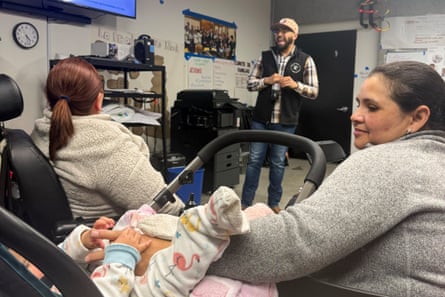
On a recent Tuesday afternoon, Roxana gathered with other parents and community members for a Tuesday-afternoon meeting with Faith in Action. They discussed how to organize and influence local government, as well as national concerns such as whether Trump would succeed in repealing birthright citizenship for children like Roxana’s daughter.
At the meeting, Roxana got some good news. A week earlier, she and other group members had met with a potential donor to their immigration legal fund. After hearing stories from Roxana and others with detained relatives, the donor decided to give $15,000.
“We spoke and it impacted him. We touched his heart,” she said, beaming.
Afterwards, she waited in the cold for an Uber ride to yet another meeting with immigrant community leaders. As her niece played with baby Briana, she took a call from Joel and told him about her day.
She’s still not sure what she’ll do for Christmas. Maybe she’ll make tamales, but she’s not planning a celebration.
“Other years, Joel always invited his friends and family,” she said. “Now, you could say that our family is the community.”









Comments