
 German (DE)
  English (US)
  Spanish (ES)
  French (FR)
  Hindi (IN)
  Italian (IT)
  Russian (RU)
  21 hours ago
The lawmakers who represent Alabama’s two Black congressional districts, who are now at risk of losing their seats after the supreme court effectively decimated the Voting Rights Act, said the decision sends the US “backwards”.
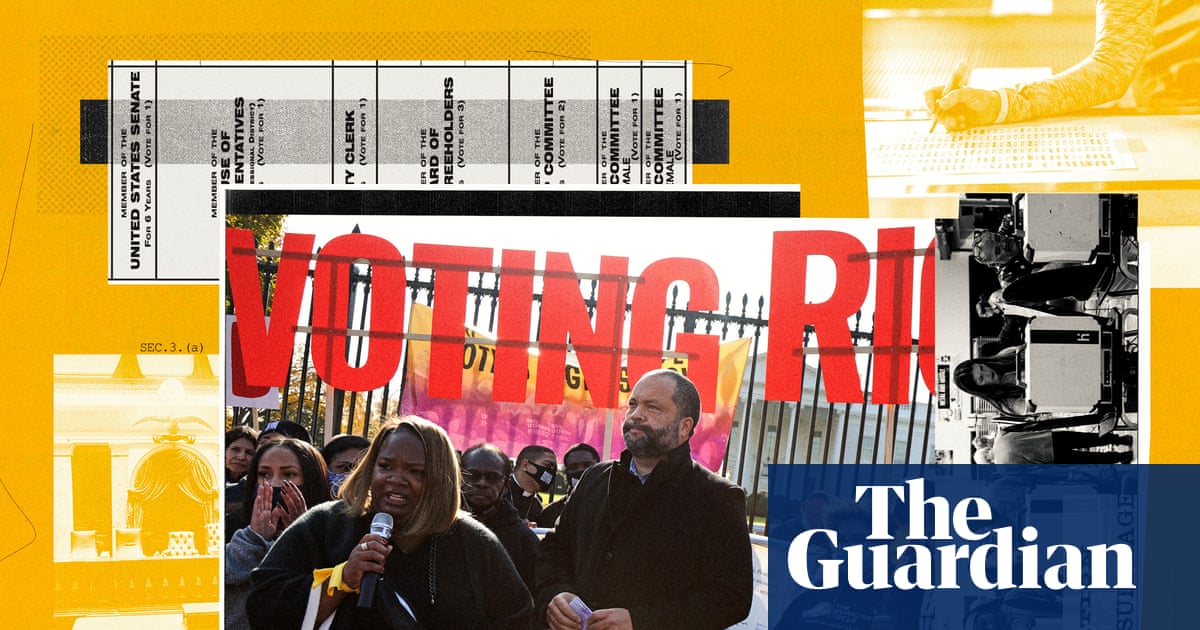
The 6-3 ruling in Louisiana v Callais on Wednesday weakens a key provision of the Voting Rights Act, opening the door for Republicans to eliminate majority-minority congressional districts across the south, and representatives Terri Sewell and Shomari Figures stand in the crosshairs.
“People in my home town fought, braved, died, marched for the right of all Americans to vote,” Sewell, who represents Alabama’s seventh congressional district, said shortly before Wednesday’s decision. “And I know I wouldn’t be here, were it not for the Voting Rights Act. I mean, actually, all Black elected officials. It’s pretty frightening to think that on our collective watch, we’re going backwards and not forwards.”
Figures, who represents Alabama’s newly drawn second congressional district, said the ruling threatens far more than the seats currently held by Black members of Congress. “The impact will be great,” he said in an interview before the decision, anticipating that the court would weaken the landmark voting law. “At the end of the day, the Voting Rights Act is about fairness. It’s about having the opportunity to elect members of Congress of your choice, and not have the district lines drawn in a way that inhibits the ability of a significant racial group to have an impact in the outcome of an election.”
In a ruling split along ideological lines, the supreme court affirmed that Louisiana’s congressional maps violated the equal protection clause. Writing for the majority, Justice Samuel Alito held that section 2 of the Voting Rights Act of 1965, which for four decades had been used to challenge electoral maps producing racially discriminatory results, does not require states to draw majority-minority districts. Justice Elena Kagan, in a dissent joined by justices Sonia Sotomayor and Ketanji Brown Jackson, wrote that the decision effectively eviscerates the law.
‘All we want is fair representation’
The implications for Alabama are immediate and deeply personal for both Sewell and Figures. Republican lawmakers in Alabama will likely move quickly to redraw the state’s congressional maps, Sewell said, but not in time to affect the 2026 midterms. The state’s deadline to qualify as a major party candidate for the 19 May primary was in January, meaning it’s likely too late for Republicans to change maps before the upcoming elections. Sewell and Figures may be safe in November, but Republicans will likely redraw their districts and push them out of Congress in 2028.
Sewell, who represents a swath of the state’s Black Belt that includes Selma, the city where she grew up – has served in Congress since 2011. For 13 of those years, she was the only Democrat in Alabama’s congressional delegation and the only representative from a district where Black voters could elect a candidate of their own choice. Her district, which winds through some of the poorest counties in the nation, was itself a product of the Voting Rights Act, redrawn to give Black Alabamians, who make up about 28% of the state’s population, a voice in federal representation.
Figures’ district, the newly drawn second district, exists solely because of a recent legal victory. The seat was created after the supreme court ruled in Allen v Milligan in 2023 that Alabama’s congressional map illegally diluted Black voting power. That decision reaffirmed section 2 of the Voting Rights Act and compelled Alabama to draw a second opportunity district. Figures, a first-term congressman from Mobile, won that seat in 2024 in what Sewell called a historic moment: for the first time in modern Alabama history, two Black representatives sat together in the congressional delegation.
“It was a long time coming,” Sewell said of that day. “When you think about representation, all we want is fair representation.”
Wednesday’s ruling puts that representation directly at risk. But Sewell and Figures were both clear that the threat extends far beyond Congress. With the Voting Rights Act weakened, representation at all levels is threatened, Sewell said, including in state legislatures, county commissions, city councils and school boards.
“When we go back to a day where majority white counties can now hold only at-large elections,” Sewell warned, “we won’t have Black county commissioners or Black city council members. The implication of Callais is far beyond congressional representation.”
Both lawmakers are already preparing to fight back. Sewell said she plans to work with stakeholders to strengthen the John R Lewis Voting Rights Advancement Act and shore up federal voting protections weakened by the court’s earlier ruling in Shelby County v Holder. “We came up with the [Voting Rights Act], so we are just going to come up with another law,” she said.
“You better believe we’re going to challenge whatever map that they create,” she added. “This is not over yet.”
Figures said the fight would also require a return to grassroots organizing, drawing on a history that Alabama knows intimately. “The civil rights movement came with an insurance plan,” he said. “It was called the right to vote. It did not come with a supplemental insurance plan to protect the right and choose not to use it.”
For Sewell, who marched with John Lewis, the late civil rights activist and former US congressman, and grew up in the church where the foot soldiers of Bloody Sunday gathered before crossing the Edmund Pettus Bridge, the moment calls for the same resolve that made Selma possible.
“I think about John Lewis, frail and willowy with cancer on that bridge the last time in 2019,” she said. “They had to hold him up, but his voice was strong: ‘Never give up. Never give in. Keep the faith and keep our eyes on the prize.’ That’s what energizes me now.”












Comments