
 German (DE)
  English (US)
  Spanish (ES)
  French (FR)
  Hindi (IN)
  Italian (IT)
  Russian (RU)
  2 hours ago
The voting rights advocates who fought for majority-minority districts across the US south are organizing their next steps after the supreme court effectively gutted the Voting Rights Act on Wednesday and eviscerated much of the work of the civil rights era.
“I think that it is deeply troubling that in 2026 that many of us have less rights than our grandparents had – and that becomes truer and truer every year,” said Ashley K Shelton, CEO and president of Power Coalition for Equality and Justice, a Louisiana-based civic engagement organization and a plaintiff in the Callais case.
Shortly after the supreme court decision, Shelton said that it was “deeply disappointing”.
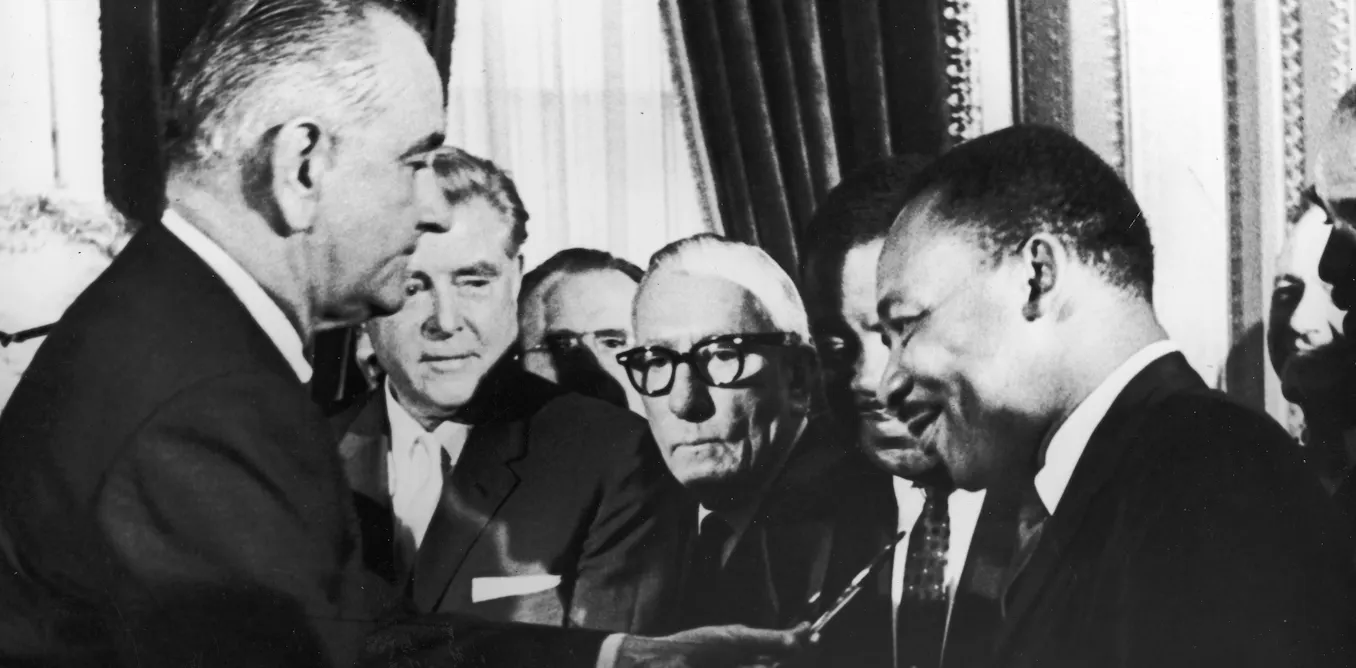
The VRA, which codified the 15th amendment’s voting protections for the first time, was signed into law after a hard battle. Exactly five weeks prior, approximately 600 people had aimed to march from Selma to Montgomery, Alabama, in demand of voting rights.
On the Edmund Pettus Bridge, the demonstrators were brutally attacked by law enforcement officers, who confronted them with teargas, billy clubs and other weapons. “Bloody Sunday”, as the march is remembered due to the viciousness of the attacks, was a turning point in the civil rights movement, and it directly led to the passage of the VRA.
In the decades since the VRA’s passage, section 2 has allowed plaintiffs to challenge electoral maps that suggest they were drawn in an effectively racially discriminatory way.
Voting rights advocates, many of whom have worked for decades to empower voters in their states and regions, say the fight isn’t over just because of the decision.
“I think the answer is for Black voters and other voters of color and voters that believe in a multiracial democracy have to show up en masse in the fall and elect a Congress that will restore our rights,” Shelton said.
Prior to the decision, Power Coalition and other organizations had been working to mobilize voters. That doesn’t stop now because of a new hurdle, Shelton said. Many of the organizations are working both in their respective states and out of them, in coalition-building across state lines. As federal policies shift, the ways in which voting advocates respond changes as well.
State-level voting rights acts were put forth in Louisiana, Alabama and Mississippi. That is not unintentional, said Anneshia Hardy, executive director of Alabama Values, before the decision.
“If section 2 gets weakened, you’re going to see a shift towards a lot of state-level strategies,” Hardy said. “You’re going to see more localized litigation, deepened investment in on-the-ground organizing. We’re realising that when federal protections are narrowed or become less reliable, which they have, unfortunately, the fight doesn’t stop. It ultimately relocates.
“If section 2 is weakened, the states are going to become the primary terrain for both protection and contestation,” she added.
Hilary Harris Klein, senior counsel of voting rights at Southern Coalition for Social Justice (SCSJ), said that the group remains “steadfast in supporting and advocating for communities seeking their right to an equal voice in government”. Like Hardy, she sees the location of some fights changing.
“We stand on the shoulders of giants, when you think about the civil rights movement and even the work before, from the mid-20th century,” she said. “I think there will be a recognition that we are in a time of retrogression of minority rights.”
“I think here, we’re going to see enormous mobilization following this decision,” she added. “The fights might not be in court as much as they have been, but that doesn’t mean that they will be over or anything will be abandoned. The fight for equal voting rights is going to absolutely continue. It just might be in a different venue.”
Many advocates compared this moment to the Jim Crow era.
“Any efforts to expand access and correct inequality have consistently been met with counterarguments that frame those efforts as unfair or excessive. History gives us those receipts,” Hardy said. “This is not new.”














Comments