
 German (DE)
  English (US)
  Spanish (ES)
  French (FR)
  Hindi (IN)
  Italian (IT)
  Russian (RU)
  3 hours ago
For 13 minutes on Sunday night, Levi’s Stadium in Santa Clara will pulse with reggaeton, Latin trap and Caribbean rhythms as Bad Bunny headlines a historic Super Bowl halftime performance, primarily – or perhaps entirely – in Spanish. The Puerto Rican megastar, whose songs fuse the raw energy of música urbana, Boricua pride and resistance politics, has promised a “huge party”.
At a moment when masked federal agents are sweeping through American cities, rounding up long-settled immigrants, legal residents and even US citizens, Bad Bunny’s presence on the grandest stage in US sports offers a striking contrast – a joyful celebration of pride and solidarity for millions of Latinos.
“Bad bunny is much more than his music,” said Vanessa Díaz, co-author of the newly released P FKN R: How Bad Bunny Became the Global Voice of Puerto Rican Resistance. “He carries the weight of the history of Puerto Rico.”
His genre-bending, politically charged artistry reflects the island’s long tradition of “music as resistance and dance as joy”, Díaz said, emphasizing that his “most significant protest songs are also party songs”.
Last weekend, Bad Bunny won three Grammys, including a historic album of the year win for DeBÍ TiRAR MáS FOToS, the first Spanish-language album to receive the industry’s most prestigious prize.
“Before I say thanks to God, I’m going to say ‘ICE out’,” he said, accepting the trophy for best música urbana earlier in the evening. “We’re not savages, we’re not animals, we’re not aliens. We are humans and we are Americans.”
Seven days later, the reigning King of Latin Trap will take center stage at the Super Bowl, an event steeped in patriotism and ritual. Tens of millions of viewers will watch – and dance, Bad Bunny hopes – as he rolls through his catalog of chart-topping hits. But long before the first beat drops, Donald Trump’s supporters had seized on the appearance, determined to turn Bad Bunny’s half-time show into an another culture war front.
Singing in “non-English” at the Super Bowl is not an FCC violation. But outside the stadium, in Trump’s America, speaking Spanish on the street can be a provocation – or worse, a potential invitation for federal agents to stop and question the speaker’s immigration status.
To perform in Spanish is an “extremely political” act, , Díaz said, even more so now.
Trump, whose political ascent began more than a decade ago with a promise to defend the homeland from foreign criminals, invaders and all-around “bad hombres”, returned to power last year with an even more ambitious goal: to conduct the largest deportation campaign in the nation’s history.
As the Trump administration has ramped up immigration operations and deportations, citizens have started to carry their US passports. Some grocery-shop for relatives less proficient in English. Undocumented parents, too afraid to leave their house, send children to school with neighbors, praying they’ll still be there when they return.
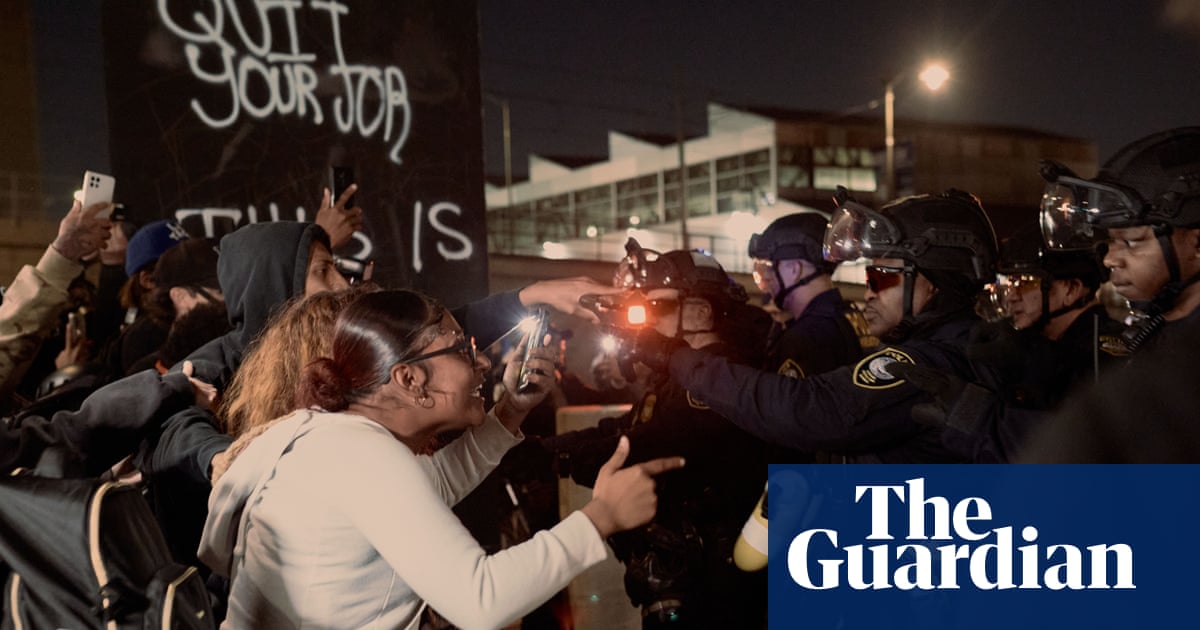
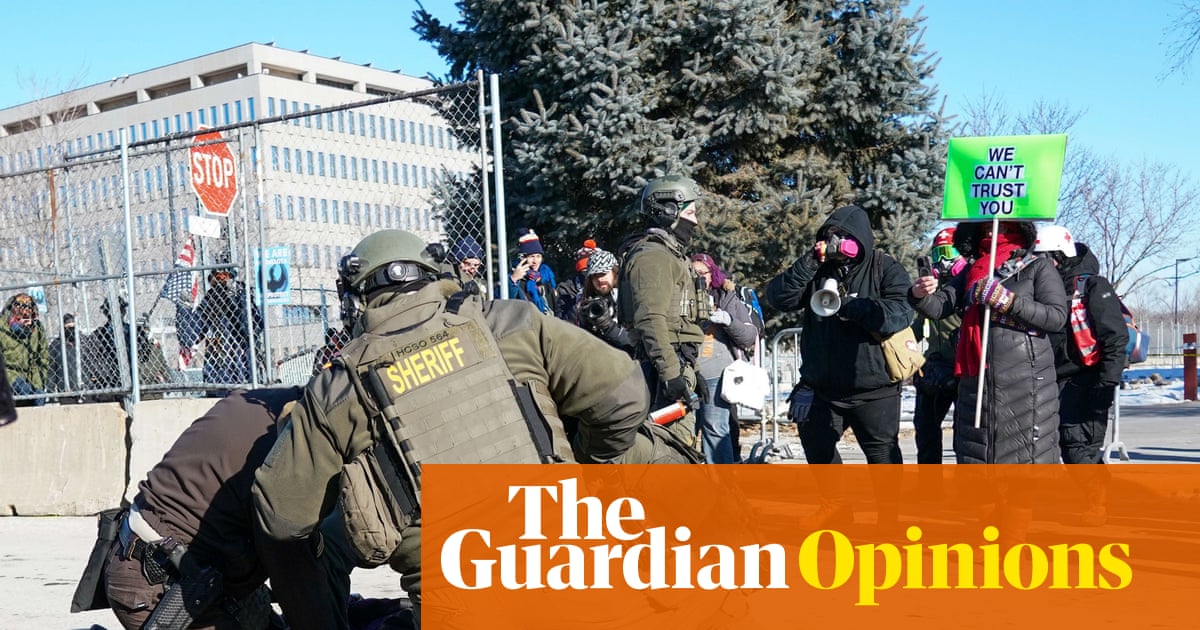
In Minneapolis, the administration’s crackdown sparked a community-wide resistance that escalated into tragedy with the killings of US citizens – Renee Good, a mother and a poet, and Alex Pretti, an ICU nurse – at the hands of federal agents.
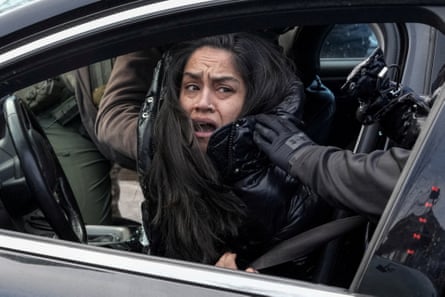
It was also there that the image of five-year-old Liam Conejo Ramos, wearing a blue knit hat with bunny ears as he was detained with his father outside their home in a snowy Minneapolis suburb, became a searing symbol of what more Americans have come to see as the indiscriminate cruelty of the administration’s enforcement campaign.(Though a judge ordered his release from a Texas detention center, his fate in the United States remains uncertain.)
“This is a time when we really need a loud and proud voice in the face of the terrorizing of our Latino and migrant communities,” Díaz said. “And we need that voice to be in Spanish.”
The NFL’s selection of a Puerto Rican pop star who does not sing in English, sometimes wears skirts and has openly criticized the Trump’s administration immigration policies was bound to stoke Maga’s rage.
Conservatives mocked him as “Bad Bunny Rabbit” and demanded an English-only performance. Right-wing commentator Tomi Lahren claimed he was “not an American artist”. (Puerto Ricans are, of course, US citizens, though they lack representation in Congress and a vote in presidential elections.)
Turning Point USA, the group founded by the late conservative activist Charlie Kirk, will broadcast an alternative “All American” half-time show, featuring Kid Rock and a lineup of country singers. “We plan to play great songs for folks who love America,” the rap-rocker turned Trump ally said in a statement.
On Capitol Hill, House speaker Mike Johnson told the immigration-focused newsletter Migrant Insider that he would have preferred an entertainer who represents “traditional American values” – someone like the 83-year-old Lee Greenwood, whose song God Bless the USA is Trump’s walk out song.
Kristi Noem, the Department of Homeland Security (DHS) secretary, warned in October that ICE would be “all over” the event. California’s governor, Gavin Newsom, has since said that his office was “assured there will be no immigration enforcement tied to the game”.
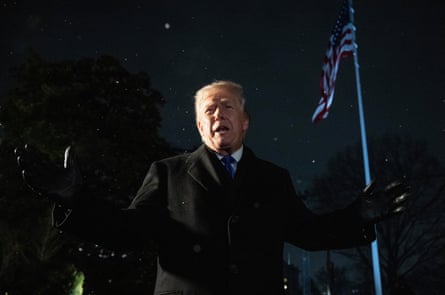
Meanwhile, Trump, who typically loves the spotlight of a major sporting spectacle, recently announced that he would skip the game, calling the selection of Bad Bunny “a terrible choice”. “All it does is sow hatred,” he told the New York Post. “Terrible.”
Many Americans disagree. A Quinnipiac University poll conducted in October found that nearly half of Americans approved of the league’s decision, while 29% disapproved. Support broke sharply along partisan, generational and racial lines, with Democrats, young people and Hispanic adults far more likely to express support.
Last year, Trump became the first president to attend the Super Bowl, watching as rapper Kendrick Lamar headlined the half-time show in New Oreleans. That performance drew more than 133 million viewers – more people than watched the game and more than the number of people who voted in the midterms four years ago.
This year, however, Trump will tune out at half-time, White House press secretary Karoline Leavitt said, telling reporters the president “would much prefer a Kid Rock performance over Bad Bunny”.
The NFL, by contrast, is betting on a future that looks and sounds more like Bad Bunny than Kid Rock, as the league aggressively courts Latino viewers to grow its fanbase at home and in Latin America. On Monday, NFL commissioner Roger Goodell praised Bad Bunny as “one of the greatest artists in the world” and a performer who “understands” the platform.
Scholars – and Bad Bunny fans – say the right-wing backlash to the Puerto Rican phenom taps into a Republic-old debate: who belongs here? It is especially fraught for the residents of US territories, where colonial legacies still shape both identity and history.
Since Trump returned to office, his administration has sought to redefine who gets to be American, pushing to restrict legal immigration pathways and end birthright citizenship. At the same time, his foreign policy reflects territorial ambitions to expand America’s reach. “This is OUR hemisphere,” the state department declared, after US military forces toppled the Venezuelan leader, Nicolás Maduro. Trump has also threatened to seize Greenland.
At the Grammys, when the South African host Trevor Noah asked Bad Bunny whether he could move to Puerto Rico if things continued to get worse in the US, the pop star offered a wry correction.
“Trevor, I have some news for you. Puerto Rico is,” he said, using air quotes, “part of America.”
By the numbers, Bad Bunny is an undeniable expression of American cultural greatness – a grocery-store bagger to Super Bowl headliner success story that directly challenges Trump’s America First ideology.The 31-year-old global superstar has shattered streaming records – and become the world’s most listened-to artist – all without translating his music to English or, observers say, softening his politics.
“I wasn’t looking for album of the year. I wasn’t looking to perform at the Super Bowl half-time show,” Bad Bunny said on Thursday. “I was just trying to connect with my roots, connect with my people, connect with myself.”
Born Benito Antonio Martínez Ocasio, Bad Bunny grew up in the in the working-class coastal town of Vega Baja and came of age as part of what scholars call the island’s “crisis generation” – a period shaped by prolonged economic recession, crippling public debt, austerity, mass out-migration and devastating natural disasters. In 2017, Hurricane Maria plunged nearly the entire island into darkness, inflicting catastrophic damage. When Trump came – belatedly, many felt – to survey the wreckage, he tossed paper towels into a crowd of survivors. The moment has lingered as a symbol of colonial indifference.
Bad Bunny absorbed those struggles into his art and his politics, said Jorell Meléndez-Badillo, an associate professor of Latin American and Caribbean history at the University of Wisconsin-Madison who collaborated with the artist to create historical “visualizers” for his 2025 album.
A vocal advocate for Puerto Rican independence, Bad Bunny once paused a European tour to join mass protests in San Juan, which forced the resignation of Governor Ricardo Rosselló. His music – rooted in reggaeton, trap and traditional Puerto Rican rhythms – is a deeply personal exploration of Puerto Rican history and identity.
“He inhabits that sort of porosity of what it means to be American – not in a US sense but in a broader hemispheric sense,” Meléndez-Badillo said. That is why, he believes, Bad Bunny’s music has resonated across the global south, including with indigenous activists, Venezuelan migrants and displaced Palestinians.
The artist’s unapologetic opposition to the Trump administration’s immigration policies has earned him new admirers in the US – some of whom raced to learn Spanish before Sunday’s show.
Last year, on July 4, Independence Day, Bad Bunny released the music video t0 NUEVAYoL – a love letter to the Puerto Rican diaspora that featured Trump’s AI-generated voice apologizing to immigrants.
When Bad Bunny launched his world tour last year, he avoided the continental US entirely, telling i-D magazine that he feared ICE agents “could be outside” his concerts. Instead, he staged a landmark 31-show residency in San Juan titled No me quiero ir de aquí – “I don’t want to leave here”. It brought hundreds of thousands of people – and hundreds of millions of dollars – to the island.
“He did not need the United States, which is the biggest market for pop consumption in the world, to do a sold-out tour,” Meléndez-Badillo said. “That changes the political conversation at a mainstream level.”
After Trump’s astonishing political comeback, many on the left were convinced that they had lost the culture. Trump, they argued, had captured grievance and spectacle while liberals were left defending institutions and the status quo.
In 2024, Latino voters from Miami-Dade to the Rio Grande Valley to East Los Angeles had rallied behind Trump’s re-election campaign, driven to a large degree by economic anxiety. But that coalition has proved fragile.
A year into his second term, Latinos have turned sharply against Trump’s economic stewardship, while the president’s sweeping immigration enforcement agenda – once a signature issue – has started to alienate broad swaths of the American public uncomfortable with its scale and cruelty. Ahead of the midterm elections this fall, both political parties are vying for Latino support.
Bad Bunny is hardly an emissary for the Democratic party. But his stratospheric success and global reach raises the possibility that Trump’s Maga movement is the cultural sideshow.
“Latinos have lost every possible policy war since I’ve been in DC,” Pablo Manríquez, a Washington-based reporter at Migrant Insider, said, ticking through a list of socioeconomic disparities that Congress has done little to address. “But culturally, we’re winning. Bad Bunny is performing at the Super Bowl.”
To many Bad Bunny fans, Sunday’s show, which he has dedicated to “all Latinos and Latinas around the world and here in the United States,” lands as an act of resistance. It’s a performance they hope will reverberate far beyond the Golden State arena.
Newsom, California’s Democratic governor and a frequent Trump antagonist, officially declared Sunday “Bad Bunny Day”. Across the country, the progressive Working Families party is hosting “Bad Bunny Bowl” half-time watch parties. Nelini Stamp, a New York-born Puerto Rican who serves as the group’s director of strategy, said the idea was to give fans, and especially Latinos, something “beautiful” to celebrate.
“I’ll be damned if I let fear take my joy away,” she said.
In the lead-up to Bad Bunny’s game-day gig, anticipation has swelled, with speculation – and bet-placing – about what he might sing, do or wear on stage.
Will he invoke the Minneapolis crackdown? Will he bring on another Latin star, like in 2020, when he appeared as a guest during the Super Bowl half-time show starring Shakira and Jennifer Lopez in Miami? That production featured children in cages, a visual some interpreted as criticism of the first Trump administration’s zero-tolerance immigration policy. Lopez also unfurled an elaborately feathered American flag cape that reversed into a Puerto Rican flag.
Bad Bunny has refused to drop any “spoilers” in advance, but he has telegraphed a message of unity. Teasing the act in a trailer released last month, he grooves with partners of all ages and backgrounds, promising: “The world will dance”.
No matter what Bad Bunny does on Sunday night, his presence – at a stadium named after the denim brand that symbolized America’s westward expansion, during the most-watched game of the country’s favorite sport – is a political statement, said Meléndez-Badillo: “He’s a colonial subject at the heart of empire.”






Comments