
 German (DE)
  English (US)
  Spanish (ES)
  French (FR)
  Hindi (IN)
  Italian (IT)
  Russian (RU)
  3 hours ago
With the public’s outrage and attention focused on the deadly surge of federal agents in Minneapolis, immigration operations have quietly continued across the US – albeit in less noticeable but still troubling ways, advocates say.
In recent weeks there have been day laborers swept up at a Home Depot in San Diego. A taco truck vendor chased down outside a church in Los Angeles. Immigrants arrested at check-in in North Carolina, and during traffic stops in the nation’s capital.
These efforts continue to stoke fear in communities and disrupt people’s abilities to work, attend school or go to doctor’s appointments. And in cities that have faced their own crackdown operations, raids and arrests haven’t stopped even after the drawdown of federal agents, with some signs that tactics are shifting.
In southern California, under-the-radar arrests have continued at a fast clip in the first few weeks of 2026, activists and legal experts say.
Los Angeles was hit with sweeping immigration raids last summer that ground daily life to a halt. Since then, even when many national headlines moved on, advocates say there’s been a steady drumbeat of arrests.
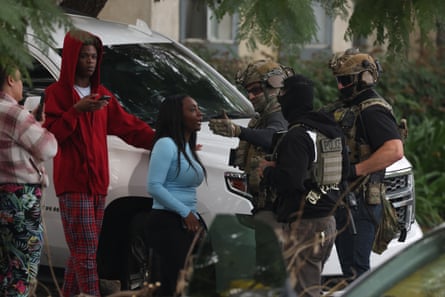
Immigrant Defenders Law Center, a non-profit firm based in LA, has seen a recent spike in the number of calls to their legal resource hotline. Those callers include people who have been detained themselves, or family members and friends trying to track down detained loved ones. For the past six months, the firm received roughly 400 calls a month. But in January, that call number jumped to 546.
More or less, each one of those calls represents a person who has been recently detained, said Yliana Johansen-Méndez, chief program officer for the law center.
“There’s just less coverage of what’s happening in LA,” Johansen-Méndez said. “But the truth is that we haven’t really seen the number [of arrests] drop.”
What has changed across southern California, experts say, is how quickly ICE is making those arrests. Earlier in 2025, the typical ICE tactic in LA seemed to involve setting up in one location, like a parking lot near Dodger Stadium, and conducting operations in that general area for an extended period of time, Johansen-Méndez said.
But in the last few months, she said, the tactic has felt more like “smash and grab”. ICE arrests now often begin and end in a matter of minutes.
“They just kind of show up in an area, do a sweep, grab a bunch of people, and by the time any responders can get there, they’re gone,” she said. “So people aren’t catching it on camera. There’s no time for protesters or for attorneys, or any legal observers, to show up. And so they’re flying under the radar by doing it faster.”
Adriana Jasso, a member of the activist organization Unión del Barrio, said that the speed of arrests is also picking up in San Diego, a region that saw immigration arrests soar between May and October of last year. When ICE agents detained about a dozen people near a San Diego Home Depot in late December, witnesses said the whole operation unfolded in about five minutes, Jasso said.
Neither ICE’s San Diego field office nor the Department of Homeland Security responded to multiple questions about the speed or frequency of recent southern California arrests.
In Portland, Oregon, residents have been on edge ever since Trump attempted to deploy the national guard to quell demonstrations outside an ICE facility. A federal judge ultimately blocked the deployment, but protests have persisted as federal agents continue regular immigration check-ins at the facility.
Tensions flared again in recent weeks after border patrol agents shot two people outside a medical facility in January, ICE agents arrested a seven-year-old and her parents as they sought emergency medical care, and federal agents teargassed thousands of people at a daytime march, including many children.
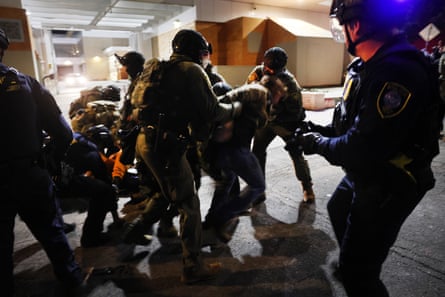
Immigration operations are continuing in the area, but appear to have declined since their peak last year. Alyssa Walker Keller, a coordinator for a statewide hotline and rapid response network organized by the Portland Immigrant Rights Coalition (PIRC), said that in January, the number of calls about detentions across the state was down to 79, half of them recorded in the first week. That is compared with roughly 1,100 calls in the second half of 2025, with roughly 300 calls each month during Operation Black Rose, enforcement operations enacted by an influx of federal agents from October through December. Detentions rose 1,500% when agents arrived in October.
Still, the fear is still palpable.
“The impact on the folks who are in these vulnerable statuses, who are being targeted right now is, this is such a dramatic, such a profound sense of being hunted,” said Walker Keller.
Many immigrants are not showing up to school or are delaying medical care, and teachers and healthcare workers are organizing to ensure people understand their rights under the constitution. Informal groups like Scrubs for Sanctuary Oregon and others have organized “know your rights” training for workers and patients to build trust with their community, saying delayed medical care can lead to negative public health impacts more broadly.
“We function together as a community with these people, working as community members,” Matthew Breeze, a Portland-area doctor of medicine, said. “We can’t simply make them all fearful to engage.”
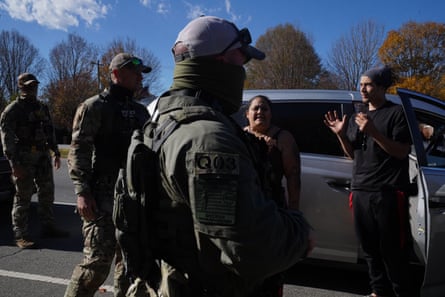
There’s a similar feeling in Charlotte, North Carolina, which was the target of a major operation in November when Customs and Border Protection descended on the diverse city and arrested dozens of people.
While the snatch-and-grab arrests from street corners have stopped for the most part after CBP withdrew en masse, Andreina Malki, a spokesperson for Siembra NC, said that driving on a street in the morning remains anxiety-provoking for undocumented motorists.
“Between 6am and 11am in the morning, when folks are going to work, we see people being stopped by ICE,” she said. Immigration officers target people in work vehicles like trucks and vans, a pattern familiar to observers across the country.
Siembra NC tracks immigration enforcement activities in North Carolina and receives real-time reports from residents. They maintain a map with active locations, sending messages to warn communities of ICE and CBP activity, and observers to document detentions.
Plenty of arrests are still taking place. For example, Malki said that detentions had increased at US Citizenship and Immigration Services or Department of Homeland Security check-in locations – offices where people in the legal immigration process have to go to fulfil their obligations. Siembra NC has received 23 calls about detentions at check-ins in Charlotte since CBP left, Malki said, adding that many people have no criminal cases against them.
Siembra NC received a call recently from someone whose husband, a green card holder, was detained during a check-in at the Charlotte office of GEO Group, a firm that operates federal immigration detention facilities for ICE across the country. In Charlotte, this office manages immigrants who wear ankle trackers as an alternative to detention, Malki said.
In the nation’s capital, it’s been six months since Donald Trump ordered federal law enforcement and national guard onto the streets of the overwhelmingly Democratic city, with the stated purpose of fighting crime.
The August deployment doubled as an immigration enforcement operation, one that activists and an immigrant rights’ group said has resulted in indiscriminate arrests of city residents based on their skin color or occupation.
Immigration-related arrests surged immediately after the deployment was announced, then declined in the months that followed, data indicates, as Trump and his administration’s attention turned to other cities. But immigration arrests remain elevated compared with before the campaign, as federal agents continue patrols of the city assisted by, activists say, the local police force.
Ever since Trump’s campaign began, mutual aid networks have seen a steep increase in demand for legal referrals as well as grocery deliveries from people fearful of encountering immigration agents while shopping. Though arrests have decreased, the impacts have lingered.
“All these people are now in detention or have been deported, and their families have lost an income, a family member, a loved one, and they are still suffering the consequences of that,” said Madhvi Bahl, a core organizer of the Migrant Solidarity Mutual Aid Network, a community organization that has responded to Trump’s deportation campaign. The effects will linger “for years to come”, added Bahl.
In December, a coalition of rights groups sued on behalf of four residents who were detained and then released amid the surge, winning a preliminary injunction from a federal judge that prevented warrantless immigration arrests without probable cause that the person was a flight risk.
Prior to the injunction, Austin Rose, a managing attorney at the Amica Center for Immigrant Rights, which represented the plaintiffs in the case, said it was typical for federal agents to make “random sweeps where, we believe, they racially profile people”. Amica was among the groups representing the plaintiffs in the case and has received data from the federal government showing that warrantless arrests decreased in December, and fell even further in January.
“It seems like it’s shifting slightly back to the norm where it’s more arrests that are targeted and less, at least in DC, of arrests that are random and warrantless,” he said.
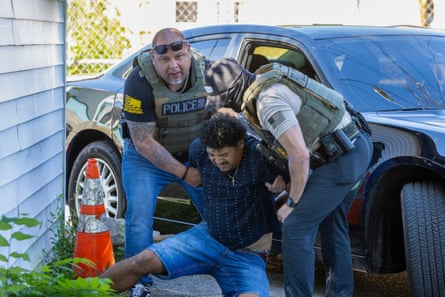
Though Trump’s takeover of the Metropolitan police department expired four weeks after it was announced, Rose said Amica has heard of instances where officers are continuing to help federal agents make immigration arrests, despite a local law that limits the city’s cooperation with ICE.
Bahl, along with two community activists involved in supporting immigrants in the district, who spoke on condition of anonymity, said it continues to be the case that caravans of federal agents and MPD will patrol the city, often making stops for traffic violations that can lead to immigration arrests.
A spokesperson for the police department said that officers do not conduct civil immigration enforcement or participate in “taskforce groups” that include ICE, but may partner with other federal agencies that do make immigration arrests.
Back on the other side of the country in California, tactics also seem to be changing within San Diego’s federal courthouse. Over the last few months, arrests have commonly taken place out of sight, in the private rooms where ICE “check-ins” are held, rather than more publicly in the hallways outside of courtrooms – as was often the case in early 2025.
Father Scott Santarosa, a Jesuit pastor in San Diego, helps run a new program called Faith, which trains volunteers to simply accompany and pray with immigrants as they arrive at the courthouse for their immigration hearings. The goal of the program was to generally lower the political temperature for ICE agents and judges.
But in the last few weeks, there has been a “greater tension” in the atmosphere at the courthouse, Santarosa said. The Faith volunteers have also spotted many new ICE agents being trained on the courthouse’s upper floors.
“It feels like the new recruits that we see coming in – and we see a lot of new recruits – I think they are just trained to see us as the enemy,” Santarosa said.















Comments