
 German (DE)
  English (US)
  Spanish (ES)
  French (FR)
  Hindi (IN)
  Italian (IT)
  Russian (RU)
  1 hour ago
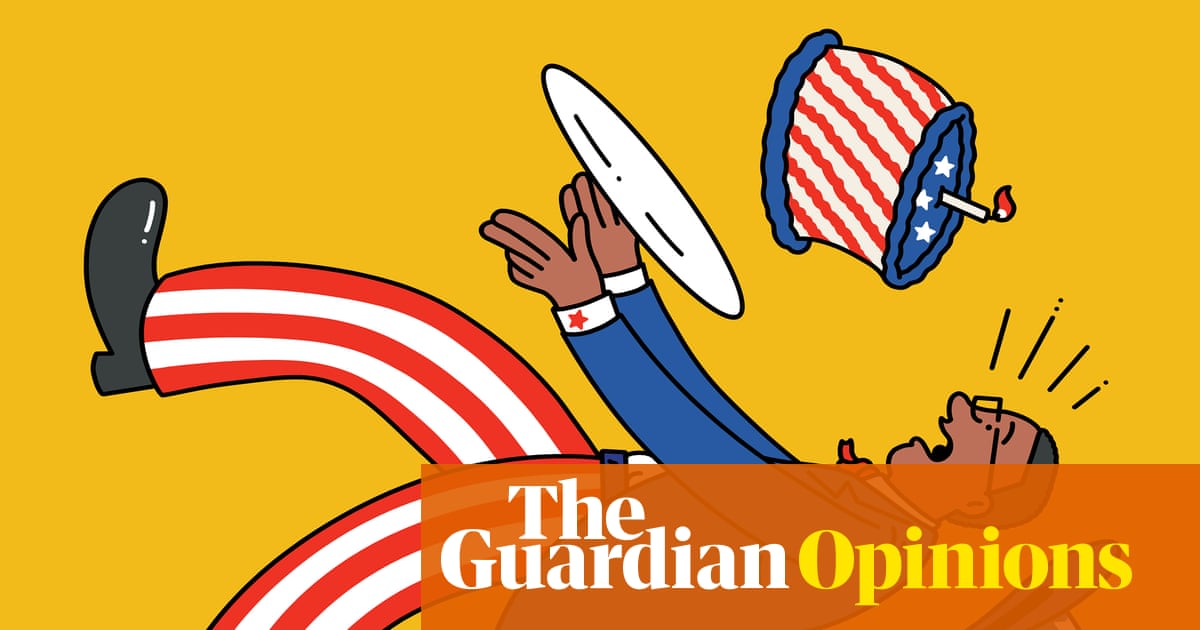
It’s America’s birthday. Ear-splitting pyrotechnics will be heard across the land tonight, as they were a few weeks ago, after the cage fight at the White House. On 24 June, the administration launched the Great American State Fair, with “spectacular flyovers” from fighter jets and stealth bombers. Six 18-wheel “Freedom Trucks” are barreling down the highways, bringing history-lite pop-up displays, mainly to red states. Later this summer, we will hear drivers revving their engines, deafeningly, as they leave skid marks around the National Mall during the Indy car race scheduled for 22 August. It’s gonna get loud.
But one guest is apparently not invited to the party. The Declaration of Independence, the reason we are convening, has been curiously absent from the lead-up. That feels strange for a document that essentially rewrote world history.
To be sure, its presence is implied now and then. An ad leading up to the UFC event featured the slogan: “History is made by revolutionary ideas.”
That doesn’t say much about the declaration. The only “idea” behind the cage fight was the one embodied in Mike Tyson’s classic insight: “Everyone has a plan until they get punched in the face.”
It could be that our history just isn’t all that interesting to a president who in 2019 praised the continental army for taking over the airports during the revolutionary war.
Maybe it goes deeper? Does the administration fear the leveling energy of the old parchment? The declaration has been setting off its own fireworks for a long time now, simply by speaking truth to power.
That was certainly the case in 1776, when the declaration launched a new nation with a document listing the 27 defects of a leader who was “unfit to be the ruler of a free people” because he had the character of “a Tyrant”. George III’s catalogue of offenses included “cutting off our trade with all parts of the world”, discouraging immigration, sending “swarms of officers to harass our people” and “transporting us beyond seas to be tried for pretended offenses”. Ring any bells?
It’s not a perfect fit; at times the declaration does not feel progressive at all, with harsh language about “merciless Indian savages” and a painful reference to “domestic insurrections” – a euphemism for slave rebellions.
But its timeless language about equality, rights and the consent of the governed has served as a check on government overreach ever since it was written. It is the ultimate No Kings statement.
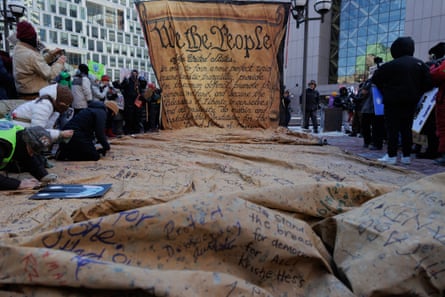
To a surprising degree, the parchment has remained a potent force for change, long after its creation in the summer of 1776, as an armada of British ships crossed the Atlantic to quiet all talk of independence. The words appeared almost miraculously, over a few weeks, from 11 June, when a five-man drafting committee was appointed by the Continental Congress, and 4 July, when it was approved.
Thomas Jefferson was the primary author, but he received edits from his fellow committee members, and from Congress itself. Even in these earliest conversations, there were sharp disagreements. Jefferson felt that Congress had “mangled” his draft (like most writers, he was sensitive – in fact, they improved it). It was difficult to bring together 56 delegates who were not always as united as that word implied (which may explain why “united” was written in weirdly tiny letters at the top of the document they signed).

Slavery divided many of them, even as they were trying to forge common cause. There were other inconsistencies: one delegate, George Read, actually voted against independence, but he signed the declaration anyway. That pattern has remained true ever since, as it has meant different things to different people, on both sides of the political spectrum.
When he was writing the declaration, Jefferson used a laptop desk of his own design, now in the Smithsonian. It could unfold in various ways, and included internal chambers that were not at first visible.
The document has many of the same qualities. The declaration is multiple things at once: a soaring paean to human rights, a philosophical statement about the capacity of people to govern themselves, and a laundry list of complaints about a feckless ruler.
Although written in a deliberately calm language, this was a revolutionary argument. No nation had been founded with such an aspirational statement, or with any statement at all. In other countries, power always flowed from the top down, and not, as the declaration claimed, from the people to their leaders. John Adams was right to call it a “revolution”, by which he meant an intellectual sea change, not simply a war.
Over the next 13 years, the declaration faded into the background as Americans turned their attention to setting up their new government. But in the years that followed, they kept coming back to the declaration as they sought to reconcile its loftiest ideals with the realities of an imperfect nation.
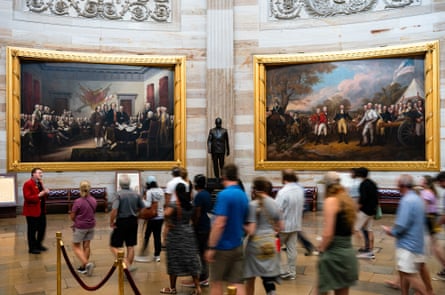
“All men are created equal” was a particularly potent idea, and Black leaders would cite the declaration to argue for the better version of the US it held out.
In 1776, while the ink was still fresh, a young mixed-race veteran named Lemuel Haynes wrote an essay about what the declaration meant to him (it was not discovered until 1983). Another African American, James Forten, was nine years old when he heard the first public reading of the declaration in Philadelphia in 1776, and went on to a long career as an abolitionist. (The constitution inspired far less reverence from Black readers, since it defined enslaved people with a most unequal value: 3/5 of a human being.)
With time, this pattern was repeated. Some people were inspired by the inviting picture painted by Jefferson’s words, offering “life, liberty and the pursuit of happiness” for all. The same words could serve as a spur to action when progress was slow. Women were not mentioned, despite Abigail Adams’s exhortation to her husband, John, to “remember the ladies” during the drafting process. Throughout the 19th century, they argued for their inclusion, and drafted new versions of the declaration to read “all men and women are created equal” (as the 1848 Seneca Falls convention put it).
So attractive was the declaration’s language that it could be repurposed to support completely different kinds of projects. When Texans decided to secede from Mexico and form an independent republic in 1836, they wrote a version of the declaration that justified reliance on slavery. Eleven years later, the opposite message was sent when a group of African Americans founded a new nation, Liberia, on Africa’s west coast. The founding document written by these settlers, now American Africans, was a declaration that excoriated human bondage in no uncertain terms.
These tensions were felt even more keenly in the approach to the civil war. Both sides coveted the patriotic aura of the declaration and tried to claim the authority of different passages. It could plausibly be used to argue for the right to secede, as Jefferson Davis did, or for human equality, as Abraham Lincoln did.
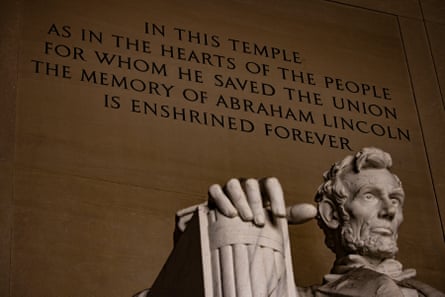
In every sense, Lincoln’s reading was deeper. He had been studying the declaration closely for years. It was, in his words, an “electric cord” tying Americans together. A “beacon” to guide them. A “fountain” to drink from. As the debate over slavery deepened, he leaned in, finding a spiritual meaning in addition to its political message. In a telling note that he wrote to himself, just before his presidency, he borrowed from the Bible to describe the declaration as an “apple of gold”, surrounded by a “picture of silver”, by which he meant the constitution. Both were valuable, but for Lincoln, the “apple of gold”, and the central idea of equality, was the idea that defined the United States. In what may have been his greatest speech, the Gettysburg address, he returned to the declaration’s themes, and suggested that its unfinished “propositions” were finally becoming real, for all Americans. “All” was an essential word for Lincoln; it permitted no lawyerly evasions.
The civil war fortified Lincoln’s argument, and the 13th, 14th and 15th amendments gave it a nearly unassailable legal standing. That included birthright citizenship, protected by the 14th amendment (despite Trump’s protestations to the contrary). To be born in the United States was to enjoy full citizenship, as the declaration had implied but not quite confirmed. The amendment begins with the word “all”.
In the war’s aftermath, the declaration continued to speak to all of the US’s jostling peoples. Many read it from the left – labor leaders and immigrants who wanted the “pursuit of happiness” to include concrete matters such as jobs, housing and healthcare. Eugene Debs, a perpetual socialist candidate for president, said: “I like the Fourth of July. It breathes a spirit of revolution.”
During the second world war, Franklin D Roosevelt translated it again. In his hands, the declaration grew into a rhetorical sword that could be used against Hitler, by explaining that its rights (which FDR boiled into “four freedoms”) were available to all people on Earth. But when the war was ending, and Black Americans were coming home to a country that was still segregated, the declaration assumed new relevance.
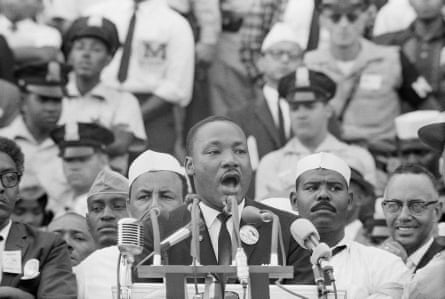
Throughout the victories of the civil rights movement, from Brown v Board of Education to the Voting Rights Act, its words were freely available to anyone who wanted to point to the United States’ founding creed, and argue that genuine equality remained unrealized. That was the thrust of King’s incandescent speech at the 1963 March on Washington, which called the declaration a “promissory note” that had turned into a “bad check, a check which has come back marked ‘insufficient funds’”. In his final 1968 speech, he said to the country: “Be true to what you said on paper.”
But King had no monopoly on the declaration; very different Black leaders also found it relevant to fast-moving changes in the 1960s. The Black Panthers reprinted a version of their own. A half-century later, Barack Obama cited the declaration in a heartfelt Rose Garden speech, delivered on the day Obergefell v Hodges was decided in 2015, cementing marriage equality.
But conservatives were always ready to make their own arguments, based on different parts of the declaration.
Republicans never relinquished their hold on the document, and argued that they, too, were Lincoln’s heirs. Presidents from Theodore Roosevelt to Calvin Coolidge delivered passionate speeches translating the declaration’s words into paeans to patriotism, free enterprise and the free exercise of religion.
Later on, the anti-abortion movement naturally gravitated toward “life, liberty and the pursuit of happiness”, and whenever far-right groups wanted to attack the federal government as a despotic regime, there was plenty in the declaration to feed their anger. Some of that feeling can be detected in a 2010 version of the declaration drafted by the Tea Party movement. It attacks “the tyranny of government and the elitist, self-styled aristocrats who seek to run it at our expense”, and points the way toward the Maga movement that was already rumbling in subterranean chambers, well before the golden escalator. On 6 January 2021, many so-called “patriots” tried to claim it was “1776” all over again.
Not all declaration-whisperers have been predictable. Ronald Reagan was conservative by almost any definition, but in 1986, he stretched out the declaration in interesting ways. Over the course of the Fourth of July holiday, he came to New York harbor to give two speeches. One, in honor of the Statue of Liberty’s centennial, celebrated an inclusive America, very different from Donald Trump’s, “where old antagonisms could be cast aside and people of every nation could live together as one”. In that regard, he was not far from his fellow Irish American, John F Kennedy, another defender of immigrants, who also championed the declaration (and gave a Fourth of July speech in 1962, in a fraught moment of the civil rights movement).
The next day, on 4 July, Reagan spoke again, to the sailors of the USS John F Kennedy. It was mostly a sunny speech, but he warned that “the only permanent danger to the hope that is America, comes from within”.
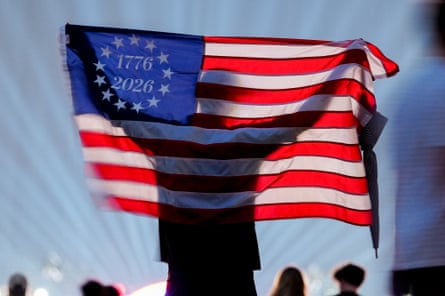
The 250th is a moment for self-congratulation, to be sure. But the most honest Fourth of July celebrations in the past have also included a pause for unblinking self-assessment. That may be difficult with all the competing noise, including the churning news cycle, foreign misadventures and the din of cage fights and car races. Other gilded distractions around the theme of the 250th include the arch coming to Washington, 250ft (76 metres) tall, in honor of all those years, and the on-again, off-again slush fund, pegged at precisely $1.776bn, as if that makes it patriotic.
These fit into a peculiar new category; observances of “history” that are actually anti-historical. They bring to mind another great achievement of 1776, Edward Gibbon’s History of the Decline and Fall of the Roman Empire, which described the Roman empire’s decadence, long after the heyday of the republic. It was not a proud moment, with Romans desecrating the memory of their ancestors by pulling down their finest structures, repurposing the stones to build private villas and other monuments to vanity. Rome was literally “dilapidated” – a word that means to scatter the stones.
The founders, in their wisdom, predicted that we might do our best to forget their work. John Adams, who did more than anyone to forge independence, predicted that a future government might find the study of American history uncomfortable if it did not like its inconvenient truths. As he put it, “arbitrary power, wherever it has resided, has never failed to destroy all the records Memorials and Histories of former times which it did not like and to corrupt or interpolate such as it was cunning enough to preserve or to tolerate”.
But Lincoln understood that the old parchment has a power all its own, not easily erased. It remains alive, and a fountain that we can return to when thirsty. Far from a relic, it’s a document that unscrolls a little more for each generation, as a perpetual “rebuke and stumbling-block” to tyranny. It feels almost unpatriotic not to heed his warning.
As tempting as it will be to enjoy the fireworks on 4 July, it will be a missed opportunity if we ignore the deeper meaning of the declaration. Remember: “Be true to what you said on paper.”
-
Ted Widmer is the editor of The Living Declaration: A Biography of America’s Founding Text, which was published on 23 June by the Library of America









Comments