
 German (DE)
 English (US)
 Spanish (ES)
 French (FR)
 Hindi (IN)
 Italian (IT)
 Russian (RU)
 4 hours ago
It was Tuesday, and the man poised to be the next governor of California wanted to talk about Donald Trump.
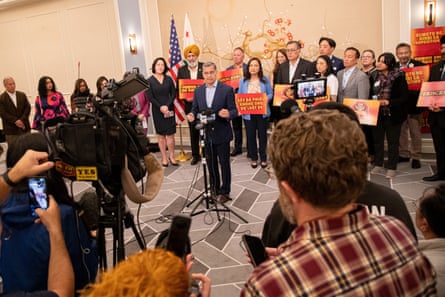
Xavier Becerra had come to Guelaguetza restaurant in Los Angeles to talk about Trump’s attacks on voting in the state, but instead found himself answering questions about a presidential provocation of a different order.
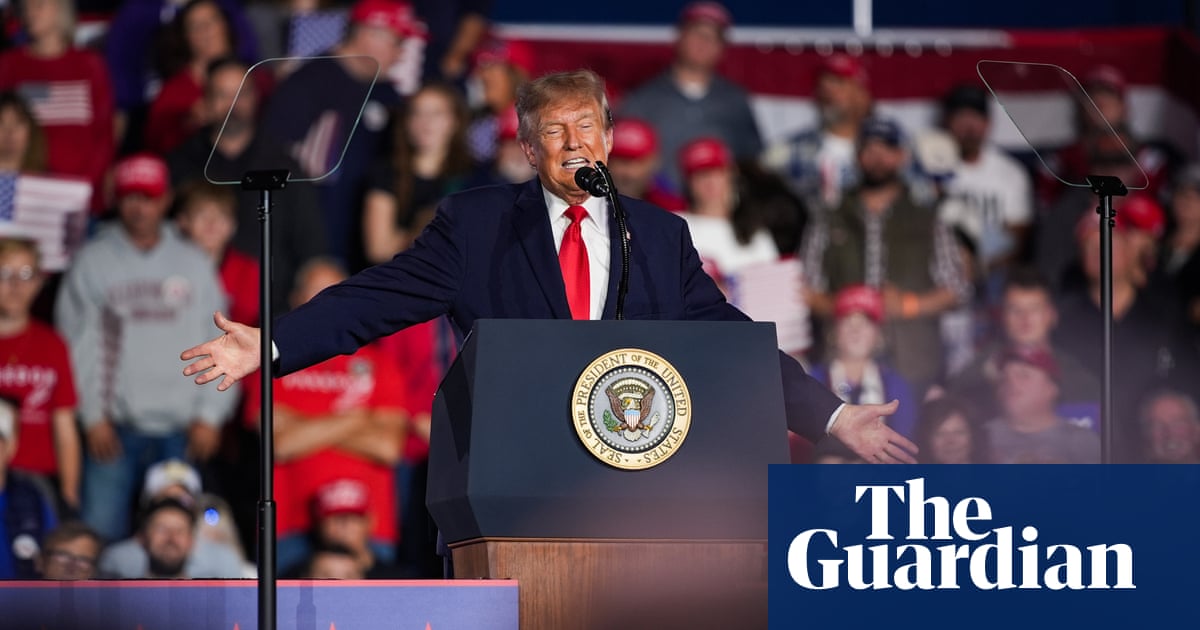
The previous day, Trump had addressed a crowd in Nebraska, and at some point during the nearly two-hour speech the president had suggested, perhaps in jest but with enough specificity to rattle nerves, that Iran might “take out” Los Angeles and San Diego.
“Life is already tough enough in California,” Becerra, 68, told reporters at the No on Prop 39 campaign event that Tuesday, offering his reaction only after taking questions related to the voter ID ballot measure being pushed by Trump’s allies in the state. “You don’t need to have a president pile on and say, ‘I don’t care about you. If you get bombed, who cares?’”
Should Becerra win, as he is all but certain to do in the heavily Democratic state, his first two years in the governor’s office will coincide with the final two years of Trump’s presidency.
Tangling with Trump is hardly new territory for Becerra. As the state’s attorney general during the president’s first term, he sued the Trump administration more than 100 times. Under priorities on Becerra’s campaign website, “fighting Donald Trump” is listed second behind “healthcare”.
Trump has spent nearly a decade targeting California, its laws and its leaders. But many of the state’s deeper structural challenges predate his political rise.
California remains prohibitively expensive. Owning a home is out of reach for millions of residents, and for those who do own one, higher wildfire risk makes insurance harder to get – and keep. Housing, utility and fuel costs run well above the national average. Hollywood is struggling, and residents are increasingly at odds with the tech titans driving the AI boom from the north of the state.
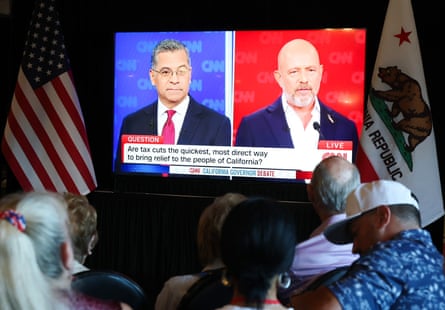
“All you ever say is ‘Trump, Trump, Trump,’” Becerra’s Republican opponent, Steve Hilton, charged in their sole general election debate. “That’s nothing but an insult to every Californian who is desperate for something to change in this state.”
Californians head to the polls in an exceptionally pessimistic mood, according to a new survey by the Public Policy Institute of California. More than eight in 10 say the country is headed in the wrong direction, and nearly six in 10 say the same of the state. Just two in 10 Californians approve of Trump’s performance in office – a record low across both terms of his presidency.
That leaves the next governor with the same weighty mandate handed to his predecessor, Gavin Newsom: lead the resistance to Trump’s Washington while delivering relief at home.
“It’s going to be a tough political environment for the new governor,” said Mark Baldassare, survey director at the Public Policy Institute of California. “People are feeling a real sense of urgency about the need to do something about affordability, the prices, cost of housing, the cost of energy … I’m not sure there’s going to be much of a honeymoon.”
Understated and amiable, Becerra is running on a gauzy promise to restore the “California dream” that allowed the son of Mexican immigrants to blaze a path from a one-room apartment in Sacramento, where he was raised alongside three sisters, to Stanford Law School, the California state assembly and then Congress.
He was elected to House of Representatives in 1992, at 34,amid a wave of Latino political activism in the state. He served 12 terms as a member of the US House representing central Los Angeles. As a member of House Democratic leadership, he helped draft and pass the Affordable Care Act, the Obama-era law that dramatically expanded access to health insurance coverage.
After nearly a quarter-century in Washington, Becerra surprised the political establishment on both coasts by returning to Sacramento, the state’s capital, to become the first Latino attorney general of California, succeeding Kamala Harris after she was elected to the US Senate. It put him at the vanguard of California’s clash with Trump.
“While we don’t go looking for a fight, we’re prepared to act when the people, resources and values of California are at stake,” Becerra said at the time, announcing the state’s 100th lawsuit against the Trump administration.
In the midst of the surging coronavirus pandemic, Becerra returned to Washington to serve as the nation’s health secretary under Joe Biden.
Not so long ago, it seemed that his political ascent might end there. His campaign for governor stalled soon after it launched – first, eclipsed by the prospect of a Kamala Harris run and then overlooked as Democrats searched for seemingly anyone else.
“When we started this campaign, we were the underdogs,” Becerra said at a rally in Hollywood on the eve of the election. “Actually we were an afterthought, maybe even a punchline.”
Fear began to spread that the party was running out of time to unite behind Newsom’s would-be successor and that the presence of too many Democrats with middling support might allow two Republicans to advance to the general election under the state’s non-partisan primary system. In short, the party was suggesting that he should drop out.
Becerra, once described by longtime California political columnist George Skelton as someone who “excels at being in the right place at the right time”, stuck around. When the gubernatorial campaign of Eric Swalwell, the now former California congressman, imploded amid allegations of sexual misconduct, the afterthought became the frontrunner.
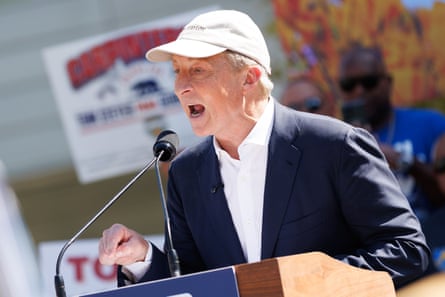
Becerra spent the rest of the turbulent primary campaign brawling with Tom Steyer, a progressive who backed Medicare for All and higher taxes on ultra-wealthy Californians like himself.
Steyer spent record sums and attacked Becerra’s corporate ties. But he was a billionaire spending hundreds of millions of dollars to drown out his opponents at a moment when voters, particularly on the left, were deeply skeptical of both.
Becerra ran on his résumé, even as Democrats across the country turned to anti-establishment populists and insurgents angry at the system. He had passed bills and whipped votes; run an executive agency with a budget larger than the US military; and sued Trump again and again. In short, he knew the levers to pull to help the Golden state get its shine back.
Critics argued that the résumé looked less impressive in practice. Former Biden administration officials came forward with sharp criticism of Becerra’s nearly four-year tenure at the Department of Health and Human Services. His detractors recalled a weak leader who had been all-but “invisible” as the federal administration marshaled a response to the pandemic – a charge Becerra pushed back on at the time. Others criticized his handling of the child migration crisis.
Former Becerra staffers bristle at that characterization of their boss’s leadership, instead portraying him as a “deliberative” and “methodical” negotiator who sought out diverse viewpoints and prized progress over purity.
“He always remembers where he came from,” Sirat Attapit, who worked for Becerra on Capitol Hill and in the state attorney general’s office, said. “His north star really is his parents.”
The test he applied to policy, she said, was personal: “Does this help people like my parents? Does it make life just a little bit easier for people like them?”
Voters picked him. And Hilton, with Trump’s endorsement, advanced to the second-place spot, edging out Steyer.
In a state that has elected actors and presidential aspirants – and in the case of Ronald Reagan, both – Becerra is, by his own admission, “not the slickest” candidate to ever seek the governor’s mansion.
A father to three daughters who flaunts his Costco membership, the Los Angeles Times columnist Gustavo Arellano dubbed Becerra a “Chicano Ned Flanders”. Like Biden did when he ran for president six years ago, Becerra offers steadiness and experience.
To date, the 68-year-old has given no indication that he views the governorship as a waypoint to the presidency.
Mark Gonzalez, a Democratic state assembly member who first met Becerra as a high school student, when Becerra was his congressman, said California needed a leader with his temperament – “someone calm, even-keeled and collected to be able to go into this storm that we’re calling the Trump administration”.
“You’re not a movie star,” he said. “You’re the governor of California.”
The knock on Becerra is that his agenda is too vague. Critics say his plans are aspirational but lack detail, while progressives fear an establishmentarian who fails to recognize the scale of change required of this moment.
“I would prefer not to run on inflated promises that then I can’t deliver on,” Becerra has said.
As governor, Becerra says lowering costs and expanding healthcare would be his top priorities. He wants to reduce permitting times for housing construction, expand down-payment assistance for first-time homebuyers, and has vowed to declare a state of emergency to address the housing shortage. He recently proposed a “power hour” of free midday electricity for low-income households.
Becerra says he supports “real guardrails” on artificial intelligence to protect workers and children, and believes Californians should share in the prosperity generated by leading tech companies that have made the state their home. But he hasn’t outlined exactly what that would look like.
“He has no incentive now to be specific,” said Melissa Michelson, a political science professor at Menlo College.
Polls show Becerra with a predictably wide lead over Hilton, in the state where Democrats hold a roughly two-to-one voter advantage over Republicans. It is to Becerra’s advantage, Michelson said, to wait and see what the fiscal and political landscape looks like after the election, rather than propose a suite of policies that might prove unfeasible once in office.
“Obviously, it’s frustrating to folks who want to know what’s going to happen,” she said. “But politically, it’s a very logical strategy.”
Becerra’s ambitions will be set against what analysts warn is a long-term structural deficit. Heavy reliance on AI-driven growth and tax revenue from the ultra-rich has left the state’s budget exposed to fiscal volatility, they say.
Compounding those fiscal pressures is the near-term risk posed by a hostile White House. Survivors of the Los Angeles fires in 2025 are still waiting for federal disaster aid, while communities rattled by immigration raids grapple with the aftershocks of mass arrests and deportations. Tariffs and the war in Iran have driven up costs everywhere, as the state braces for a sharp rise in its uninsured rate after the healthcare cuts approved under Trump’s One Big Beautiful Bill Act take effect next year. And in the final weeks before the 3 November midterm elections, the Trump administration has escalated its attacks on California’s elections system, alleging voter fraud.
One proposal to offset the looming coverage losses is the ballot measure known as Proposition 40 – a one-time 5% wealth tax on Californians worth more than $1bn. The so-called billionaire tax, brought to the ballot by a healthcare union and championed by the progressive senator Bernie Sanders, could raise huge sums earmarked primarily for healthcare. But it faces opposition from an unlikely coalition that includes Becerra, Newsom, tech billionaires, the California Teachers Association and Planned Parenthood Affiliates of California.
Billionaires should pay more, Becerra has said, but Prop 40 is “not the way to do tax policy”.
After winning the primary in June, Becerra kept a relatively low profile. So low, in fact, that when comedian Sophia Garrow interviewed him for the San Francisco Standard, she asked if he knew who he was running against in November. The confusion, she said, stemmed from the fact that Becerra’s website was still filled with references to Steyer months after his rival exited the race. (It has since been updated.)
In the final stretch, Becerra stepped up his campaigning, crisscrossing the state to rally for Democratic candidates running in competitive House seats redrawn last year as part of California’s counterpunch to Texas’s gerrymander. On Sunday night, he dropped back down to Los Angeles for a rally with Newsom, Harris and the state’s US senators, Democrats Alex Padilla and Adam Schiff.
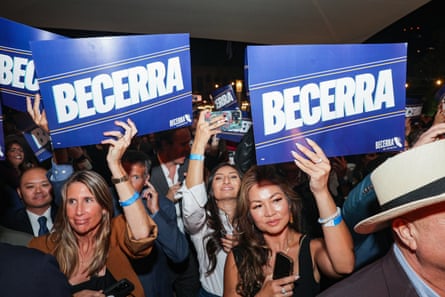
“In so many ways, this election is a choice between reaching higher for California’s golden dream or descending further down Donald Trump’s golden infamous escalator,” the Democratic nominee told an ebullient crowd, waving “Becerra era” placards. “I promise California will be the light at the end of the tunnel for the next two years.”
On the campaign trail, Becerra frequently invokes his parents, retelling the story of their arrival in California from Mexico “with just $12 in their pockets”. Yet he has not made much of what his historic victory would mean in a state where more than 40% of residents are Latino and nearly one in two children has an immigrant parent.
No Latino has been elected governor of California in modern times. The last time was in 1875, when the then lieutenant governor, Romualdo Pacheco, served the remaining months of the governor’s term.
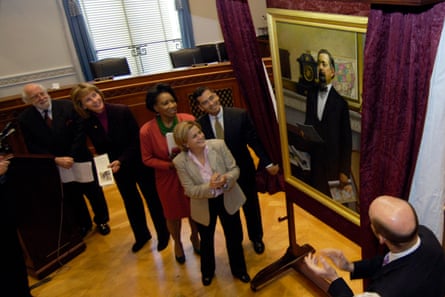
In Los Angeles last month, surrounded at the anti-Proposition 39 event by Congressman Pete Aguilar, chair of the House Democratic caucus, and Monique Limón, state senate president pro tempore, Becerra reflected, briefly, on the ascendancy of Latino political power in the 30 years since California voters overwhelming approved Proposition 187, a law that would have denied public services to undocumented immigrants, but was ultimately ruled unconstitutional.
“It’s not because we got lucky,” Becerra said. “It’s not because it was accidental. It was very intentional. There was a lot of hard work done by our parents, by our communities, to get us where we are.”
Part of his final push this campaign season is to defeat Prop 39, a ballot initiative that would require additional identification to vote.
Making his case in English and Spanish, Becerra spoke of his mother, a naturalized US citizen.
“We want to make it possible for people to exercise their vote,” he said. “I want to make sure I protect my mother’s right to vote.”











Comments