
 German (DE)
  English (US)
  Spanish (ES)
  French (FR)
  Hindi (IN)
  Italian (IT)
  Russian (RU)
  2 hours ago
Workers renovating one of Washington DC’s most historically symbolic sites in a project ordered by Donald Trump may be risking their safety as they race to finish on time for the US’s 250th anniversary celebrations, a union monitoring the site has warned.
Trade union scrutiny has focused on the reflecting pool on the US capital’s National Mall – scene of Martin Luther King’s 1963 “I have a dream speech” – after it was drained of water and fenced off from the public to allow contractors the chance to upgrade it by 4 July.
The pool, a Washington landmark since it was dug in 1922, is currently the site of frenetic repair activity, its usual watery surface occupied instead by vehicle and work equipment. Tourists visiting the area have found their view obscured by black tarpaulin.
Leaks and algae blooms have for decades dogged the 2,000ft pool, which sits between the Lincoln and George Washington memorial monuments, turning its water green and confounding previous expensive government-commissioned repair schemes, including one commissioned by Barack Obama’s administration.
Last month, the Trump administration – vowing to solve the problem once and for all – awarded a no-bid contract to waterproof and repaint the pool to a Virginia-based company, Atlantic Industrial Coatings.
The president told journalists the company had successfully carried out work on a swimming pool at his golf club in Sterling, Virginia. In a patriotic flourish, he ordered the firm to repaint the pool’s floor “American flag blue”.
Other companies that do similar work have expressed indignation over being denied the chance to compete for the contract, according to Herbert Zaldivar, the business development director of the International Union of Painters and Allied Trades, who has visited the site as an observer.
Now the award is threatening to boomerang amid disclosures that Trump drastically understated the contract’s cost, and reports that officials at the Department of the Interior – which has responsibility for the site – are dissatisfied with the company’s work.
The New York Times reported that interior department staff members had complained of bubbles and small holes appearing in one of the layers meant to waterproof the pool. Documents also revealed concerns over varying shades of blue mottling the pool’s flooring, resulting from an uneven application of tinted waterproofing and fears that a 22 May deadline for completion of the work may be missed.
Meanwhile, the contract’s true cost – which Trump initially told journalists would be $1.8m – has been revealed to be $13.1m. Amid the controversy, Trump has distanced himself from the company, contradicting previous statements by denying that he had ever used it, and insisting he was not involved in awarding the contract.
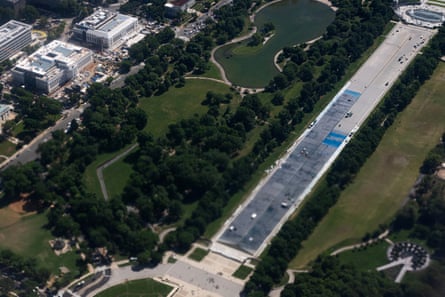
Visiting the site on a blustery day last week, Zaldivar said he had been contacted by union-affiliated companies anxious to know why the usual bidding process had been circumvented.
“I’m here to verify if the company is in compliance and following the right guidelines,” the union representative said. “It’s very rare that a job like this, which is a publicly funded contract, doesn’t go to a competitive bid.
“This didn’t go through the right processes, so we lost the chance for a union-affiliated contractor to be part of the competition.”
The federal government has powers to award contracts on a non-competitive basis, but only when there is a risk of competition causing “serious injury” to the government.
Atlantic Industrial Coatings, which is described on its website as a “woman-owned advanced coatings application company”, has never previously been awarded a federal government contract, according to official databases.
Zaldivar said he was concerned for the safety of the workers on the project, none of whom had been willing to talk to him. “They are afraid to touch the subject, although I will continue to come and try to have conversations with workers,” he said. “With this project, they are trying to rush on a timescale that is most likely to leave some liability with the contractor.
“The chemicals are hazardous. My concern is usually the level of risk when it’s rushed. Are workers taking the rightful steps to protect themselves?”
Richard Jones, a company supervisor working on the site, answered “no comment” to a series of questions posed by the Guardian and referred all inquires to the National Park Service. “That’s who we have a contract with,” he said.
A spokesperson for the Department of the Interior – the park service’s parent agency – said: “There is no merit to these accusations. Like every federal agency, we follow all laws and regulations designed to ensure fair treatment and safety in the workplace.
“Unlike Barack Obama’s over $35m, 18-month long failed effort to fix the reflecting pool – which failed immediately, President Trump is an expert builder and will get this job done for many generations to come.”
Surveying the cordoned-off scene from near the Lincoln Memorial, Al Havinga, a retired civil servant with the US Environmental Protection Agency on a cycle ride with two friends, voiced fears about air pollution arising from the coating materials being used.
“All this stuff is volatile,” he said. “People are breathing in poisonous chemicals. There’s no consideration to the risk to the public in applying this stuff. I would guess they are using volatile organic chemicals. There’s no information on that. It’s opaque.”
Tourists visiting from afar voiced a mixture of disappointment and bewilderment at the sight. “It’s hugely disappointing and ruining the historical integrity,” said Michelle Criswell, a federal government worker from Oklahoma City touring the site with her husband, Michael, referring to the site’s importance in the campaign for Black civil rights.
Criswell, who is African American, added: “I came here for the history and had been looking forward to seeing this site for a while and that’s what I see – a row of black tarp. I feel that everything that’s being done is being done intentionally.”











Comments