
 German (DE)
  English (US)
  Spanish (ES)
  French (FR)
  Hindi (IN)
  Italian (IT)
  Russian (RU)
  5 hours ago
Gas has topped $4 a gallon for the first time since 2022. The president’s approval rating just fell below 40%. The war in Iran is entering its sixth week, with thousands dead and no end in sight. The strait of Hormuz is blockaded, food prices are climbing and US households are staring down hundreds of dollars in added living expenses.
So naturally, the Democratic party has found something truly urgent to focus on: a Twitch streamer.
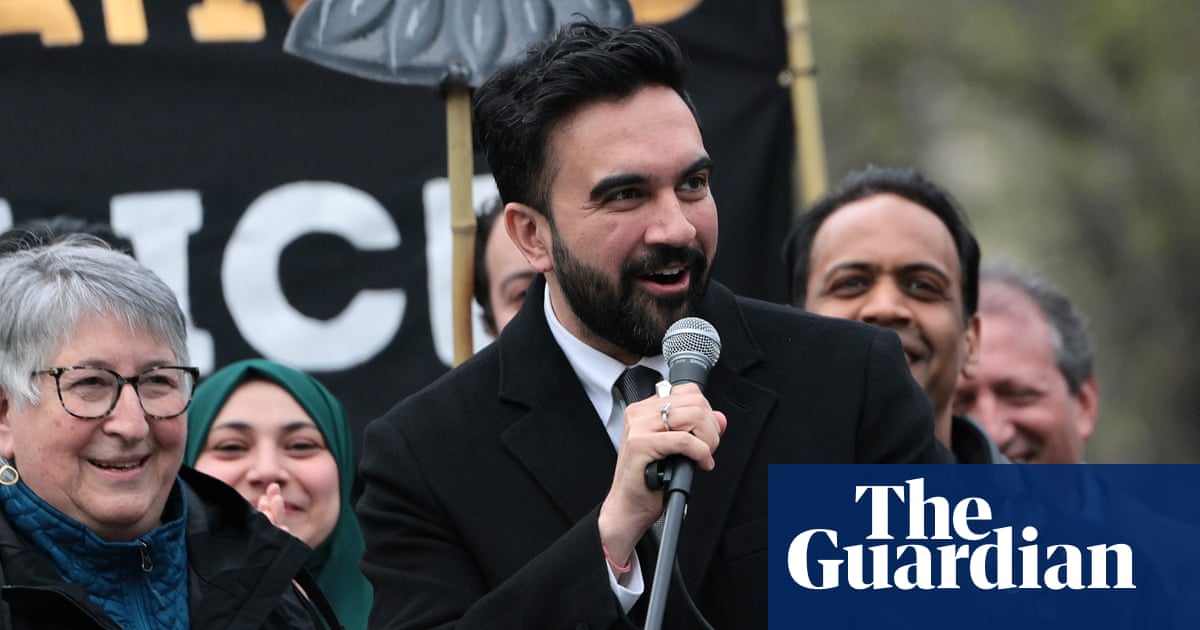
The latest intraparty panic was triggered by Abdul El-Sayed, a progressive running in Michigan’s competitive Democratic Senate primary, who announced that Hasan Piker would appear at two campaign rallies alongside him. The response from the party establishment was swift. Representative Brad Schneider branded Piker “an unapologetic antisemite”. Michigan’s own senator Elissa Slotkin, a former Pentagon official, weighed in with her condemnation, as did Representative Haley Stevens, one of El-Sayed’s primary rivals. Another opponent, Mallory McMorrow, went so far as to liken Piker to Nick Fuentes, a white supremacist who has enthusiastically praised Adolf Hitler on camera. When Politico came calling, both Cory Booker and Ruben Gallego rushed to declare they would refuse an invitation to appear on Piker’s stream.
It was quite the pile-on. But who is Hasan Piker, and why have some Democratic party elites branded him enemy No 1?
Piker is one of the most-watched political streamers in the country. His audience skews young and male – exactly the demographic that deserted Democrats in historic numbers in 2024. He’s a socialist who talks about class politics, foreign policy and the failures of the American system with a directness that clearly resonates with millions. Last month, he joined a solidarity convoy bringing humanitarian aid to Cuba. He’s also the guy who turned down $500,000 to play poker on stream and who walked away from a million-dollar offer from Polymarket for his 2024 election night coverage. At a time when surveys show nearly 40% of young men admit to betting more than they can afford, that consistency is worth something. It also puts Piker on a higher plane than some establishment figures. Stephanie Cutter, Obama’s former deputy campaign manager, announced just days ago that she’s excited to be advising Kalshi, one of Polymarket’s prediction-market competitors. The establishment’s moral compass is conveniently selective.
Has Piker said things that are offensive? Of course. He’s a streamer who broadcasts for hours every day – the medium almost guarantees it. But the specific charges being recycled against him are years old: a 2019 remark that “America deserved 9/11”, which he has since walked back as a hyperbolic critique of US foreign policy; forceful criticism of Israel and its crimes in Gaza; and the time he called ultra-Orthodox Jews “inbred”. “Inbred” is an unfortunate but standard piece of American insult vernacular. Piker himself uses it freely against white nationalists, neo-Nazis and anyone else he dislikes. He has said he regrets applying it to Jewish people specifically and will not do so again. None of this is new. And none of it makes McMorrow’s comparison of Piker to Nick Fuentes, an actual Holocaust denier, anything but ludicrous. None of it was a problem for establishment Democrats until the day El-Sayed announced his rally. The framing of Piker as a threat to all that is decent is nothing but a campaign tactic designed to kneecap a progressive challenger in a primary race.
It’s worth reflecting on the power of the respective sides of this controversy. Cory Booker, for example, is a United States senator. Hasan Piker is a guy with a laptop and an audience. Booker supports a bill that would unconstitutionally ban boycotts of Israel and has repeatedly voted to arm a country that has killed tens of thousands and leveled the Gaza Strip. But a streamer who says strident things about it from his living room is somehow beyond the pale? The double standard tells you everything about what the establishment considers dangerous – not the exercise of actual state power, but the existence of a popular voice they can’t control.
On Pod Save America, Booker said he’d never even heard of Piker before this past week. This is revealing in a way Booker probably didn’t intend. A senator who aspires to lead the party can’t be bothered to know who commands the attention of millions of the young voters he claims to want back, but he can be mobilized overnight to condemn the guy. His priority clearly isn’t engaging with the audience, though he does find time to “text message back and forth like teenagers” with the American Israel Public Affairs Committee’s president.
After 2024, Democrats conducted an anguished post-mortem about why young men were abandoning the party. Pundits filled columns wondering where the party’s Joe Rogan was – someone with cultural reach who could talk to disaffected men on their own terms. As Ryan Zickgraf pointed out, they got one. And the party’s first instinct was to try to cancel him.
What this episode makes painfully clear is that for too many leading Democrats, the priority is defeating progressives within their own ranks and triangulating their way back to power behind a well-heeled professional base.
Palestine has become a populist issue among young Americans in a way that the Democratic mainstream still refuses to comprehend – not just in Brooklyn and Ann Arbor, but in rural and working-class communities where people are angry, and where anger at the human cost of US foreign policy doesn’t break neatly along the lines the party expects. We are living through an era of extremes: a war in Iran that almost no one asked for, an economy that’s squeezing ordinary people and a president whose approval is cratering. The old playbook of moderation and scolding isn’t just uninspiring – it’s a proven loser.
Abdul El-Sayed understands that you can’t meet this moment by hiding from the people who are actually reaching the voters you’ve lost. The Democratic establishment’s problem isn’t Hasan Piker. It’s that they’ve run out of ideas, and they’d rather police who progressives talk to than offer the country something worth voting for.
-
Bhaskar Sunkara is the president of the Nation, the founding editor of Jacobin and the author of The Socialist Manifesto: The Case for Radical Politics in an Era of Extreme Inequalities












Comments