
 German (DE)
  English (US)
  Spanish (ES)
  French (FR)
  Hindi (IN)
  Italian (IT)
  Russian (RU)
  3 hours ago
Few ideas are as central to the nation’s identity as that of the American Dream.
With the 250th birthday of the United States coming up in July 2026, it’s worth stepping back to examine a concept essential to the nation’s self-image.
The term “American Dream” was actually coined in the 1930s by historian James Truslow Adams. Ever since the establishment of the Colonies, however, America has been viewed as a land where individual and collective hopes and aspirations can be realized.
From the idea of America as a shining “city on a hill” to the Declaration of Independence’s guarantee of “life, liberty, and the pursuit of happiness,” the nation has been premised on high aspirations. The concept of the American Dream has epitomized these hopes, and it continues to be present throughout our cultural landscape.
As a social scientist, I set out to explore what Americans thought about the American Dream in today’s society. I interviewed scores of people, from an elderly man sleeping on the street to a billionaire entrepreneur.
I wanted to know exactly how they defined the American Dream – and whether it has become harder to achieve today than in the past.
Defining the dream
From pickup trucks and lawn tractor ads to the labeling of undocumented immigrant children as Dreamers, references to the American Dream in contemporary life are ubiquitous. Washington, D.C., is now home to a brand-new, US$500 million museum, the Milken Center for Advancing the American Dream, devoted to celebrating the idea and its history.
It turns out that for most people I interviewed, the American Dream consists of three basic ideas.
The first is what might be called an economic bargain: If you work hard and play by the rules, you should expect to have a financially secure life. This includes owning a home, being able to afford raising kids and retiring in comfort.
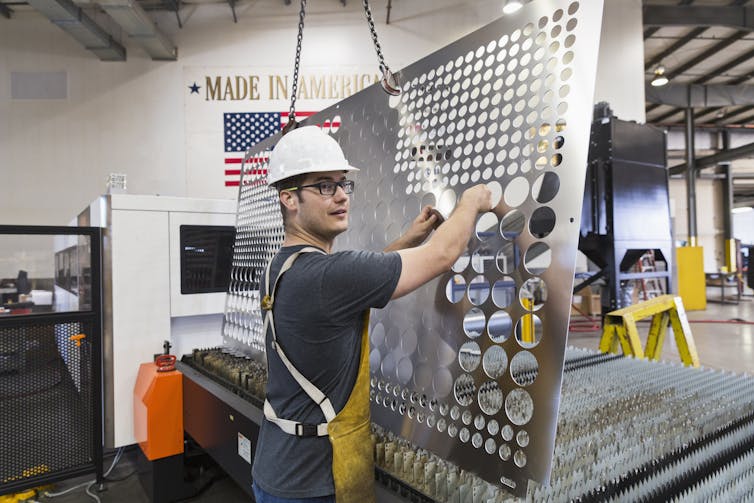
Second, the American Dream is centered on hope and optimism. It is about personal progress and the belief that the nation’s best days lie ahead. It’s the idea that each generation should do better than the previous one, and that upward economic mobility is essential for bringing this about.
The third and final idea people expressed was having the freedom to pursue their hopes to reach their full potential. For many, this is the epitome of the American Dream.
At its best, the U.S. is seen as allowing individuals the freedom to live the life they want. Liberty and rugged individualism have been hallmarks of America since its beginnings, so it should come as no surprise that they are also central to the American Dream.
Economically more elusive?
Given this, has the American Dream become more or less difficult to achieve over time? Unfortunately, for a growing number of Americans, it appears to be more difficult.
First, the goal of leading an economically secure life in exchange for hard work has become more elusive. Data from the Census Bureau indicates that median wages for full-time male workers have essentially flatlined since 1973. The economy has been producing more low-wage and part-time jobs. Many of these lack benefits, such as health insurance.
Less-skilled workers, such as truck drivers and postal clerks, have actually lost ground in terms of income. At the same time, housing, medical care, child care and higher education costs have dramatically increased over the past 40 years.
What about upward mobility and the hope for each generation to do better economically than the previous one? There is some evidence that one reason the middle class is shrinking is that more people have entered upper-income tiers.
Still, younger generations will actually earn, on average, less as adults than their parents did. This is the first time in U.S. history that this is the case. The formerly taken-for-granted idea of generational progress and moving forward appears to have stalled.
Upward economic mobility for lower-income workers has also slowed over the past 50 years, making it harder to climb the ladder of opportunity.
Dissatisfied, not dreaming
Finally, what about personal freedom? Survey data indicates that greater numbers of Americans feel they have less control over their lives and futures than in the past.
For more than 20 years, Gallup has asked the question, “In this country, are you satisfied or dissatisfied with your freedom to choose what you do with your life?” The percentage of Americans reporting being satisfied has dropped notably over the past two decades. In 2007 it was 87%, but by 2024 it had fallen to 72%. For women, the number was even lower, declining from 85% in 2007 to 66% in 2024.
By comparison, the average for the wealthiest countries in the Gallup survey was 86%. Consequently, on all three counts it appears that the American Dream is becoming harder to achieve.
An aspirational hope
These trends are important for making sense of the polarization and general negativity found in America today. Too many Americans feel that they’ve been left behind and that the American Dream has become a distant reality.
For these Americans, the words of the late comedian and social commentator George Carlin ring true: “It’s called the American Dream because you have to be asleep to believe it.”
Yet the American Dream is a powerful metaphor and aspiration that continues to inspire many in this country. Among those I interviewed, there was a strong consensus that it represents the very best of what America has to offer.
There is no other country that has quite the equivalent of the American Dream. As the nation enters its next 250 years, working toward reestablishing the concept as a reality for millions of people who have fallen behind may be vital to maintaining the essence of the American promise.


















Comments