
 German (DE)
  English (US)
  Spanish (ES)
  French (FR)
  Hindi (IN)
  Italian (IT)
  Russian (RU)
  2 hours ago
On an April morning at Winooki high school, the day started with a writing prompt: Do you feel safe in school? Why or why not?
The students – whose families hail from across the globe and speak Arabic, Nepali, Spanish, Somali and more – wrote their responses before reading them aloud.
“I feel safe in school because I saw the school doors are locked every time,” one student said.
“ICE can’t come in,” said another.
The sense of security students feel in this multilingual learner class at the Vermont high school is hard-won. Since the start of the second Trump administration, the federal government has investigated schools for diversity, equity and inclusion (DEI) efforts, rescinded a policy protecting students on school grounds from Immigration and Customs Enforcement (ICE) arrests and threatened school districts with the loss of federal funding. Administration officials have also encouraged states to challenge a decades-old supreme court decision guaranteeing undocumented students’ right to public schooling.
While many districts have chosen to go quiet or self-censor, the Winooski school system and its superintendent, Wilmer Chavarria, have taken the opposite approach.
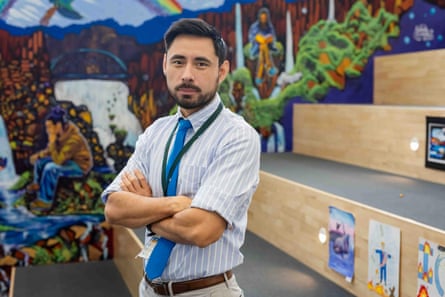
Last year, this small district of about 800 students was the first in Vermont to pass a sanctuary policy aimed at protecting students from immigration enforcement while at school. Chavarria also refused to sign a document from the Trump administration saying it was complying with the federal ban on DEI efforts in schools.
This was despite the district being directly affected by federal policies. Last year, Chavarria, a naturalized citizen, was detained for several hours by immigration officials at the Houston airport while on his way back from visiting family in Nicaragua. Over Thanksgiving break, a second-grader was detained with his mother by federal agents. In early December, the Winooski school district was the target of racist messages and phone calls after a video of a student raising the Somali flag on a pole outside the high school went viral on social media.
While there have been no direct threats by the Trump administration to pull Winooski’s federal funding, which accounts for 6% of the district’s annual budget, Chavarria said he was preparing for the possibility.
“When somebody wants us to lose funding, we’re going to lose it anyways. The difference is, did we lose it while bending the knee, or did we lose it while standing up for our values?” Chavarria said. “Either way, the outcome will be the same.”
Nestled along the Winooski River on the outskirts of Burlington, this 1.5-sq-mile community is the most diverse district in a state that ranks among the nation’s whitest. Nearly 60% of students are people of color and more than a third are learning to speak English.
For more than three decades, the town and neighboring region have been a federal refugee resettlement community, accepting hundreds of immigrants annually who are fleeing conflict from Bhutan, Somalia, Bosnia and Syria, among other countries. Last year, the Trump administration decreased the admissions cap for refugees into the US from 125,000 in 2025 to 7,500 in 2026, the lowest level since the program’s inception. So far, about 50 refugees, all from South Africa, have relocated to Vermont this year.
Chavarria, 37, joined Winooski schools in 2023 after serving as director of equity and education support systems in another Vermont district. Born in Nicaragua, he didn’t learn English until high school, a background that resembles many of the Winooski students he serves. His actions on behalf of immigrant students have built him widespread support locally.
“Wilmer has been a brave voice in a time in our country where that’s being punished,” said Robin Merritt, a parent of three children in the district.
The sanctuary schools policy is a key reason. The guidance formally outlined in Winooski’s policy reaffirms that staff will not share student data with immigration officials. It also restricts agents’ access to campus without a signed judicial warrant, among other steps. In May, after advocacy from Chavarria and others, the Vermont legislature passed a law modeled after Winooski’s policy, requiring all schools in the state to have immigration enforcement protocols.
Ignacia Rodriguez Kmec, policy counsel at the nonprofit National Immigration Law Center, said clear policies like this one not only protect students, but also staff, who may not know what immigration agents are allowed to do on school grounds.
“You want to be able to show that you support all families, including immigrant families, that they ideally should participate and not be afraid of coming to school,” she said.
A 2022 study found that children from families with mixed citizenship status were more likely to earn As and less likely to report problems with their teachers and peers if they attended a school that had a “safe zone” policy restricting immigration enforcement on campus.
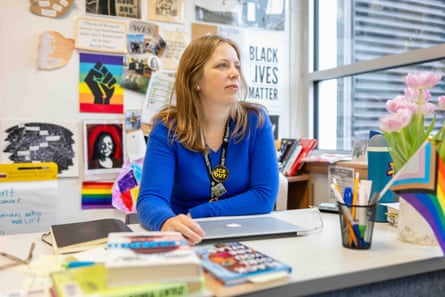
“I really see the impact in the classroom,” said Caitlin MacLeod-Bluver, who teaches English and history at Winooski high and was Vermont’s teacher of the year in 2025. “When kids feel seen and heard and valued in our district and community, it shows up in the work they’re doing.”
A desire to reassure immigrant families was the reason Chavarria decided to raise the Somali flag on school grounds on 5 December, three days after Donald Trump referred to Somalis as “garbage” in a cabinet meeting. When a video of the flag went viral on rightwing social media, staff had to temporarily take down the district’s website and social media accounts and unplug school phones because of death threats.
Despite the onslaught, the staff kept the Somali flag up, beside the US and Vermont flags, through the following week to show support for Somali students, who make up about 9% of the school system’s student population.
Chavarria – who, with his husband, stayed at a hotel for a few days following the episode after receiving death threats – said he believed if more school leaders publicly and vocally pushed back on Trump administration policies, Winooski wouldn’t be as big a target for hate.
“It does feel like we are alone in an ocean,” he said.
Inside the Winooski school building this spring, there were visible traces of the challenges of the past year. Since the deluge of death threats in December, doors separating hallways are locked, requiring a staff member to let students through sections of the building throughout the day.
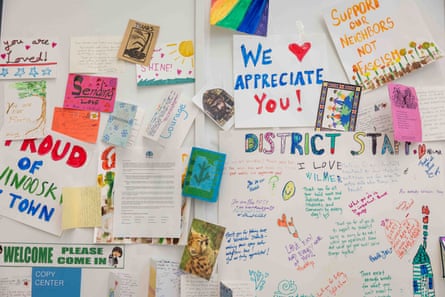
A table with “Know your rights” and “Conoce tus derechos” emblazoned across a banner sits off to the side, with documents translated into more than half a dozen languages telling families how to organize their documents and talk to children about ICE.
Still, outside of school walls, the district has not been able to keep all students safe. In the weeks following the second-grader’s detention in November, teachers wrote letters of support appealing to immigration officials and organized a fundraiser for emergency resources and legal fees. Erin Hurley, a multilingual teacher who taught the boy, said detention center officials denied her request to send his schoolwork to him.
During phone calls, the mother told Winooski staff that her son wasn’t doing well at the detention center in Dilley, Texas. After seven weeks, and despite having a lawyer fighting for their release, the family decided to self-deport.
In the last year, Hurley and other staff members at the school district have volunteered to be temporary guardians for several students whose parents worry about being detained.
“I feel so disgusted that our country has come to this. These families make our community so much brighter. They contribute to Vermont so much,” Hurley said.
Back in Winooski high school’s multilingual learners class, their teacher turned to a new topic: astronauts onboard Artemis II had just released photos from the moon, the farthest any human has ever traveled from Earth. She pulled the images up on a screen for the class to see.
They had a million questions. Is that photo artificial intelligence? How do the astronauts have access to the internet? Why didn’t they land on the moon?
For a few minutes, their thoughts were 250,000 miles away. Then, it was time to practice reading and writing in English again.
This story was produced by the Hechinger Report, a non-profit, independent news organization focused on inequality and innovation in education. Sign up for the Hechinger newsletter.









Comments