
 German (DE)
  English (US)
  Spanish (ES)
  French (FR)
  Hindi (IN)
  Italian (IT)
  Russian (RU)
  1 hour ago
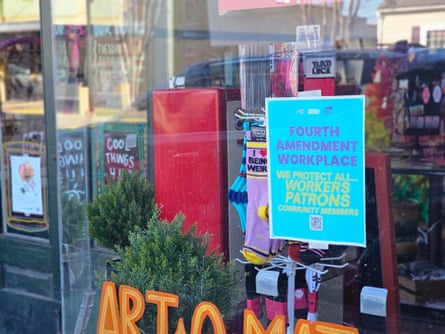
When Immigration and Customs Enforcement (ICE) and Customs and Border Protection agents descended on North Carolina last month, many local businesses were ready to push back. Posted on store- and restaurant-front windows across the state were signs reading: “private area”, “fourth amendment workplace” and “There’s always room at our table, but to enter past this point, we’ll need to see a warrant signed by a judge.”
The signs are part of a new fourth amendment strategy launched by the North Carolina immigrant rights group Siembra, to teach business owners their rights if federal agents show up at their door. While most Americans can name the rights protected by the first and second amendments, far fewer are familiar with the fourth, which prohibits unreasonable government searches and seizures. Siembra is working to change that, seeing the fourth amendment as a vital tool in fighting against the Trump administration’s brutal immigration crackdowns.
“The constitution is the highest law of the land,” said Emanuel Gomez Gonzalez, communications strategist at Siembra. “Even at a time when there are such flagrant violations, that’s there. If we are to insist on the lawfulness of our governance, the constitution offers a clear example of inalienable rights. And that includes all of us.”
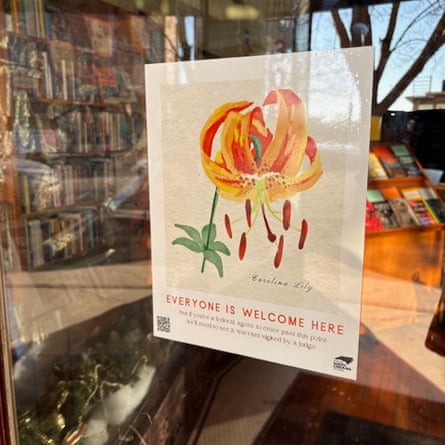
According to Siembra, this means that ICE agents are not legally allowed to enter private areas, such as kitchens or storage rooms, without a warrant; employees have the right to call a lawyer or an advocacy organization; and business owners can shelter an undocumented employee in a private area, but they cannot shelter a customer.
Siembra created a workbook outlining its strategy, as well as printable posters, workplace trainings, a pledge for business owners and a team of volunteers who canvass and persuade business owners to sign on to that pledge. So far, more than 250 businesses across the state have signed on. (Siembra’s workbook is free online, so that groups across the US can access it.)
Angela Salamanca, an immigrant from Colombia who owns several restaurants in Raleigh and Durham, said that once she heard about the pledge, she immediately signed up. For 15 years, she has strategized on how to best protect her undocumented employees from raids, arrests and deportations, and said she was always looking for new resources in the face of changing immigration policy.
“We have worked with Siembra for a while, and when they started this initiative, it’s the language we speak,” she said.
Jackie Ramirez, a Siembra organizer in Johnston county, just south of Raleigh, has been conducting fourth amendment trainings for months. She visited a taqueria where business had been sluggish because patrons were scared into staying home. “[The owner] asked me, ‘I’ve seen you around here doing this work, do you have the ability to train businesses and make them feel safe now?” Ramirez recalled.
She quickly onboarded them, but not every business is so eager.
When Ramirez visited a beloved local taco shop in Newton Grove, south-east of Raleigh, and tried to persuade them to sign on, she was stonewalled. “The cashier said, ‘no, that never happens here, we’re good.’ I reached out to the owner and they never got back to me,” she said.
Gonzalez says this type of response isn’t uncommon. When immigration is in the news, community members are eager to jump on board, but it is easier to ignore when it is not happening right now, in your city or town, he said.
“Throughout the course of Trump 2.0, in North Carolina specifically, there have been moments of high levels of urgency where people have been very activated around what they can and should be doing to participate in community defense, and there have been lulls,” Gonzalez said. “There can be times where it’s challenging to illustrate the necessity of preparing to exercise your constitutional rights.”
Some reluctance also stemmed from fear. Ramirez said she has talked to managers who were afraid that by erecting signage, they were putting a target on their heads. That’s partly why Siembra has courted not just Latinx-owned businesses, or ones that employ undocumented people, but everyone.
Earlier in the year, Siembra approached Steve Mitchell, co-owner of the well-known Scuppernong Books in Greensboro, about signing on to the pledge, to create momentum among other businesses in the area. Mitchell, who is white, knew that ICE raids would not personally affect him or his staff. But he was still eager to sign on.
“We definitely wanted to sign on to show our support for the resistance to the idiotic things that are going on at the moment,” Mitchell said, adding that Siembra’s signs and materials in his store have sparked conversations and questions from customers who want to help.
Renee’ Reynolds, owner of the picture frame shop 64 Harvard in downtown Graham, a small city halfway between Durham and Greensboro, had a similar motivation. She asked for the training after meeting some Siembra canvassers, and found herself receiving a crash course on the constitution.
“I didn’t know about those rights, so I learned a lot,” she said.
Reynolds said her position as a fourth amendment business sends a message to customers and passerby – and, hopefully, to other business owners. “If I have the courage to speak loudly, hopefully it can inspire other people to do so as well,” she said.
Next, Gonzalez said Siembra wants to expand to neighboring towns and city governments in North Carolina. Durham and the town of Carrboro have signed on, which means they will train municipal employees, pass resolutions condemning specific ICE actions, and spread the word to local businesses about the fourth amendment push. City councils in Chapel Hill and Greensboro are pushing forward initiatives to do the same.
Siembra isn’t the only group in the US training communities on the fourth amendment as a way to push back against ICE. Some groups, like the Oregon-based Baddies for the Fourth and the city government of Cleveland Heights, Ohio, are implementing similar fourth amendment strategies, and Gonzalez said that before Siembra rolled out its own initiative, groups around the country engaged in similar work, including the Georgia Latino Alliance for Human Rights, which creates “ICE-free zones” by training community members on their constitutional rights.
Meanwhile, in North Carolina, the door’s always open for local businesses that want to join. Some weeks after Ramirez visited the Newton Grove taqueria, whose owner had previously ignored her calls, federal agents showed up in the roundabout right outside the restaurant and started making arrests. “It was the first time in my area of the state that it was that clear they were detaining folks,” she said. In the aftermath, she went back to the taqueira.
“I finally met the owner in person,” she said. “And he was like, yes, I want the training.”














Comments