
 German (DE)
  English (US)
  Spanish (ES)
  French (FR)
  Hindi (IN)
  Italian (IT)
  Russian (RU)
  1 hour ago
US supreme court considers state bans on transgender athletes in school sports

Sam Levin
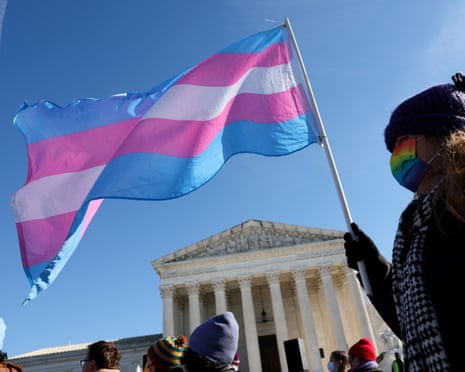
The US supreme court is considering the rights of transgender youth athletes on Tuesday in a major hearing on state laws banning trans girls from girls sports teams.
Oral arguments center on two cases of trans students who sued over the Republican-backed laws in Idaho and West Virginia prohibiting them from participating in girls athletic programs. The cases could have far-reaching implications for civil rights, with a ruling against the athletes potentially eroding a range of protections for trans youth and LGBTQ+ people more broadly.
In West Virginia v BPJ, 15-year-old Becky Pepper-Jackson challenged the state’s 2021 law banning her from track. A federal court blocked the ban, but the state appealed to the supreme court.
In the second case, Little v Hecox, Lindsay Hecox, a trans college student pursuing track, sued to overturn Idaho’s first-in-the-nation 2020 law categorically banning trans women and girls from women’s sports teams. She has since pushed to have the case dismissed, saying she is not doing sports in college and doesn’t want further harassment, but the supreme court is still hearing the matter.
Twenty-seven states have now restricted trans youth access to school sports – most with laws targeting trans girls, but some applying to all trans youth. Defenders of the bans argue they are promoting fairness and safety in women’s sports, while trans rights advocates counter the laws are cruel and discriminatory, and that there’s no credible evidence inclusive sports policies have endangered cis girls and women.
We’ll bring you all the latest from inside and outside the court as we get it.
Key events Show key events only Please turn on JavaScript to use this feature
Justice Neil Gorsuch chimed in with a big question about whether transgender people should be considered a legally protected class.
Gorsuch, a member of the court’s conservative majority, is one of the most closely watched justices in this case. He wrote a key 2020 decision upholding workplace discrimination protections for transgender people, but in 2025 joined the majority in allowing states to ban certain healthcare for transgender youth.
Hurst replied that he did not question there has been “some discrimination against transgender people, significant discrimination” in the United States, but said it did not compare with that historically faced by black people and women.
On the issue of whether the case is moot, the justices have said they would wait to make a decision about whether to dismiss it until after today’s argument.
A reminder that Lindsay Hecox, the transgender college student who challenged Idaho’s state law, sought to have her case dismissed in September, arguing that she is no longer pursuing sports and doesn’t want further harassment.
Alan Hurst, Idaho’s solicitor general, has said in defense of the state law:
Idaho’s law classifies on the basis of sex, because sex is what matters in sports. It correlates strongly with countless athletic advantages, like size, muscle mass, bone mass and heart and lung capacity.
A reminder that the first case is a transgender college student’s challenge to Idaho’s state law banning trans women and girls from women’s sports teams.
Oral proceedings have begun, we’ll bring you all the key developments here.
At issue is whether state bans on trans girls in athletics violate the US constitution’s 14th amendment, which ensures the law applies equally to all, or Title IX, which prohibits sex discrimination.
As the highest court in the US debates their rights to participate in school sports, five trans youth and their families spoke to the Guardian about the role athletics has played in their lives. The students are based in California, a state that has long had trans-inclusive policies.
The youth described the joy sports brings them and how meaningful it has been to play on teams that match their gender identity. They said sports were about community, team-building, socializing and exercising, like they are for so many youth in the US. Some expressed frustration and anxiety about the national debates focused on “fairness” in competition, saying the legal battle was about fighting for their place in society and their fundamental rights to access the same opportunities as their peers.
Here are some excerpts of their reflections:
Sam Levin
For context, in the last five years, 27 states have restricted trans children and teens’ access to school sports – most targeting trans girls, but some applying to all trans youth.
The anti-LGBTQ+ legal movement shifted its focus to trans athletes after the supreme court legalized marriage equality in 2015. Supporters of bans on trans athletes, including the Alliance Defending Freedom (ADF), the major Christian legal group defending the state laws today, argue they are promoting fairness and safety in women’s sports.
LGBTQ+ rights advocates counter there is no credible evidence that inclusive sports policies have endangered cis girls and women, and the controversy is manufactured by anti-trans activists; one conservative group, for example, acknowledged in 2019 that its polling suggested people could be swayed to support Republicans with ads raising fears about trans girls in sports.
The GOP’s escalating campaign against trans youth athletes is directed at a minuscule fraction of the population. The National Collegiate Athletic Association president testified in 2024 he was aware of fewer than 10 trans college athletes, and Republican legislators have at times struggled to identify any trans girls playing sports in their states.
Meanwhile, states such as California have long allowed trans youth to play on teams that match their gender with little pushback – until the issue became subject to national debate.
While there are few out trans youth on sports teams at all levels, advocates note the bans have been devastating for those directly affected and LGBTQ+ youth who may be avoiding athletics due to the climate.
Advocates are not optimistic the supreme court will block the sports bans, but hope the decision will be narrow. Last year, the court upheld Tennessee’s ban on gender-affirming care for trans minors. The ruling was a devastating blow for access to vital medical treatments, but was limited to healthcare and did not, as some had feared, establish a broader precedent supporting anti-trans legislation.
Sam Levin
Lawyers for Hecox and Pepper-Jackson argue the bans violate the equal protection clause of the constitution, and in the West Virginia case, attorneys also argue the ban violates Title IX, the federal law prohibiting sex discrimination in schools.
One crucial question the court will consider is whether the laws are discriminatory against trans people and merit what’s known as “heightened scrutiny” – a more rigorous review, meaning the government has a higher burden to justify the bans. The court has never issued a ruling addressing whether it considers trans people a class that deserves this protection.
If the court were to use the sports cases to rule that laws targeting trans people do not warrant heightened scrutiny, then “any type of law discriminating against trans people is going to be presumptively constitutional”, said Joshua Block, senior counsel for the LGBTQ and HIV projects at the ACLU, which is representing both students.
“These laws were passed to establish a legal principle that transgender girls and women shouldn’t be treated like other girls and women, and then to use that principle as a jumping-off point for rolling back protections for transgender people more generally,” said Block, who is presenting oral arguments.
Scott Skinner-Thompson, a Colorado law school professor, said he feared the ruling could leave trans people with “minimal constitutional protections” from laws explicitly targeting them:
That would further embolden legislators to continue to pass laws that exclude transgender people from public life.
In addition to bolstering laws banning trans people from bathrooms, that outcome could also make it even harder for incarcerated trans people to access critical healthcare and safe housing, said Skinner-Thompson, who signed an amicus brief arguing the bans should remain blocked.
The broad question in these cases is: are we a society that’s interested in recognizing people’s common humanity, or are we more interested in excluding people for the purpose of a particular version of what counts as ‘fair’?
The ruling could also establish that trans people are not protected under Title IX, which could be catastrophic, said Block. A school could deny admission to or expel a student on the basis of them being trans and it wouldn’t be considered a Title IX violation, he said.
In one particularly damaging outcome, which he hoped was unlikely, Block said the court could support the Trump administration’s assertions that Title IX requires that schools ban trans girls from sports. That would potentially invalidate policies in Democratic-run states that allow or mandate trans inclusion in youth athletics.
Sam Levin
In the first case, Little v Hecox, Lindsay Hecox, a trans college student, challenged Idaho’s first-in-the-nation law categorically banning trans women and girls from women’s sports teams, which passed in 2020, blocking her from track at age 19. She has since sought to have the case dismissed, arguing she is no longer pursuing sports and doesn’t want to be subjected to ongoing harassment. But the US supreme court decided to hear the case, anyway.
In the second case, West Virginia v BPJ, 15-year-old Becky Pepper-Jackson has challenged her state’s law banning her track participation, saying in a recent statement:
This case isn’t just about me, or even just about sports. It’s just one part of a plan to push transgender people like me out of public life entirely.
Analysis: How the US supreme court case on trans athletes could unravel LGBTQ+ rights
Sam Levin
The two bans in question were both previously blocked by federal courts, but the states appealed to the supreme court, which is hearing a case on trans people’s access to sports for the first time. If the court’s conservative supermajority sides with the states and upholds the bans, the rulings could have significant ripple effects, paving the way for the enforcement of a range of anti-LGBTQ+ policies.
If the rulings are broad, civil rights advocates warn, the supreme court could make it easier for lawmakers and school officials to ban trans students’ access to appropriate bathrooms and facilities, restrict LGBTQ+ youth’s ability to use chosen names and pronouns, enforce strict dress codes, limit protections against anti-LGBTQ+ harassment, and further deny access to accurate identification documents.
“It’s really scary. The supreme court is poised to tell us whether dislike and moral disapproval of a specific group can be a real basis to make law,” said Cathryn Oakley, senior director of legal policy for the Human Rights Campaign, an LGBTQ+ rights group.
US supreme court considers state bans on transgender athletes in school sports
Sam Levin
The US supreme court is considering the rights of transgender youth athletes on Tuesday in a major hearing on state laws banning trans girls from girls sports teams.
Oral arguments center on two cases of trans students who sued over the Republican-backed laws in Idaho and West Virginia prohibiting them from participating in girls athletic programs. The cases could have far-reaching implications for civil rights, with a ruling against the athletes potentially eroding a range of protections for trans youth and LGBTQ+ people more broadly.
In West Virginia v BPJ, 15-year-old Becky Pepper-Jackson challenged the state’s 2021 law banning her from track. A federal court blocked the ban, but the state appealed to the supreme court.
In the second case, Little v Hecox, Lindsay Hecox, a trans college student pursuing track, sued to overturn Idaho’s first-in-the-nation 2020 law categorically banning trans women and girls from women’s sports teams. She has since pushed to have the case dismissed, saying she is not doing sports in college and doesn’t want further harassment, but the supreme court is still hearing the matter.
Twenty-seven states have now restricted trans youth access to school sports – most with laws targeting trans girls, but some applying to all trans youth. Defenders of the bans argue they are promoting fairness and safety in women’s sports, while trans rights advocates counter the laws are cruel and discriminatory, and that there’s no credible evidence inclusive sports policies have endangered cis girls and women.
We’ll bring you all the latest from inside and outside the court as we get it.

















Comments