
 German (DE)
  English (US)
  Spanish (ES)
  French (FR)
  Hindi (IN)
  Italian (IT)
  Russian (RU)
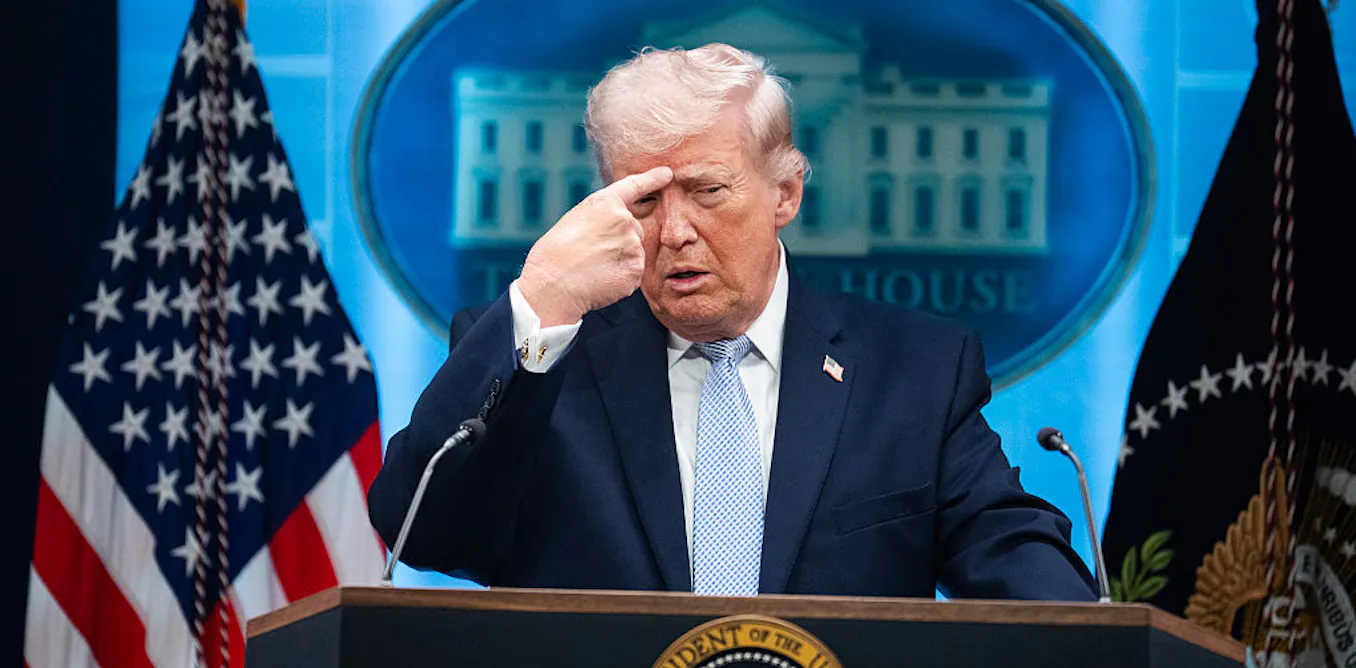
 WASHINGTON (AP) — The president who yearned for a Nobel Peace Prize and once reveled in the appearance of solving conflicts has turned to the language of annihilation as he struggles to find a resolution to his war of choice in Iran.
President Donald Trump's latest threat over the Iran war hit a new extreme Tuesday as he warned, “A whole civilization will die tonight, never to be brought back again," if Iran fails to make a deal that includes reopening the vital Strait of Hormuz.
The Republican president's comments were swiftly met with condemnation from Democrats, some “Make America Great Again” supporters who have since broken with Trump, and the first American pope. Some fellow Republicans suggested his comments were a negotiating tactic.
It follows his threats in recent days that he would be “blasting Iran into oblivion” and “back to the Stone Ages!!!” He said he would blow up bridges and civilian power plants, which experts in military law said could constitute a war crime. And on Easter morning, he wrote on his social media account: "Open the F——-in’ Strait, you crazy bastards, or you’ll be living in Hell.”
Trump’s intensifying warnings of widespread and seemingly indiscriminate destruction are a sea change from his January pledge to the people of Iran that “HELP IS ON ITS WAY" after a brutal crackdown on protests. They are the antithesis of the peacemaking image he spent much of the last year trying to cultivate as he sought a Nobel Peace Prize.
And, most urgently, they raised questions about whether the president is threatening actions that could be considered war crimes, whether he is considering using a nuclear weapon or whether it is all bluster.
“The Iranian regime has until 8PM Eastern Time to meet the moment and make a deal with the United States. Only the President knows where things stand and what he will do,” White House press secretary Karoline Leavitt said in a statement.
The president’s extraordinary threat came as the conflict with Iran reached a precipice. Iran rejected the Americans’ latest ceasefire proposal, and the Middle Eastern country’s president said 14 million people, including himself, have volunteered to fight. Meanwhile, there were international calls for restraint, and officials involved in diplomatic efforts said talks were ongoing.
Experts said that Trump's threats to blow up bridges and power plants could constitute a war crime depending on whether the power plants were legitimate military targets, whether the attacks were proportional compared with what Iran has done and whether civilian casualties were minimized.
Trump has extended previous deadlines in the 5 1/2-week-old war but insisted Tuesday night’s limit is final. On Monday, he defended his profane language, saying he used it only to make a point, and said he’s “not at all” concerned that his threats amount to a war crime.
Trump's comments draw condemnation and hopes that it is bluster
Sen. Todd Young, an Indiana Republican and a Marine Corps veteran, said that what Trump is “clearly trying to accomplish” is to “bring this whole effort to a close and that’s the best way to preserve lives and property and reduce suffering.”
“The president clearly, to me, wants to increase the amount of leverage he has immediately so that we can bring this conflict to a close and avoid further bloodshed or suffering from the Iranians, from the Americans or from any other people.”
Sen. Ron Johnson, a Wisconsin Republican and a stalwart Trump ally, said Monday before Trump's most recent threat that he hoped Trump’s threats to bomb power plants and bridges were bombast.
“I am hoping and praying that President Trump is, this really is bluster. I do not want to see us start blowing up civilian infrastructure. I do not want to see that,” Johnson said on a podcast. “We are not at war with the Iranian people. We are trying to liberate them.”
Democratic leaders in the House said in a joint statement that Trump's “statement threatening to eradicate an entire civilization shocks the conscience." Their Senate counterparts said it was “a betrayal of the values this nation was founded on, and a moral failure.”
Texas Democratic Rep. Joaquin Castro called on Trump to immediately make clear that he is not considering using nuclear weapons, and Colorado Democratic Rep. Jason Crow warned that “calling for the elimination of a civilization is a war crime.”
Pope Leo XIV said any attacks on civilian infrastructure violate international law and called the president’s comments “truly unacceptable.”
Former Georgia Republican Rep. Marjorie Taylor Greene, once a stalwart MAGA supporter who has since turned critic of the president, suggested invoking the 25th Amendment, under which the vice president and a majority of Cabinet members declare a president unfit for office and remove him.
“Not a single bomb has dropped on America. We cannot kill an entire civilization. This is evil and madness,” she wrote on X.
Sen. Lisa Murkowski, an Alaska Republican who often breaks with the president, called Trump's latest threat “an affront to the ideals our nation has sought to uphold and promote around the world for nearly 250 years.”
The comment, she said, “cannot be excused away as an attempt to gain leverage in negotiations with Iran." She urged Trump and Iranian leaders to “de-escalate their unprecedented saber-rattling before it is too late.”
Trump's history of inflammatory threats
Roseanne McManus, a professor of political science at Penn State University whose research has focused on international security and how countries signal their intentions in ongoing or potential conflict, said presidential threats of force traditionally had some restraint and subtlety.
But Trump, dating back to his first term, has broken with those norms, she said. That was most notable when he warned North Korea in 2017 that it would see “fire and fury like the world has never seen" if it made more threats against the U.S., raising fears of a nuclear escalation. He later said he and North Korean leader Kim Jong Un “fell in love," and the threats largely stopped.
Since returning to the White House last year, he has made more incendiary threats and moves.
Last summer, he joined Israel in striking Iran's nuclear sites, a move that came before a self-imposed timeline for action ran out. Earlier this year, he launched a brazen strike that captured Venezuela's authoritarian president, Nicolás Maduro, and brought him to the U.S. for trial.
He has also suggested using military force to take control of Greenland and has said he believes he’ll have “the honor of taking Cuba” soon, but he has so far not followed through on those threats.
Trump has referred to his unpredictability as an asset, McManus said, and has seemed to lean into the “Madman Theory,” attributed to former President Richard Nixon, that aims to deter adversaries by convincing them he’s unpredictable enough to carry out an extreme action.
His actions over the last year, along with increasingly frequent over-the-top threats in recent days to Iran, seem to show that “he’s been leaning into the strategy to a greater extent in his second term.”
“I think the fact that Trump is willing to shatter these norms with his rhetoric could suggest that he is not restrained by the same sorts of things that would restrain a normal leader,” she said.
___
Associated Press writers Steven Sloan and Stephen Groves in Washington and Nicole Winfield in Rome contributed to this report.











Comments