
 German (DE)
  English (US)
  Spanish (ES)
  French (FR)
  Hindi (IN)
  Italian (IT)
  Russian (RU)
  16 hours ago
The attack on Venezuela and the seizure of its president was a shocking enough start to 2026, but it was only the next day, when the smoke had dispersed and Donald Trump was flying from Florida to Washington DC in triumph, that it became clear the world had entered a new era.
The US president was leaning on a bulkhead on Air Force One, in a charcoal suit and gold tie, regaling reporters with inside details of the abduction of Nicolás Maduro. He claimed his government was “in charge” of Venezuela and that US companies were poised to extract the country’s oil wealth.
Clearly giddy with the success of the operation, achieved without a single US fatality but several Venezuelan and Cuban ones, Trump then served notice on a string of other nations that could face the same fate. “Cuba is ready to fall,” he said. Colombia was run by a “sick man” who was selling cocaine to the US but who would not “be doing it for very long”.
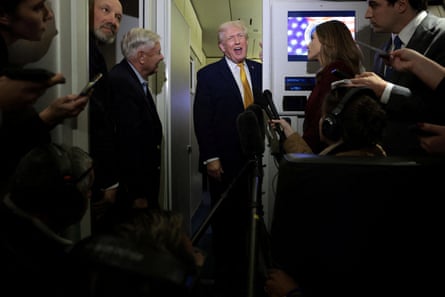
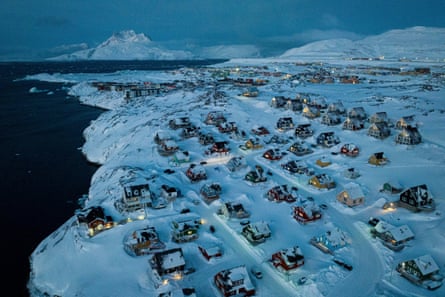
Trump said he would postpone for 20 days to two months any discussions about his desired takeover of Greenland, the semi-autonomous territory of Denmark, a Nato ally, but made clear he was determined to seize it for the sake of US “national security”.
New imperialism
Lest there was any doubt about the scale of Trump’s territorial ambitions, his administration posted its message to the world in capital letters, some of them red, on social media.
“This is OUR hemisphere,” the state department declared on X above a black and white picture of Trump looking grimly determined.
The White House deputy chief of staff, Stephen Miller, went on CNN to provide the rationale for Trump’s new approach to foreign policy.
“We live in a world, in the real world, Jake, that is governed by strength, that is governed by force, that is governed by power. These are the iron laws of the world since the beginning of time,” he said.
Miller is one of the few aides to have served in high positions in both the first and second Trump tenures. He has emerged as chief ideologue, channelling the impulses of the president and packaging them as policy. In a social media post on Monday, Miller addressed the bigger picture and argued it was time for the west to stop apologising for its imperialist past.
“Not long after World War II the West dissolved its empires and colonies and began sending colossal sums of taxpayer-funded aid to these former territories (despite have [sic] already made them far wealthier and more successful),” Miller wrote.
“The neoliberal experiment, at its core, has been a long self-punishment of the places and peoples that built the modern world.”
The US has invaded a long list of countries and changed regimes many times over the past few decades, but this is the first time it has done so since the second world war as a self-proclaimed exercise in imperialism. The extraordinary change in rhetoric coming from Washington means all three of the world’s military superpowers are overtly pursuing revanchist aims, the recovery of lost imperial greatness.
Vladimir Putin has taken on the mantle of Peter and Catherine the Great in restoring historical Russian lands, at the cost so far of a million Russian troops killed or injured in Ukraine, according to the British Ministry of Defence, the culmination of a string of conquests in Chechnya and Georgia.
Xi Jinping has dedicated himself to China’s “great rejuvenation”, which includes recovering the territorial expanse of the Qing empire at its high-water mark before the “century of humiliation” at the hands of foreign powers from the mid-19th to mid-20th centuries. Beijing’s projection of force with military bases around the South China Sea draws from that rationale, but Xi has repeatedly made clear the mission will not be completed until Taiwan is back under Beijing’s rule.
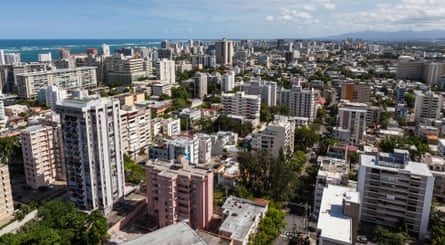
Like the other two ageing autocrats, Trump’s vision for his country harks back to a bygone imperial past. His favourite president is William McKinley, who led the US through a surge of territorial expansion at the end of the 19th century, including the military takeover of Cuba and the annexation of Hawaii, Puerto Rico, Guam, the Philippines and American Samoa.
Trump has also looked to the early 19th century for inspiration for his new bout of territorial acquisitiveness, in the form of the Monroe doctrine.
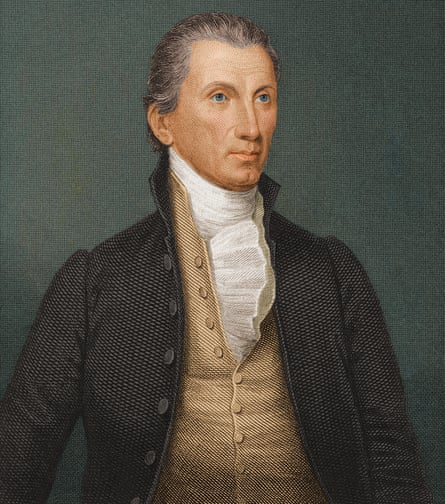
“It was very important, but we forgot about it. We don’t forget about it any more,” the president said on Saturday.
The reference not only reflected a view of the past uncomplicated by any detailed reading on Trump’s part, but also the changing relationship between the US and the notion of empire.
The country was founded as a rejection of British imperialism and when President James Monroe developed his doctrine in 1823, setting out the leading US role in the Americas, it was to act as a barrier to any further European colonialism.
The version of the doctrine that Trump appears to embrace, however, is its repurposing by Teddy Roosevelt in 1904 at the height of a US exercise in traditional imperialism. Under the “Roosevelt corollary”, the US took on the role of “police power” which would intervene in any country in the region where it perceived there to be “flagrant cases of wrongdoing or impotence”.
In its national security strategy document published in November, a blueprint for the expansionism of early 2026, the White House laid out a “Trump corollary” to the Monroe doctrine “to restore American pre-eminence in the western hemisphere”.
Trump calls it the “Donroe doctrine”, copying a New York Post front page from a year earlier. The difference from previous versions, he boasted characteristically, was that it would be bigger and better.
The original Monroe doctrine was “a big deal”, he said, but added: “We’ve superseded it by a lot, by a real lot.”
For all the febrile talk of doctrine and the sharp swerve in rhetoric coming from the White House, it is far from clear how it intends to proceed in Venezuela.
New president, old policy?
There appears to be disagreement within the administration – to the extent there is detailed discussion at all – on how to turn the president’s self-image of hemispheric emperor into a plan of action. Until that happens, what Trump has done in Venezuela is arguably not out of line with what the US has done around the world, but particularly in the Americas, when it was supposed to be abiding by the post-1945 “rules-based order”.
Some argue that, as seen from the global south, US imperialism has remained a constant, and that all Trump has done is to drop the mask of hypocrisy.
“The idea that this is new is ridiculous,” said Kehinde Andrews, a professor of black studies at Birmingham City University in the UK and the author of The New Age of Empire: How Racism and Colonialism Still Rule the World. “The US has been doing this all along, but the only difference here is it’s just brazen. There’s nothing new about this at all. This is what the west does; Trump’s just honest about it. I actually find it refreshing to be honest.”
Andrews added that if Trump carried out his threat to seize Greenland, directing his imperialist appetites towards another western state and thereby crippling Nato, it would mark a significant break with the past. But for that same reason, he doubted it would happen.
“If it was a black or brown place, it would have happened already,” Andrews said.
Daniel Immerwahr, a historian and humanities professor at Northwestern University in Illinois, and the author of How to Hide an Empire, agreed that “the US empire never really ended”.
He pointed out that the US still owns five permanently inhabited territories – Puerto Rico, the US Virgin Islands, Guam, the Northern Mariana Islands and American Samoa – and maintains 750 military bases around the world.
On the other hand, Immerwahr argued that, for all the US hypocrisy and double standards under the “rule-based international order”, it remained markedly different to the imperial era.
“The notion that as the US got more powerful it would grow larger – that was largely broken by the end of world war two,” Immerwahr said. While the liberal international order did not stop invasions and wars, “it is also true that the post-1945 era has seen far more decolonisation than imperial expansion, in terms of territory. And that has helped bring down war deaths enormously”, he said.
The left has historically condemned the post-1945 global order because it baked in western advantage, but the more extreme elements of the right have despised it because it involved surrendering colonial assets, and helping old adversaries recover from the war.
Trump spent much of his career as a property developer railing against Japanese competition, an antipathy he has since broadened to China. Much of his rhetoric over Venezuela and other would-be imperial targets revolves around reclaiming assets, such as oil industry infrastructure, that had been “stolen” from the US. So in Trump’s view, making America truly great again inevitably demands a return to expansion. Putin and Xi are bent on making Russia and China great again, for similar motives.
Potential clash of empires
The US seizure this week of an oil tanker, the Marinera, despite the fact it was Russian flagged and escorted by a Russian submarine, brought into urgent focus the question of whether, and for how long, the ambitions of the three superpowers can be reconciled without major conflict.
“There can be really rather a protracted period of time in which empires can coexist,” Nathalie Tocci, the director of Italy’s Institute of International Affairs, said. “It’s not as if Trump is saying: I want to be the only empire; Trump is basically signalling and acting as if he’s absolutely fine with Russia and China being empires.
“In the short to medium term, I would say that the greater risk is not the empires clashing with one another, but the subjugation of the colonies,” she said.
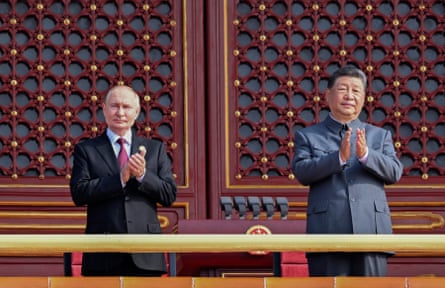
Putin and Xi would certainly be content with a world sliced into spheres of influence. During the first Trump administration, Russia informally floated the idea that the US could have a free hand in Venezuela in exchange for Russia holding sway over Ukraine in its sphere of influence.
Fiona Hill, who at the time was serving in the Trump White House as the national security council director for Russian and European affairs, said: “The Russians were trying it on. It was all vague and a matter of hint-hint, wink-wink, saying: ‘Let’s talk about the Monroe doctrine,’ and then giving a meaningful look.”
Hill said the first Trump administration rejected the suggestion of any such deal, but she acknowledged that the president’s views on empire had clearly evolved.
“I remember actually telling people before that he was a real estate mogul. He didn’t want to own your country, just put up his buildings on it,” she said. “But I suppose it’s a quick jump for him from real estate to state acquisition, and that’s what we weren’t anticipating before.”
Hill is not confident that the three great revanchist empires can stay out of each other’s way. In his newly whetted appetite for US expansionism, Trump has reserved the right to act far beyond his hemisphere, bombing Iran or even running Gaza.
“He’s saying: ‘Hands off and keep away from the western hemisphere’, but he’s not necessarily going to leave China unchecked in the Asia-Pacific,” Hill said. “The US is still supposed to be an Asian-Pacific power, and part of the western hemisphere is in the Pacific.
“This world is much more complex now,” she added. “It’s all very fragile, especially because we don’t know what mistakes he’s going to make.”
Domestic considerations
Trump’s imperial impulses may be constrained, to some extent, by US politics. Post-Venezuela polling suggested that large majorities, among Democrats and Republicans alike, were opposed to any long-term involvement in the country.
However, Trump’s Maga base was thrilled by the success of the operation, and his long-sagging popularity gained a minor bump. For a president seeking to distract from an intractable affordability crisis at home and the looming threat of more child-trafficking revelations in the Epstein files, that may be enough to seek out other quick military spectacles abroad.
With the guardrails of the old order demolished, Trump’s US would be an ever more chaotic factor in the world, not coherent enough to be called an empire but imperial in the imposition of suffering by the strong on the weak.
Writing in Mother Jones this week, the magazine’s Washington editor, David Corn, suggested that is the essence of the real Trump doctrine: “Violence is ours to use, at home and abroad, to get what we want.”
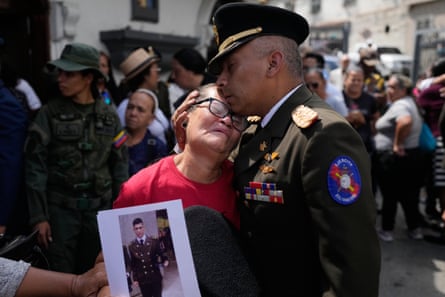
What was the Monroe doctrine?
The Trump administration has revived the 203-year-old Monroe doctrine, and made it the cornerstone of its newly aggressive policy in the Americas.
The US national security strategy (NSS) published in November, stated that: “After years of neglect, the United States will reassert and enforce the Monroe doctrine to restore American pre-eminence in the western hemisphere.”
Trump himself has bandied the term about, characteristically adapting it to the “Donroe doctrine”, a play on his first name to emphasise his ownership of the idea.
The original doctrine, put forward by President James Monroe in 1823, meant something quite different. He proposed that the recently established United States act as a guarantor against European imperialism in the region, declaring the nations of the American continents were “not to be considered as subjects for future colonisation by any European powers”.
In 1904, however, the doctrine was updated by President Theodore “Teddy” Roosevelt to suit the enthusiasm for US colonialism at the time, in the aftermath of the Spanish-American war. The “Roosevelt corollary” bestowed “international police power” on Washington to intervene anywhere in the Americas where it perceived there to be “chronic wrongdoing” by a sovereign government.
The NSS declares a new “Trump corollary” to the doctrine, marking a return to colonial appetites, and the president’s focus on natural resources. It states no outside power has the right to “own or control strategically vital assets”.







Comments