
 German (DE)
  English (US)
  Spanish (ES)
  French (FR)
  Hindi (IN)
  Italian (IT)
  Russian (RU)
  9 hours ago
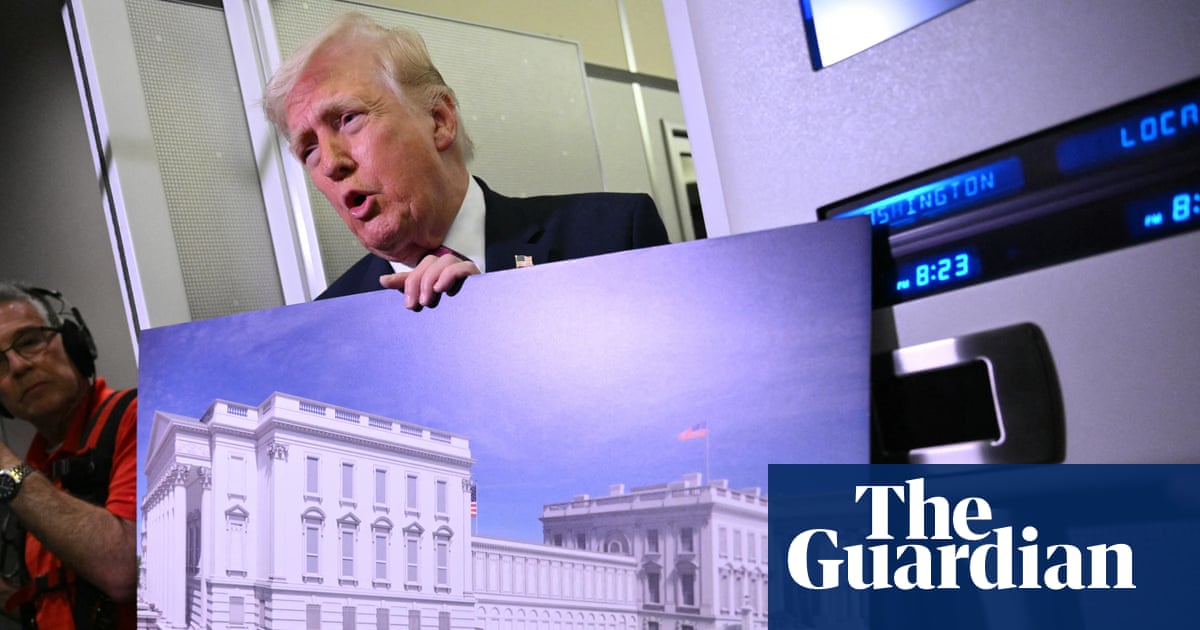
A judge’s order to stop construction work on the White House ballroom poses security risks, the Trump administration argued in an emergency motion that seeks to set aside the ruling.
The emergency motion argues that US district judge Richard Leon’s decision has left the executive mansion “open and exposed” and is “threatening grave national-security harms to the White House, the President and his family, and the President’s staff”.
Leon on Tuesday ruled that construction work on the White House ballroom must pause while a lawsuit works its way through the courts. The lawsuit seeks to halt the $400m project on the site of the recently demolished East Wing, with plaintiffs arguing that it needs approval from Congress to proceed.
Halting $400m White House ballroom project is national security risk, Trump officials say
“Time is of the essence!” the administration’s lawyers wrote in the motion, citing materials that will be installed to make a “heavily fortified” facility.
The ballroom construction also includes bomb shelters, military installations and a medical facility, according to the filing. The ballroom is part of Trump’s plans to remake Washington.
Search for missing US crew member of downed fighter jet enters second day
US search and rescue efforts for the missing second crew member of the downed F-15E fighter jet continued into a second day. A pilot had been rescued on Friday after the F-15E Strike Eagle became the first US plane to be downed over Iran during the five-week-long war, but the second of the two-strong crew has not been accounted for.
The US military had not had a jet shot down by enemy fire in more than 20 years – since a warplane was downed during the 2003 invasion of Iraq, retired air force Brig Gen Houston Cantwell told the Associated Press.
Federal judge halts White House effort to collect university data on applicants’ race
A federal judge on Friday halted efforts by the Trump administration to collect data that proves higher education institutions aren’t considering race in admissions.
The ruling from a US district court in Boston granting the preliminary injunction follows a lawsuit filed earlier this month by a coalition of 17 Democratic state attorneys general. It will only apply to public universities in plaintiffs’ states.
The federal judge said the federal government likely has the authority to collect the data, but the demand was rolled out to universities in a “rushed and chaotic” manner.
How will US prices stand as war in Iran surges on?
As consumers watch the price of gasoline and airline tickets rise, experts say that the war in Iran will continue to drive up prices across the economy.
“The good old days are gone,” said Christopher Tang, a professor at the UCLA Anderson School of Management who studies global supply chain management. “Right now we see the gasoline prices going up, but that is only part of the story. Everything will be more expensive.”
The price of oil has risen steadily since the war began at the end of February, with crude oil prices surging past $110 per barrel, this week. Fuel prices have risen in part because Iran controls access to the strait of Hormuz, a narrow passageway between the Persian Gulf and the Gulf of Oman where about 20% of the world’s oil travels through.
What else happened today:
-
Donald Trump appears to be on a quest to become the US president with the most things named after him. Less than 18 months into his second term, Trump has seen his name, face and signature daubed across government buildings, institutions and currency at an unprecedented rate.
-
As vice-president JD Vance prepares to travel to Hungary ahead of crucial elections, questions have begun to swirl as to why the US and Russia appear to agree on the need to keep Viktor Orbán in power.
Catching up? Here’s what happened on Friday 3 April.













Comments