
 German (DE)
  English (US)
  Spanish (ES)
  French (FR)
  Hindi (IN)
  Italian (IT)
  Russian (RU)
  4 hours ago
Billionaires raised fortunes against him. The president threatened to strip his citizenship. Mainstream synagogues slandered him as the spawn of Osama Bin Laden and Chairman Mao. But today, Zohran Mamdani became the first socialist mayor of New York City.
For all the hysteria, when I look at Mamdani, I didn’t see some radical departure from the past. I see him as the heir to an old and venerable Jewish tradition – that of Yiddish socialism – which helped build New York.
In some cases, the link is direct. Bruce Vladeck, a member of one of Mamdani’s transition committees, is a well-respected expert on Medicare, but for the sake of this article, his credentials matter less than his surname.
Vladeck is the great-grandson of Baruch Charney Vladeck, a Marxist troublemaker from the Pale of Settlement, a tract of land in the Russian empire where Jews were permitted to live at a time of rampant antisemitic oppression. Baruch showed up in New York after the failed Russian Revolution of 1905 with a Cossack’s saber scars all over his face. He later became a socialist alderman and member of Mayor Fiorello La Guardia’s housing administration. Vladeck was not actually his birth name. It was rather a nom de guerre, adopted when he joined the Jewish Labor Bund, the socialist, secular and defiantly anti-Zionist movement whose slogan, “here where we live is our country,” would make an apt tagline for Mamdani’s New York.
In our city, exiled revolutionaries like Vladeck found fertile ground. At the dawn of the 20th century, New York was home to nearly 600,000 Jews, making it the largest Jewish city on Earth, a title it still holds. They packed 10 to a room, into the squalid tenements of the Lower East Side, where they toiled in garment sweatshops, and where the fires caused by their in-home piecework businesses mirror those caused by the exploding lithium-ion batteries of e-bikes today. They soon transformed into a clamorous, disputatious and utterly radical proletariat – the same sort of constituency that powered Mamdani’s campaign.
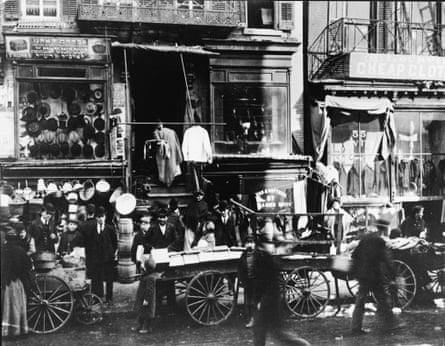
While New York’s Jewish communities are far too numerous, and far too fractious, to jam into one single story, there is still a narrative that gets spun. It goes like this. After the second world war, Jews made bank, assimilated into America, and fell in love with Israel. (Never mind the many communities this story leaves out – the booming, non-Zionist, utterly unassimilated Satmar community; the Jewish immigrants from the former Soviet Union; the dykes and freaks and commies and artists; Bernard Sanders. The list goes on.) The institutions associated with the narrative – the Anti-Defamation League, posh New York synagogues – have been Mamdani’s most virulent attackers.
The hysteria of this elite over Mamdani’s ascent would have seemed bizarre to so many of their great-grandparents. In New York at the turn of the century, Jewish workers created a secular, socialist, but specifically Yiddish world. By the time my own great-grandfather turned up in Ellis Island in 1904, this sort of socialism was alive on every Lower East Side street – in the mutual aid societies, debate clubs, picket lines, night schools, and the lectures that Jewish workers obsessively attended. Socialist Yiddish papers sold 120,000 copies a day. The socialist Workmen’s Circle attracted tens of thousands of members in hundreds of branches across America and educated thousands of children at their secular Yiddish schools. Two garment workers unions, led by former Jewish revolutionaries, represented more than 100,000 workers between them. And in 1912, the Yiddish, socialist newspaper The Forward constructed a beaux-arts skyscraper on the corner of Rutgers Square on the Lower East Side. “Where is the synagogue of our Jewish workers? Where is the temple of freedom, of equality, of brotherhood?” Forward editor Abe Cahan asked. That building was his attempt at an answer.
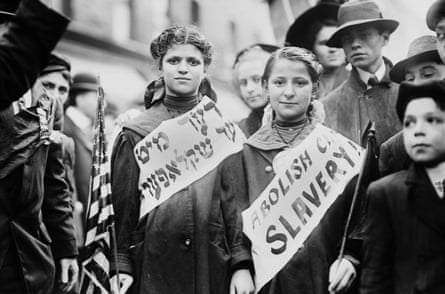
Cahan adorned the Forward Building’s facade with busts of Marx and Engels, but on the Lower East Side, socialism meant more than the words of these two men. It was the idiom of something broad, free and generous – the fight for a better and more beautiful world. To be a socialist meant to be a human, to affirm that there was more to life than the brutish quest for coin. Not just wages, but dignity. Not just bread, but roses too.
Or, as Mamdani’s first campaign for state assembly put it – “roti and roses”.
Today, just blocks away from the Forward Building is the New York office of the Democratic Socialists of America. Mamdani joined the group in 2017, and it continues to be his political home. The thick culture the DSA created – of picket lines and soccer leagues, educational lectures and political canvasses and dating nights – recalls that of its socialist forbearers. Over the last eight years, it has also built a formidable political machine. The DSA launched Mamdani’s bids for state assembly, then for mayor. When it came to door-knocking, they were his army.
Like the Jewish socialists of old, Mamdani grew his base with militant labor organizing. In 2021, when taxi drivers camped out in front of City Hall, to protest their murderous medallion debt, Mamdani was with them. He moved his assembly office on to the sidewalk, went on a 14-day hunger strike with the drivers, then danced with them when they won their debt relief. I remember the emotion in his voice when he shouted into the microphone: “This is just the beginning of solidarity. We are going to fight together until there is nothing left in this world to win.” Those words that could have echoed down Broadway 100 years before.
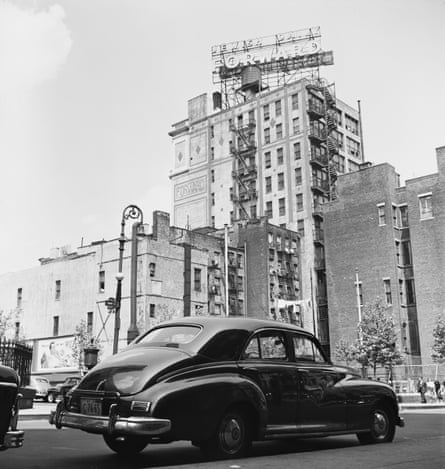
Like New York itself, Mamdani’s campaign was multicultural, multiracial, polyglottal. When Andrew Cuomo tried to bait him as un-American, he released ads in Spanish and Bangla, Hindi and Arabic. He ran a campaign devoted to class-first politics that sought to speak to everyone in their own idiom, while never once apologizing for who he was.
This too mirrors the tactics of New York’s old school Jewish left. They also lived and struggled in a diverse immigrant world – where their co-worker at the garment factory might be Italian, and where their uncle, the radical lawyer, would defend a boricua comrade from the cops. They also knew how to organize across difference.
As Ben Davis wrote in the Guardian this April: “Jews in New York voted in the hundreds of thousands for socialists for decades.” In the years before the first world war, Jewish districts in New York elected 10 socialist assemblymen, seven socialist city councilmen, and one socialist municipal judge. In 1914, these neighborhoods sent Jewish socialist labor lawyer Meyer London to Congress.
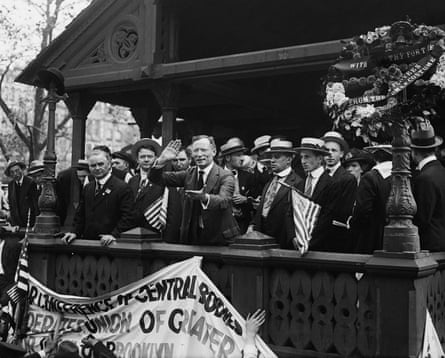
London was not a favored choice – not any more than Mamdani. He had once raised money for guns to fight the tsar. He denounced lynching and supported open immigration regardless of race, and opposed the creation of a Jewish ethnostate on the backs of Palestinians. Worst of all, he was hated by the Tammany machine, which sent thugs to the polls to gin up support for their favored candidate. But unionized garment workers turned the tables, canvassing, door-knocking and poll watching with a fervor that reminds me of the canvasses we Mamdani volunteers undertook on the murderously hot days before the primary. Then, and now, the socialists won their race.
Power concedes nothing willingly, and as socialists took political office, they fell ever more under siege. In 1918, London opposed attempts to create a Jewish state against the will of Palestine’s Arab majority. Furious, wealthy Zionists rallied against him, their denunciations likely costing him his election. (Billionaires such as Bill Ackman ran a similarly vicious, but blessedly futile campaign against Mamdani). With America’s entry into the first world war, jingoistic nationalism swept the country, leading to the arrests of socialist politicians, and the Palmer Raids that savaged the Jewish left. In 1920, five New York socialist assemblymen were expelled from office on accusations of disloyalty. Three of them were Jewish. During the Red Scare, and later, throughout the McCarthy years, the institutions of the Jewish left would be surveilled, raided and smashed. Partial as it was, this attempted erasure was effective enough that in the years 2025, Jewish institutions could bellow that Mamdani’s politics were foreign to their New York.
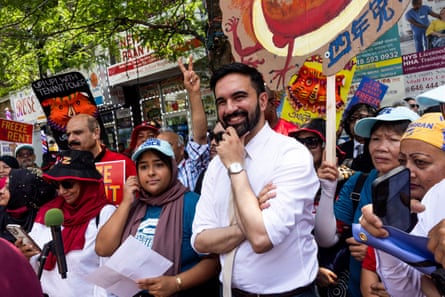
As Mamdani’s video team churned out content throughout his campaign, they sought to situate him in his city’s socialist legacy. Particularly moving were his history lessons, where he sat at a desk in the middle of the street and expounded on his political forbearers – like East Harlem congressman Vito Marcantonio, and the Yiddish-speaking, socialist birth control pioneer Fania Mindell. At the same time, he spoke in the idiom of today’s New York, with its neighborhoods of more recent arrivals. He went on Subway Takes and passed out sweets for Diwali in Jackson Heights, and showed up at the queer dance party Papi Juice to ask for votes. He honored the past, but found new voters in new coalitions, in a city that is ever in the process of becoming.
Throughout the election, Zionists tried to smear Mamdani as an antisemite. It didn’t work. Not even with these Zionists’ own children; according to one July poll by Zenith Research, two-thirds of Jews under age 40 supported Mamdani. There are many reasons for this, including the craven falsity of the charge, which had grown hollow from misuse; the moral anguish of witnessing Israel’s genocide in Gaza; and the fact that Jews, just like everyone else, want affordable rent, free childcare, and buses that are fast and free.
But another reason is this. Mamdani walks in an older Jewish tradition. Not that of ritzy Upper East Side synagogues, but of so many of our great-grandparents: the socialist sweatshop workers who fought for a better and more beautiful world.
-
Molly Crabapple is an artist and the author of the forthcoming book Here Where We Live is Our Country: The Story of the Jewish Bund, which will be published by One World Random House on 7 April 2026











Comments