
 German (DE)
  English (US)
  Spanish (ES)
  French (FR)
  Hindi (IN)
  Italian (IT)
  Russian (RU)
  3 hours ago
This article is a collaboration between the Guardian and Enlace Latino NC, an independent bilingual publication.
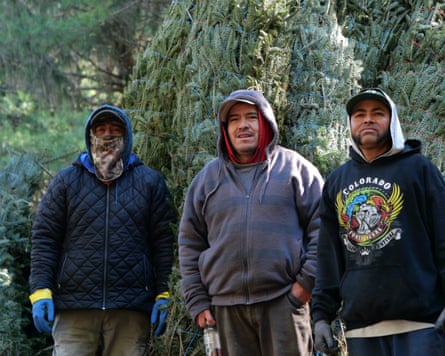
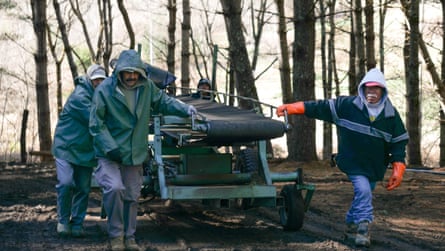
On a cold December afternoon, about 10 workers load the season’s final Christmas trees onto a truck at Wolf Creek Tree Farm and Nursery in Cullowhee, North Carolina. Nearby, another group takes a break, warming up around a barrel fire. More workers are out in the fields, a half-hour’s drive up further into the mountains.
It’s the last day of work for the 2025 season, and the air is relaxed, even merry. These men are here from Mexico as temporary agricultural workers under the H-2A visa program, and they will soon return home to celebrate Christmas with their families.
Nahuel Hernández Nabor has made the journey from Tlaxcala in central Mexico to western North Carolina for 26 years. He arrives each April, as caring for these trees is a yearlong job that requires weeding, fertilizing, pruning and administering pesticides. But the most intense work starts in November.
“Last week, we were working from seven in the morning to eight at night,” he told the Guardian and Enlace Latino NC in Spanish. “We cut the trees, tie them, carry them and load them onto the trailer.”
The hardest part, he says, is the time away from his wife and two children, a 19-year-old son and a daughter who is 17. He tries to phone them every day, but it’s not the same.
Even so, Nabor, 50, will probably return to the US next April. But he’s not sure. The US Department of Labor recently instituted new wage guidelines for H2-A visas that could cut wages by $5 to $7 an hour, saving employers as much as $2.5bn annually. The move is one of a number of changes that the Trump administration’s immigration policies have introduced this year that might reduce the number of H-2A workers who come to keep North Carolina’s Christmas tree industry going.
“We do it for the money,” Nabor said. “If it’s not worth it, then we’re not going to come.”
What it takes to grow the US’s Christmas trees
Nearly one of every four Christmas trees sold in the US comes from North Carolina, according to the North Carolina Christmas Tree Association. A key reason is the native Fraser fir, popular due to its natural pyramid shape, needle retention and strong pine scent. Nearly all the state’s 940 growers are in western North Carolina, where Christmas trees are the No 1 agricultural crop. In 2022, sales from more than 3m trees brought more than $144m to the state’s economy.
It’s difficult to know how many H-2A workers are propping up the Christmas tree industry. Leticia Zavala, co-coordinator of El Futuro es Nuestro (It’s Our Future), a worker-led non-profit supporting immigrant and guest agricultural workers in North Carolina, suggests it could be as many as 4,000 at peak harvest time.
The Beutell family have owned and run Wolf Creek Tree Farm since 1949 and have participated in the H-2A program since its creation in the mid-1980s. The largest temporary visa program in the country, it issued visas to 318,000 workers in the 2024 fiscal year. For all of the Trump administration’s rhetoric about replacing immigrant labor with Americans, in September, the Department of Homeland Security announced changes to the program designed to process H-2A visas more quickly. Experts say the move signals the administration’s recognition that US agriculture cannot operate without immigrant workers.
“We just don’t even consider any other type of labor force,” said Reneé Beutell, daughter of Wolf Creek’s founders and its current president. “We have some local people that come to work for us, but they usually don’t last any length of time.” (Beutell is a member of the Real Christmas Tree Board and the North Carolina Christmas Tree Association but spoke to the Guardian as an individual farmer.)
At Wolf Creek, the first group of immigrant workers for each season arrives in February. Christmas trees begin life in the nursery; two years later, they are transplanted into the field so they have room to grow. Once a tree reaches 4ft, it’s ready for yearly shearing to ensure the tree keeps its iconic shape. All told, it takes about eight to nine years to grow a 6ft-8ft Fraser fir – and many hours of care.

“Every year, it has to be sheared. It has to be mowed around. It has to be fertilized. We take soil samples every year to make sure that our soils will grow good Christmas trees. Unfortunately, we have to spray the trees,” Beutell said. Workers at other tree farms have experienced adverse health effects from pesticides and herbicides, especially if pressured by growers to work without waiting for the chemicals to disperse.
Such repetitive manual labor wears on the body, says Marianne Martinez, CEO of Vecinos, a non-profit that provides free healthcare to immigrant workers in western North Carolina. Vecinos staff frequently treat musculoskeletal issues like carpal tunnel syndrome, as well as vision problems from sunlight exposure and seasonal allergies.
Then there’s the mental health toll. “There’s a lot of isolation and psychological challenges, especially coupled with the fact that traditionally, our region has had really, really bad internet access,” Martinez said. Vecinos has installed hotspots at farms over the last six years to help workers connect with their families.
Even so, it’s a grind. “You get home just [in time] to cook your lunch for the next day, because here you have to cook for yourself,” said Margarito Salcido, who has worked at Wolf Creek for 13 years. “You cook, wash your clothes, and the next day at five [am] you’re up again preparing your lunch.”
Providing for families back home means sacrificing mobility and autonomy. The men live together in housing provided by their employers, who are also required to provide either laundry equipment or weekly trips to a laundromat, as well as trips to grocery stores and cooking equipment.
Isolation, language differences and having to rely on employers for basic transport and amenities means that these legal contract workers can be vulnerable to abuse. As the Guardian has previously reported, some employers withhold the food or appliances they’re supposed to provide or offer poor-quality meals. The contractor laborers work in extreme heat and cold. In North Carolina, Christmas tree workers have tried to organize in years past, saying they were underpaid, sickened by toxic chemicals sprayed on them as they planted trees and forced to work exceedingly long hours to make sure Christmas trees arrive in stores in the fall.
“It’s like being in prison,” Salcido said of working in the US in general and particularly during the grueling tree harvest. From October to early December, workdays are routinely 12 hours, often seven days a week. The men who come to plant trees in January and stay through the early winter look forward to year’s end and that one month when they return home. “When you get to Mexico, you feel different, like you’re free,” Salcido said.
The fear factor
While workers like Salcido and Nabor describe the work as a tedious necessity to earn a better living for their families back in Mexico, Roberto Ceballos sees it differently. Over 14 seasons, he has experienced everything on this land: he fell in love, studied law online and earned enough money to support his family in Durango, where he is close to finishing his own home.
This season, though, feels different. Even though the Trump administration has mostly avoided targeting agricultural workers and their communities, Ceballos has felt nervous. “We were seeing in the news that these ICE agents aren’t even respecting citizens or legal residents,” he said. “It made us a bit scared.”
Beutell has not noticed any ICE or border patrol agents in the area this season; Durham-based non-profit Siembra NC has no reports of such activity on their real-time map of ICE sightings across North Carolina. Still, she encouraged workers to have their documents ready anytime they left the farm, something that Zavala said many growers advised their workers to do. Zavala also heard reports that some workers were limiting their trips off the farm to Walmart or laundromats to try to ensure their safety.
Much of that fear, she said, comes from the sense that simply looking Latino can be enough to feel – or be – at risk, given the rise in racial profiling. “The immigration situation, and the new rules to lower wages, are both making many workers think hard about whether they will come back next year,” Zavala said.
The foremost concern for both employer and employees is the change to the wage guidelines. Beutell does not want to cut her workers’ wages, but she fears getting undercut by other growers who do.
“These guys work really, really hard,” Beutell said of her staff.
Ceballos hopes other growers, like Beutell, understand the value of experienced crews. “It wouldn’t be good business for them to start over with people they have to train from zero,” he said. But he also knows that it pays to plan ahead in such an unstable political landscape. “My intention is to keep coming here, and also to have a possible plan A, plan B, plan C for whatever might come,” he said. Some workers, he said, have even discussed going to Canada.
“We feel like what we do – our work – isn’t valued,” he said. “We’re an economic pillar for Mexico, but also for the United States, because part of what we’re paid we send to Mexico and part we spend here. So when our wage is cut, yes – we feel bad, we feel humiliated.”
Salcido was more blunt: “$11 [per hour] is too little.”
Zavala said workers face a significant power imbalance and deep industry volatility. Recruiters and growers often remind them that they are replaceable. “If you don’t come, there are 100 people in line waiting to come,” she said. And tariffs have shaken up US agriculture, even as the federal government has announced billions in one-time assistance for farmers affected by the very tariffs it’s imposed.
“There’s a lot of concern, a lot of uncertainty,” Zavala said. “We’ll have to see what comes next.”
The immigration Grinch
The region needs these workers and this industry, as it still recovers from the damage Hurricane Helene brought in September 2024. While rising costs of equipment and the growing market for artificial trees are ongoing existential threats to the industry, few changes could have as much impact as a drastically reduced workforce. Even though growers have reported a strong growing season, at least one farmer asked the public for patience on his choose-and-cut lot, as he has struggled to find labor.
“If we were … to never sell one more Christmas tree because there are no more coming out of the field, that would be a devastating blow to our regional economy,” Martinez said. But she also noted that it would have a ripple effect beyond North Carolina: Wolf Creek alone ships trees as far away as Idaho and Texas.
“We provide for the entire country,” Martinez said. “It would be like the Grinch.”
















Comments