
 German (DE)
  English (US)
  Spanish (ES)
  French (FR)
  Hindi (IN)
  Italian (IT)
  Russian (RU)
  3 hours ago
Vanessa Martinez used to work two jobs to make ends meet. Now she works three.
In another era, the 26-year-old from California’s hardscrabble Central valley could have been a poster child for the American Dream, the sort of ambitious, up-by-her-bootstraps personality that politicians of both major parties like to highlight.
Forced to fend for herself from the age of 18 and with no family money to fall back on, Martinez put herself through cosmetology school so she could work as a hairdresser. Now she’s studying again to qualify as a funeral director.
When she’s not cutting hair, she has a job picking up bodies for a funeral home and another helping a large building company line up its subcontractors.
Still, it is not enough, because the federal student grants she thought she could rely on have dried up and her government health insurance coverage is in danger of disappearing, too. Meanwhile, the price of day-to-day living – rent, groceries, fuel, and repayment of her student loans – keeps going up.
“I’m making the most I’ve ever made, and I’m probably the brokest I’ve ever been,” she said.
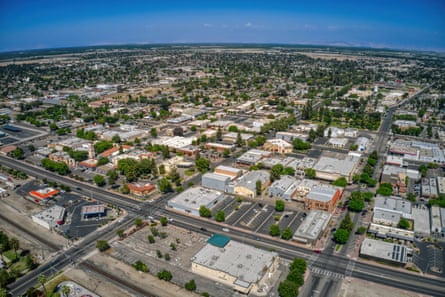
Martinez lives in one of the poorest and, this year, most competitive congressional districts in the country, California’s 22nd, and both parties have been courting voters like her aggressively. Her county, Tulare, voted for Donald Trump by a margin of 59% to 38% over Kamala Harris in 2024, thanks in part to the district’s majority Latino population, which shifted markedly to the right in the hope of seeing their economic fortunes improve.
Polls now show that Trump’s popularity has fallen as dramatically locally as it has nationally – one, taken earlier this year, showed his approval ratings in the district underwater by 15 percentage points. Democrats in California have also redrawn the electoral map to tilt more in their direction. But that does not necessarily spell defeat for David Valadao, the incumbent Republican congressman, who has overcome a registration advantage for the Democrats in six of his last seven elections.

Valadao likes to tell voters that he is a proud native son of the valley and an even-tempered pragmatist who works collegially with both parties to bring federal dollars to the district. Yes, he conceded in a candidates’ debate last week that the Iran war has caused a temporary, painful spike in prices, starting with the price of gas, which in Tulare now averages more than $6 a gallon.
But he suggested that the war would be over soon, and argued that the surest way to bring prices down was through deregulatory measures that he and his fellow Republicans champion to increase the supply of food, oil and gas.
Valadao’s Democratic challenger, Randy Villegas, has a dramatically different viewpoint, one that bucks the received wisdom that valley voters prefer their politicians moderate and soft-spoken. The entire political system is corrupted by corporate money, he says, and will never deliver for the agricultural, heavily working-class Central valley unless it is reformed from the ground up.
“The valley has been left behind by both parties, in Sacramento and in Washington DC,” Villegas says. “We deserve better than the scraps these politicians give us.”
Villegas is also a native son, who started out working in his family’s car repair shop in Bakersfield, the district’s biggest city, before pursuing an education and becoming a community college professor. He sees nothing moderate in Valadao’s recent voting record, which includes casting one of the decisive votes for Trump’s One Big Beautiful Bill Act with its $1.1tn in tax cuts and steep reductions in government healthcare and other public assistance programs.
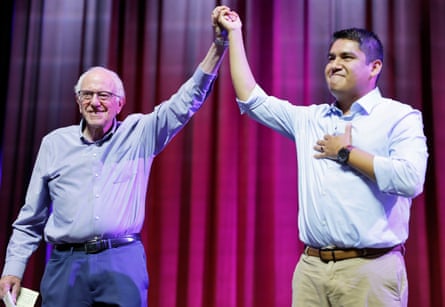
“There’s nothing moderate about ripping health insurance from 70,000 of his constituents,” Villegas thundered at a crowded rally in Bakersfield last weekend, where he shared a stage with Bernie Sanders, the progressive Vermont senator. “There’s nothing moderate about voting six times to approve the war in Iran. There’s nothing moderate about tripling ICE’s budget …”
Villegas’s fighting spirit resonates with Martinez, because she, like many valley residents, feels she has hit a breaking point. Her brother, who also works in the funeral business in Tulare, voted for Trump all three times that he ran for the White House. But she feels that was always asking for trouble.
Voters who put their faith in Trump, she said, especially Latinos, were “licking the boot that will stomp them” and paying the price now.
A few weeks ago, Martinez lost a federal Pell grant that previously paid for her community college classes. She is alarmed and demoralized by immigration enforcement raids that are breaking up families all over the district – an issue with particular resonance for her as her construction worker father was caught without papers and deported to Mexico in 2015.
Now she is afraid of being kicked off Medi-Cal, California’s version of Medicaid, and having to pay out of pocket for the chronic diabetes she has lived with since she was 15. Type 2 diabetes is a widespread condition in the Central valley, especially among working-class Latinos, who often cannot afford the fresh fruit and vegetables grown in the region in great abundance. She lost her mother to the disease at 62.
“I’m in the funeral industry, and I’ve seen the death certificates,” Martinez says. “There’s a lot of cancer, especially among farm workers exposed to pesticides. And a significant number have diabetes. You see it again and again in box 14, which lists underlying conditions … It’s cheaper to go to McDonald’s and eat a $5 meal than to make a salad at home.”
Medi-Cal has hardly been a smooth ride for Martinez – she likened it to being served cereal without milk. She says she had to fight for two years before the program would reimburse her for needles for her insulin shots. She continues to fight for test strips to monitor her blood sugar. Now that she is in danger of losing her coverage altogether, she is stocking up on medication and getting her lab work up to date.
It’s an approach that thousands of valley residents are taking as they remain unsure if they will keep or lose their coverage in the coming months. California’s 22nd has the highest percentage of Medicaid recipients of any congressional district in the country – close to two-thirds – and clinics report being inundated with appointment requests.
Even doctors and health administrators say they have no idea who will stay covered – Villegas’s figure of 70,000 losing benefits is just one of many estimates. “There are a lot of unknowns,” said Raul Ayala, a medical director with the Adventist Health network of clinics. “These patients may be in cancer treatment or awaiting surgery … I’m pretty sure there are going to be exceptions, but I don’t know how that is going to turn out.”
Ayala and other experts expect cuts to Medicaid to deter people from seeking mammograms, blood tests and other wellness checks in a district where doctors are already in short supply and preventive care is an area they have spent years fighting to improve. Hospitals now expect to see a lot more routine cases coming through their emergency rooms, which by law cannot turn away patients whether they have health insurance or not.
“All of that puts a strain on patients, but also on the business side of healthcare,” said Jevon Price, who serves on the county healthcare board in Tulare. “We’re telling hospitals: prepare to not be funded for what we will be requiring you to do.”
If Valadao does lose his seat, political observers say healthcare is likely to be the decisive issue in a year when Republicans are on the defensive all around. Villegas is certainly pushing the issue as hard as he can. “Nobody should have to fight cancer and their congressman at the same time,” he tells audiences.
In response, Valadao’s campaign has sought to paint Villegas as a far-left candidate out of step with local sensibilities. When Mike Johnson, the speaker of the House, swung through the district late last month, he declared: “The Marxists are on the march to our institutions. And now the institution they have in their crosshairs is the United States Congress.”
Such rhetoric works with Republican partisans, an outspoken and significant segment of the district electorate. “Villegas will tax you dry,” warns a homemade sign stapled to an electricity pole in Hanford, the town where Valadao grew up as a dairy farmer and still lives.

Other, less ideological voters say the most immediate differences between the two candidates are in style and energy. Valadao, far from a natural public speaker, has not held an in-person town hall in over a decade and tends to prefer closed-door meetings with constituents and donors. Villegas, by contrast, has an easy touch with voters, whether he is knocking on their doors, as he often does between events, or addressing hundreds of them at once. His campaign knows turnout will be crucial in a district where many working-class voters are disengaged from politics – it’s more common, in smaller towns, to see a Jesus placard than a lawn sign for a congressional candidate – and need a reason to see this election differently.
“Randy is the hardest-working candidate we have ever worked with,” said Jorge Contreras, state director of the Working Families party, which is championing Villegas and four other progressive congressional candidates in California in November’s general election.
Villegas defines himself as a populist, not a leftist. He refuses to take corporate political action committee money, even if it means relying on individual donations averaging about $50 – or alienating the Democratic party establishment. Jasmeet Bains, his more conventionally centrist primary challenger who lost despite being championed by the party leadership in Washington, has yet to endorse him.
“I’m running on the power of the many against the power of their money,” Villegas says. “The Democrats should be the party of the working class. And the only way we transform that is by electing leaders who stand up for the working class and for working people.”
Villegas has Martinez’s vote, but she worries what might happen if he does end up in Washington. Valadao, she remembered, also campaigned as someone who would fight hard for the valley’s interests, only to succumb to pressure from his party to approve the war in Iran, trade tariffs, and other Trump policies linked to the sharply rising cost of living.
“A lot of politicians get into this because they want to make a difference,” she said. “I don’t know what changes them.”
Martinez is sanguine about what she can expect for her own future – a job with health insurance, perhaps, but not home ownership, which feels entirely out of reach now that coastal Californians stung by dizzyingly high housing costs in Los Angeles and San Francisco are moving inland and pushing prices higher in communities like hers.
Her expectations of a member of Congress are similarly muted. “I want someone who can at least fake that he cares about us,” she says, only half joking. “My friends and I know what’s at stake … I’m really hoping Randy Villegas is the change we want.”














Comments