
 German (DE)
  English (US)
  Spanish (ES)
  French (FR)
  Hindi (IN)
  Italian (IT)
  Russian (RU)
  2 hours ago
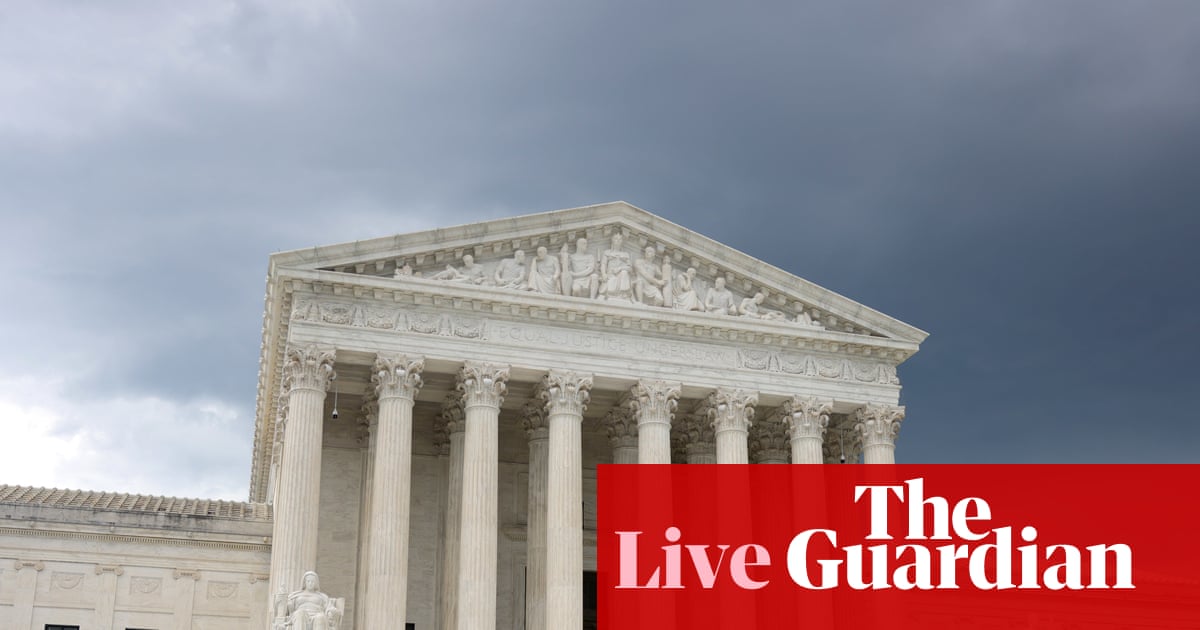
On Thursday, the US supreme court authorized the Trump administration to end Temporary Protected Status (TPS), facilitating the largest single assault on immigrants in contemporary United States history.
While the case concerned the 350,000 Haitian and 6,000 Syrian holders of this status, the decision could expose more than 1.3 million people to potential deportation to countries that the United States has recognized as unsafe.
This act is the cruelest component of a growing strategy in the Trump administration’s ethnic cleansing agenda, one that is increasingly being facilitated by a conservative supreme court – the cancelling of statuses that were once legal.
TPS became law in 1990, under George HW Bush, to fill a gap left by the narrow legal definition of asylum, which is limited to people who have a “well-founded fear of persecution” on the basis of “race, religion, nationality, membership in a particular social group, or political opinion”.
People fleeing other dangers, such as those whose countries are embroiled in ongoing armed conflict, environmental disasters, or pandemics, cannot secure asylum under this law. They also cannot be sent home, as the country by law cannot send people to their persecution or death – a principle called non-refoulement.
TPS, designated by country of origin and renewable for six, 12, or 18 months, offers its holders protection from deportation and work authorization, but not a pathway to residency.
However, due to rising environmental degradation, inequality and continued military belligerence (including by the United States), administration after administration has renewed these designations year after year: Haiti’s TPS has been renewed for the past 15 years (since the country’s 2010 earthquake), El Salvador for 25, and Somalia for more than 35 years.
As a result, people built lives here and raised their children – Yemeni TPS holders, as one judge pointed out, run half of New York’s bodegas.
Donald Trump’s former homeland security secretary, Kristi Noem, however, tried to terminate TPS for 13 countries.
Judges in the lower courts fought these terminations, arguing that they had nothing to do with the legal basis for the protection.
Just before TPS was set to expire for Haitians, in February, judge Ana Reyes argued that while the executive had discretion regarding renewing TPS, it was not unbounded – officials had to follow a process to ensure they weren’t sending people to their deaths.
She argued that the motivation exhibited by the administration was racial animus, including in her scathing 85-page decision a screenshot of a social media post in which Noem recommended to the president a travel ban “on every damn country that’s been flooding our nation with killers, leeches, and entitlement junkies”.
Even as the United States government claimed it was safe for Haitians to return to Haiti, the judge wrote, the US maintained a “Level 4: Do Not Travel” advisory for the country due to “crime, terrorism, kidnapping, unrest and limited healthcare”.
In its 6-3 decision this week, however, the supreme court argued that TPS could be decided on the whim of the executive, and that the judiciary could not act to stop them.
Justice Samuel Alito went so far as to write that presidential statements about Haitian immigrants – Trump has made the false and baseless claim that they eat dogs and that immigrants are “poisoning the blood” of the nation – are not “overtly racial” but rather “expressed policy views that could rest on race-neutral justifications”.
This decision leaves our neighbors – people who contribute over $29bn to the US economy, in addition to nearly $8bn in taxes, who pay into systems they cannot use because they are ineligible for public assistance – exposed to an ever-expanding, for-profit mass deportation regime.
They are left at the political whim of people who openly hate them, who slander them from the most powerful pulpits in the nation.
And they are not the only immigrants who find themselves staring off a cliff into an abyss of impossible choices.
The attack on TPS comes amid the total decimation of our asylum system.
after newsletter promotion
In another 6-3 decision on the same day, the supreme court allowed the Trump administration to block people from entering the US at the Mexico border while they apply for their asylum.
Meanwhile, domestically, courts are “pretermitting” asylum seekers with strong claims, or ordering them removed without a hearing, and sending them to third countries to have their claims heard there.
Pathways to residency are narrowing as new nonsensical policies demand that people return to their countries of origin to apply for green cards, or make it difficult for people who are pro-Palestine to secure residency.
Travel bans make it so that if people were to return home – a requirement to adjust legal status in a lot of cases – they wouldn’t be able to return to the United States.
By some estimates, we are anticipating a 30%-55% reduction in legal migration as a result of these policies, and a dramatic expansion of targets for the torture, family separation and psychological damage of ICE detention.
The attack on TPS reveals the absurdity of a talking point that has long defined immigration debates, summarized in the question of: “Why don’t people just come here legally?”
It shows that what is “legal” and “illegal” is a political construct by the people in power, a reflection of whose lives are valued and whose lives are not.
The lack of protection built into the design of TPS is the original sin: there should always have been a pathway to residency and citizenship for people who make their lives here in our communities, regardless of how they came. People’s lives should never be left up to political whim.
The Senate can immediately act to protect TPS, passing the bill – which has already passed the House with bipartisan support – that defends the status for Haitians. But we need to do better than that.
There needs to be immediate action by Congress to create pathways to residency for holders of this status, to intervene in the catastrophe that will unfold if over a million people are pushed into undocumented status, and quite possibly to their deaths.
-
Heba Gowayed is an associate professor of sociology at Cuny Hunter College and Cuny Graduate Center and author of the book Refuge: How the State Shapes Human Potential














Comments