
 German (DE)
  English (US)
  Spanish (ES)
  French (FR)
  Hindi (IN)
  Italian (IT)
  Russian (RU)
  1 hour ago
First, American forces would strike with poison gas munitions, seizing a strategically valuable port city. Soldiers would sever undersea cables, destroy bridges and rail lines to paralyze infrastructure. Major cities on the shores of lakes and rivers would be captured in order to blunt any civilian resistance.
The multipronged invasion would rely on ground forces, amphibious landing and then mass internments. According to the architects of the plan, the attack would be short-lived and the besieged country would fall within days.
The target was Canada, part of a classified 1930 strategy – War Plan Red – for a hypothetical war with Great Britain where the US would seek to deny it any foothold in North America.
But the invasion plans, once dismissed as a fumbling historical quirk, have taken on fresh relevance as the US pivots its foreign policy to an increasingly aggressive view of its “pre-eminence” in the western hemisphere and turns its sights on both foes and allies.
In early January, the fusion of economic nationalism and belligerent foreign policy championed by Donald Trump was on full display when his government ordered the capture of Venezuela’s president, Nicolás Maduro, and the US president announced on social media the US would seize control of the South American country’s oil. Days after, both Trump and prominent officials spoke openly of using military force to invade and capture Greenland for its strategic position and its immense mineral wealth. In late January, the Globe and Mail reported that Canada’s military had modelled a hypothetical invasion of Canada, suggesting guerrilla tactics, similar to those used to repel both Russian and US forces in Afghanistan, would supplant conventional war.
With declarations from US officials that regional dominance is their main geostrategic objective, threats from Trump that he intends to annex Canada have rattled the country. Last year, Trump said the centuries-old border between the two nations was no more than an “artificially drawn line” that, with force and persuasion, might be redrawn.
“Somebody drew that line many years ago with, like, a ruler – just a straight line right across the top of the country,” Trump told Canada’s prime minister, Mark Carney – adding a unified continent was “the way it was meant to be”.
On 20 January, Trump posted an altered image on his social media account that features the US flag covering Canada, Greenland and Venezuela.
His comments, condemned by Canadian lawmakers, nonetheless exposed a deep and persistent anxiety that the country, despite decades of tight economic integration, remains vulnerable to US aggression.
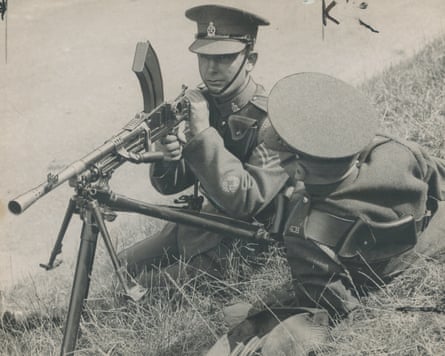
War Plan Red, first devised in 1927 and then approved in 1930, was drawn up amid fears from American military planners that Britain could launch a war against the US where Canada would be the most likely theatre for battle. US planners conceded that if they lost, Canada would “demand that Alaska be awarded to her”. But the plan highlighted both how Americans believed Canada, with the vast majority of its citizens clustered along the shared border, would fall quickly – and the broader flimsiness of political alliances.
“I’ve always felt that Canada was this incredibly ‘ridiculous’ country, geographically and demographically – and this makes us one of the most vulnerable states in the world,” said Thomas Homer-Dixon, a Canadian conflict researcher. “We’ve been critically dependent on the friendship and benignness of the United States, and all of a sudden, both those things have just disappeared. They’ve vanished and I worry that only now Canadians fully appreciate what this means.”
Homer-Dixon, who runs the Cascade Institute, a Canadian thinktank that studies global crises, says battle designs such as War Plan Red underscore fears within Canada of its continued vulnerability to US military action.
After seizing Venezuela’s president in a brazen night-time attack, the focus of the Trump administration shifted to Greenland, a territory controlled by Nato ally Denmark.
“We need Greenland from the standpoint of national security, and Denmark is not going to be able to do it,” Trump told reporters on Air Force One. His vice-president, JD Vance, also chimed in on the issue, telling reporters that Denmark “obviously” had not done a proper job in securing Greenland and that Trump “is willing to go as far as he has to” to defend American interests in the Arctic.
Homer-Dixon says the pursuit of Greenland – where the US already has the unfettered ability to build military bases – represents “outright avarice and greed” from the White House. “It is a vanity project because there’s absolutely zero security justification for this,” he said.
With Canada, Homer-Dixon warns Trump and his allies could deploy a sustained campaign to “demonize” Canada by warning the 5,500-mile (8,850km) border has grown increasingly lawless and drugs are “pouring across” in order to shift how Americans perceive of their northern neighbour. Alternatively, he worries that a fledgling secession referendum in Alberta could fail but Trump could argue the results were “fake” and the US would move troops to the northern Montana border and tell the rest of Canada that Alberta must be allowed to join America as the “51st state”.
Last year, the then prime minister, Justin Trudeau, warned business leaders Trump’s threats to annex Canada were a “real thing” and the president wanted to access the country’s critical minerals.
“Canadians need to understand that our neighbour has desires and ambitions and goals under the current administration that no other administration in American history has had,” Bob Rae, Canada’s former ambassador to the United Nations, recently told the Globe and Mail, calling the threats “existential” to Canada’s future.
A 2025 poll found that 43% of Canadians believed a military attack by the United States within five years was at least somewhat likely, with 10% deeming it highly likely or certain. Calls for a “whole-of-society” response have grown and in May, a directive signed by Canada’s chief of the defence staff outlined how the military could train federal and provincial employees to handle firearms, drive trucks and fly drones in order to bolster the country’s supplementary reserve. The Canadian military currently has 4,384 personnel in its supplementary reserve, which is largely made up of inactive or retired soldiers. But the Canadian Forces suggest new plans could boost that figure to 300,000. The Cascade Institute also released a plan that suggests a “bare-bones” national service program could be delivered for C$1.1bn, with a more robust plan costing C$5.2bn.
Homer-Dixon said that in addition to funding a civil defense, Canada needed to both deepen its relationship with Scandinavian allies and to adopt their longstanding approach: “If you attack us, you may ultimately succeed, but it’s going to really hurt.
“At the end of the day, we spent decades building a deep economic, social and cultural relationship within a country that can change its character very quickly. Economists told us integration would make two countries incapable of harming each other,” said Homer-Dixon. “But this idea of ‘might makes right’ has always been this recessive cultural gene of the United States. And we fooled ourselves into thinking it had gone away. But it has re-emerged to the surface because it never left.”














Comments