
 German (DE)
  English (US)
  Spanish (ES)
  French (FR)
  Hindi (IN)
  Italian (IT)
  Russian (RU)
  12 hours ago
It took all of two minutes for Bobby Pulido’s electoral stealth weapon to come into play. The Tejano music star turned Democratic congressional candidate had barely begun canvassing in the high school football stadium in Edinburg, Texas, when a 15-year-old girl came rushing up to him.
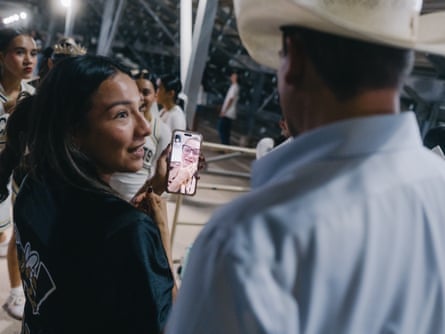
“Señor Pulido! Señor Pulido!” she cried. A few months ago, she told him, he had made a surprise appearance at her quinceañera, the coming-of-age girls’ 15th birthday party that is a rite of passage in these US borderlands.
He had serenaded her with Desvelado, his blockbuster love song, which though released three decades ago retains a treasured place in Tejano – that is Hispanic Texan – culture.
The brief encounter gave a glimpse into one of the key dynamics of Pulido’s bid to flip Texas’s 15th congressional district. He calls it the “quinceañera strategy”.
The tactic was handed to him, inadvertently, by his rival, the two-term incumbent Republican congresswoman Monica De La Cruz. In March, she posted a video deriding her opponent as a lowly quinceañera singer.
The election, she said, “isn’t about who you want performing at your niece’s quinceañera. It’s about who you trust with your family’s future.”
Pulido pounced. He counter-posted his own video in which he accused De La Cruz of belittling a cherished local tradition and encouraged families in the district planning a quinceañera to invite him. “I’d be honored to stop by and celebrate with you,” he said.
Within 24 hours, Pulido’s campaign had been inundated with over 1,000 invitations. By the time the Guardian went canvassing with him in September, that number had surpassed 5,000.

He has now performed at 81 quinceañeras and counting. Each one is attended by scores of family and friends, most of whom are eligible voters and many of whom livestream the event on their smartphones, broadcasting it to additional scores of eligible voters.
“She presented us with an opportunity for a very unique kind of field plan,” Abel Prado, Pulido’s campaign manager, said.
The ‘quinceañera strategy’
Pulido, 53, is hoping to convert the quinceañera strategy and the rest of the tireless retail politics that he is doing into a winning political formula. His mission: to take back the congressional seat, and in the process both help the national Democratic party regain control of the US House and teach it a lesson or two about Mexican American politics.
Much is riding on his success.
It’s not just that flipping Texas 15 could give Democrats the edge they need to take back control of the House of Representatives. The stakes are also huge for the Rio Grande Valley itself, the overwhelmingly Hispanic border region in south Texas that for over a century was solidly Democratic but swung hard for Donald Trump in 2024.
Trump won the district, which is 81% Mexican American and which runs for over 300 miles from the border to San Antonio, by 18 points.
How Pulido fares in the November midterm elections could have ripple effects for fellow Democrat James Talarico’s currently neck-and-neck fight for a US Senate seat against the state’s scandal-ridden Republican attorney general Ken Paxton. Talarico’s chance of success is also heavily dependent on Latino turnout.
And in the widest sense, Pulido’s message has bearings on the national Democratic party as it debates how to counter the dramatic inroads made by Trump two years ago when he smashed records and garnered 55% of Texas’s Hispanic vote.
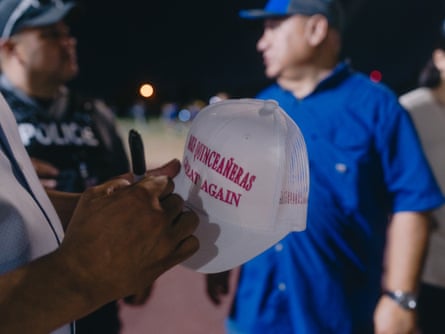
Pulido made sure to display his Tejano stripes as he strutted around the Edinburg stadium, while cheerleaders and a marching band filled the night air with colour and noise. Dressed in jeans and denim shirt, cowboy boots and hat, he moved confidently through the crowd of high-school football fans.
He shook the hand of everyone he met, chatting to supporters on both sides of the bleachers – a calculated move as both high school teams, Sabrecats and Yellowjackets, are in the 15th district. (The Sabrecats won 31-14.)
And yet almost everyone in attendance was too young to vote – so what was the point?
“To win re-election,” Pulido quipped, without missing a beat. Then, with more reflection, he added: “If you treat kids good, their parents will like you.”
Pulido has a catchphrase: “Any occasion, big or small.” He means it. The football game was the 526th campaign event he had attended in person. His record is 12 such stops in a single day.
When Pulido sat down to talk with the Guardian, he emphasised accessibility was a critical element of his campaign. It’s his answer, he said, to the increasingly polarised left-right media bubbles that keep voters divided.
“The only way I can break through is to actually get in front of people the old-fashioned way. Then people can hear me. They can look me in the eye, and decide for themselves whether I’m full of shit or not.”
Direct connection with voters also Pulido, who has roots stretching back seven generations in the Rio Grande Valley, allows him to play his ace card: his near-universal name recognition in the region.
Desvelado (“sleepless”) was his first, and is still his biggest, hit – the 1995 album of the same name went platinum, and the song has been played 615m times on Spotify. He has won two Latin Grammys for best Tejano album; the day before we met he celebrated yet another nomination for the award, for Una Tuya, Una Mía, Vol 2.
If the massive popularity of Desvelado gives him an entree with younger and middle-aged Tejanos, he can count on his father to grab the attention of older voters. José Roberto Pulido, 75, is a Tejano music star in his own right, having enjoyed a large local following in the 1970s and 80s.
In Pulido’s analysis, Trump lured so many of these Tejano voters away from the Democratic party in 2024 because he spoke to their longing for the American dream. There’s a popular phrase in the valley: “We know we’re broke, but don’t tell us we’re poor.”
Pulido said: “If you’re poor, you’ve already lost; if you’re broke, you could still make it one day. Trump kind of won because of that message. ‘Look at me, I’m rich, and some of my richness will transfer to you’ – that was music to people’s ears.”
Trump’s promise to close the US-Mexico border also spoke to many people in the valley. The disruption caused by record numbers of undocumented immigrants crossing into the US during the Biden administration was especially felt in this frontier zone, and many Tejano US citizens bridled against it despite their own immigrant heritage.
“Under Biden, the border was chaotic,” Pulido said. “The tent cities, the visible hardship, so many coming across.”
Since the return of Trump to the White House, however, Pulido believes that the president has squandered much of that goodwill. Immigration and Customs Enforcement (ICE) has made Texas the ground zero of its mass deportation efforts, notably so given the central position the state commands within Trump’s Maga universe.
Figures compiled by the Deportation Data Project show that ICE made 12,086 arrests in July in Texas. That was almost twice the number in the next most intensely targeted states, Florida (7,405) and California (6,464).
Pulido is convinced that Trump will pay a price in November for this blanket assault on Texas immigrants. “People are angry, ICE enforcement is splitting up families and spreading fear. And it’s hurting our economy. There’s not a building in the Rio Grande Valley that was put up without immigrant hands. None.”
He added: “There is a reckoning coming, that’s for sure. I see it. We’ve polled it. People don’t like what the Republican party is doing.”
The most recent survey of the 15th district, from Texas Southern University, puts Pulido five points ahead of De La Cruz (50% to 45%). Among Latino likely voters, the gap widens to 25 points (60% to 35%).
“This election is showing that the Trump bubble is burst,” the co-author of the opinion poll, Mark Jones, professor of political science at Rice University, said. “We did see a temporary shift towards Trump among Latino voters, but now we’re coming back to a more standard status quo.”
The Guardian spoke to several 15th district voters who two years ago enthusiastically cast their ballots for Trump yet who have grown disaffected and disillusioned.
Yajaira Martinez, 43, is a naturalized citizen who came to the US from Mexico when she was six. In 2024, she voted for Trump because she believed his promises about bringing down prices and improving the economy, and because she supported his desire for a stronger border.
She heard him pledge to remove undocumented immigrants with criminal records. “If you want to take the criminals out of the country, by all means go ahead,” she said.
But she did not expect the ICE dragnet of hardworking people trying to make a go for their families. She knows several people who have been deported even though they had legitimate work permits.
“ICE is breaking the law, they are assaulting, they are chasing down. They are terrorising. This administration doesn’t care about anybody’s rights.”
Juan Cantu, 66, was born in Mexico but lives in the US, and as a naturalized citizen is entitled to vote. He makes an income both as a cabinet maker and rancher.
He voted for Trump in 2024 because he was fed up with Democrats talking about social issues such as abortion and trans people using women’s bathrooms, and he thought Trump would be on his side as un trabajador, a worker.
But he’s been appalled as he watches “the politics of Trump spinning out of control, harming so many working people”. The Iran war, which he said he does not understand, and tariffs has pushed the diesel that powers his tractor to $6 a gallon, and that’s a problem.
As for Pulido, Cantu likes his father’s Tejano music. “That’s the music of my epoca,” he said. And he warms to the candidate’s politics. “From what I’ve heard, he wants to help the poor, the working people.”
He will vote for Pulido.
Juan Pablo Lopez, 41, a first-generation Mexican American born in the US, is the owner of a real estate and construction company in McAllen. He voted for Trump because he liked the way he spoke the language of business.
In the past year, though, it’s turned sour for Lopez. He estimates that about 60 of his co-workers and friends have disappeared, rounded up by ICE and detained then deported.
He said he has come to conclusion that Trump is not the friend of Tejanos. “Everybody here believed in him, and instead of helping us, he’s hurting us.”
As for his vote in November, it’s complicated. Lopez said he likes Pulido. “I was born and raised with his music. He’s a family guy, and I like that he’s very conservative.”
What he doesn’t like is that Pulido is running as a Democrat, a party he thinks has a “Robin Hood mentality”. “They take from the rich to give to the poor – let’s give everybody food stamps, let’s make sure everybody’s on housing. I’m a hardworking American.”
That leaves him in a bind. “I’m faced with a very hard decision of who I’m going to vote for. I don’t want to vote Democrat, but look at what Trump has done to us.”
It’s Pulido’s challenge to overcome the hesitation of voters like Lopez. He must harness their patent anger towards Trump’s handling of immigration and the economy, and persuade them that not all Democrats are leftist progressives.

As he faces this challenge, Pulido is careful to emphasise his conservative convictions while avoiding talking in party political terms. The race is not about Democrat versus Republican, but about Bobby versus Monica.
“I do not mention blue waves. Not ever.”
There is a populist side to Pulido’s politics that bears comparison to Bernie Sanders. He denounces “crony capitalism” and demands that corporate money is removed from US elections.
Pulido doesn’t have health insurance because “it’s not worth it”.
“I should not feel obligated to feed those monsters. Health insurance companies get away with it, and doctors can’t even be doctors any more,” he said.
Beneath the populist patina, his innate cultural conservatism – typical of this border region – is glaringly apparent. He is a man of faith, and is personally opposed to abortion though his policy is that he would not impose his views on anybody else: “Pro-life is a choice too. It’s my choice,” he said.
He opposes restrictions on oil and gas extraction, including fracking, as they account for a significant proportion of the Valley’s jobs. He wants the border to remain locked down even after Trump has gone, though he wants that to be done humanely.
There’s no doubting his support of the second amendment. He named his son Remington, after the Remington 700 bolt-action rifle that he loves.
If you described a politician with that set of convictions to a person in Brooklyn or Santa Monica they might assume he were a moderate Republican. So what makes him a Democrat?
“I’m a Democrat because I lead with my democratic heart,” he said. “I understand that there are people out there who need help, and that it’s my obligation as a Catholic and as a Christian to do what I can to help my fellow neighbor.”
In all this, there is an implicit criticism of the national leadership of the Democratic party and what he regards as its coastal elite prejudices.
“In music, you have to know your audience. I’m smart enough to know that you don’t take a symphonic orchestra to the dance hall – people want to dance. But that’s what my party is doing, taking the east coast and west coast politics of the liberal elites and bringing them to where they do not resonate.”
Warming to the theme, he said: “What plays well in New York City likely won’t play well among Democratic voters in the valley. The party has become too one-size-fits-all, and that’s a big mistake.”
His main takeaway from his months running for congressional office is that Democrats “let other people define us”.
“When I first told people in this district that I was running as a Democrat, their automatic assumption was that I was going to take away their guns, that I was for trans in women’s sports, that I was going to take away their oil and gas jobs,” he said. “That’s the narrative they were fed by Republicans.”
As the 3 November election gets closer, and the temperature of the race rises, De La Cruz has tried to stall Pulido’s advance by hitting him with negative attack ads casting him as a “corrupt liberal celebrity”. In particular, she has focused on revelations that an accordionist in Pulido’s band who played on the recording of Desvelado later became a registered sex offender.
De La Cruz has accused Pulido of “endangering our families”. He counters that he only discovered his band member’s sex crimes record years later.
The Republican has also charged Pulido with demeaning voters, basing the claim on a 2020 video that has resurfaced in which he is seen laughing as a comedy host made remarks about women’s bodies following childbirth and on past social media posts in which he used racist and homophobic slurs. Pulido has admitted that some of his comments crossed the line and apologised for them. But he argues that De La Cruz has supported a president who has repeatedly attacked women’s appearances.
So far there is insufficient data from opinion polls to know whether the mud is sticking.
Republican efforts to win congressional seats in south Texas through redistricting may also backfire on De La Cruz. The 15th district was redrawn with the aim of preserving her lead while at the same time attempting to flip neighboring seats from the Democrats.
As a result almost two-thirds of the voters in the reconfigured 15th district are new to De La Cruz with many voters having little or no idea who she is.
That matters when she is up against someone with almost universal name recognition like Pulido. “When I saw the map, I was very happy,” he said with a grin.
Asked to comment on Pulido’s political record and the state of the race, De La Cruz’s campaign manager James Shook described Pulido as “a silver-spooned scumbag who enabled a sex predator”.
“Anyone starstruck by this pedo-protecting loser should be ashamed of themselves,” he said in the statement.

There is a bitter-sweetness to the looming election for Pulido. He is potentially poised to pull off an historic victory that would send him to Washington where a whole new political life would await him.
But it would mark the end of his other life as a Tejano musician. Last year he embarked on a farewell tour, and just before we met his final performance was announced.
It will take place in Edinburg, 17 days before the election. He’s calling it La Última Desvelada.



















Comments