
 German (DE)
  English (US)
  Spanish (ES)
  French (FR)
  Hindi (IN)
  Italian (IT)
  Russian (RU)
  2 hours ago
The notion of virtue-signalling – the act of performing progressive stances that don’t cost you anything in order to burnish your own moral credentials – has been around since at least the 00s. In a political sense, it meant always being the one who reminded others to say “chairperson” not “chairman”; always manning the barricades for signs of bigotry, always being on the right demo. If its values were sound – all we’re talking about, really, is trying to systematise courtesy to others – it was often easy to lampoon, because it felt performative and had a hair-trigger.
But what has risen in its wake – vice-signalling – cannot be seen as its mirror or answer, any more than dehumanisation could be seen as the equal and opposite of decency. They’re not in the same rhetorical category. The term doesn’t bring itself to life; for that you need the US president. Cast your mind back to 2015; although Donald Trump had said he might run for election to the highest office in every cycle this century, his speech in Trump Tower was his first campaign launch, and it was where he announced that he would build a wall between the US and Mexico. In seemingly unplanned remarks – the grammar was off, the structure meandered, the vocabulary was vague and repetitive – he said “[Mexico] are sending people that have lots of problems, and they are bringing those problems to us. They are bringing drugs, and bringing crime, and they’re rapists.”
This is classic vice-signalling, breaking taboos in this case both general (against hate speech) and more specific (against falsely associating base or criminal traits with a race or ethnic group). He was signalling that he was prepared to go there – say what the establishment would not allow, and therefore assert himself as a politician who is authentic and courageous, who cannot be muzzled. The video he posted last Thursday of the Obamas depicted as apes, a trope so racist it was breathtaking, did not come out of nowhere. Trump and his allies have been signalling the vice of racial hatred for more than a decade, and each new event punches out the space for the next, worse signal.
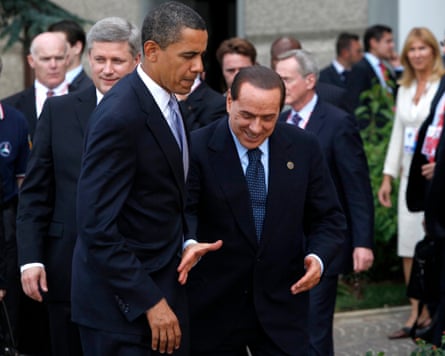
Vice-signalling is attention-seeking – a typical strategy of the hard and far right “to constantly violate taboos, and in this way escalate the dynamics of the whole conversation, while getting immediate media attention, usually front page”, says Ruth Wodak, emeritus professor of linguistics and chair of discourse studies at Lancaster University. It works for a political insurgent, as Trump was, as Nigel Farage still is, because it breaks down establishment barriers to entry, in terms of coverage. Not that winning power stops provocateurs, as Silvio Berlusconi illustrated, still making dog-whistle racist remarks about Barack Obama – “young, handsome, and tanned” – when he had been prime minister of Italy on and off for nearly 10 years.
Misogynistic vice-signalling has always been high-risk electorally, since even if you accept that women will vote for candidates who openly deride them (which we have to), there are so many of us. The best way to understand the recent surge of radical sexism is that it doesn’t so much address the voter as kick the door down (rhetorically speaking) for the next guy.
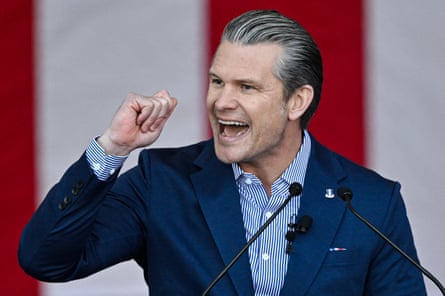
The cascade has been dizzying: Trump’s pussy-grabbing (he later apologised if his comments caused offence and dismissed the words as “locker room talk”) cracked open the space for JD Vance to come out and say that the Democratic party was run by childless cat ladies (he later downplayed it as sarcasm), which opened up Tucker Carlson’s “daddy’s home” speech on the eve of the election (“Dad is pissed. And when dad gets home, you know what he says? ‘You’ve been a bad girl. You’ve been a bad little girl, and you’re getting a vigorous spanking right now’”) and that, fair play, was not literally directed at women, because metaphorically, all liberals had become women. Literally, though, Christian nationalists have started to float the view that voting should be done by household, which is to say, not by women, a view that has been vice-signally reposted on social media by the US defence secretary Pete Hegseth.
Every time open misogyny is voiced by a politician with no consequence except more attention, it emboldens his allies. And every signal that makes an impact changes the weather. “People’s preferences are endogenous as well as exogenous,” says Tim Bale, politics professor at Queen Mary University of London, meaning: “What goes on in politics does shape what people think, as well as what’s happened in their own lives.” Alarming, aggressive, taboo-breaking statements by today’s politicians create an Elysium yearning, so that when Trump appears at a press conference and he’s in a good mood, not threatening to deport anyone or invade anywhere, you get this wash of relief that feels like relaxation, even fellowship. It’s a trauma bond.
Not that vice-signalling per se is new. Wodak first noticed the vice-signalling of Jörg Haider in the 1980s. He was the head of Austria’s Freedom party, which is no stranger to far-right narratives, though even in that context he was an outlier, known for “really antisemitic and revisionist utterances”. But precisely because taking the long view is soothing, it is dangerous. Today’s rightwing provocations have plenty in common with yesterday’s, but this is not just racist or misogynist undercurrent-as-usual. Elon Musk’s apparent Nazi salute is different, in effect and intensity, to Ronald Reagan falsely associating welfare fraud with Black people with his racially coded Welfare Queen trope.
What is particularly scary about today’s all-out vice-signalling is that it still gets you the camera and bathes your agenda in a metaphorical ring-light, but these days doesn’t carry the same political risk, which was previously twofold: it would cost you at the ballot box – commentators thought Trump was crazy with that 2015 bid, since the Hispanic vote was considered so critical to Republicans at the time that Jeb Bush was making speeches in Spanish – but you wouldn’t even get in front of voters if your speeches were hateful enough, because you’d be shunned by the establishment. “Enoch Powell is the classic example,” says Bale. Even while there were attendant benefits of taboo-breaking, such as creating your own army of hardcore fans, which Powell achieved, the MP never regained his foothold in mainstream politics after his 1968 anti-immigration “rivers of blood” speech, and was spent as a force. That establishment shun-operation no longer functions, and Trump’s emergence as a Republican candidate should have alerted us to this a decade ago.
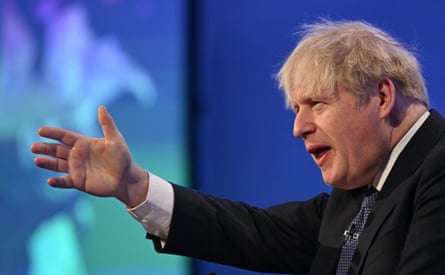
We talk a lot about why voters embrace those making openly racist and misogynistic comments: whether it signals widespread racism and misogyny that had previously been forced underground, or whether people overlook hate because they admire rule-breakers, and however they feel about bigotry, they feel worse about establishment politics. We talk much less about the failure of the first line of defence: why did the Republican party make Trump its candidate after the 2015 speech? Why was Boris Johnson not deplatformed after saying Muslim women looked like letterboxes in 2018, or 10 years earlier over the “watermelon smiles” of Commonwealth citizens? (He eventually apologised for both comments.) Why did Kemi Badenoch fire Robert Jenrick when he was about to defect to Reform, and not when he bemoaned the fact that there weren’t enough white faces in Birmingham (he said he was making a point about integration)? Why, in a country that has quite advanced laws against hate speech, does Herbert Kickl, the current leader of the far-right Freedom party in Austria, run rings around them? (“He’s a clever rhetorician,” Wodak says. “His speeches really escalate. There is so much hate expressed but you often can’t pin it down.”) Why did David Lammy go fishing with JD Vance after the vice-president time and again equated female worth with motherhood?
Nigel Farage has been accused of astonishing antisemitism in his schooldays, but he has also been criticised for using recognised antisemitic tropes much more recently, such as “Jewish lobby”, “new world order” and threat of a “globalist” government. While he denies any antisemitism, this really is some bold vice-signalling, both breaking the taboo against such tropes, and breaking the iron-clad unity over that period that the right had never even heard of antisemitism, and it was a leftwing problem. How did he keep his chummy media persona?
The rightwing media in the UK is a bit of a cul-de-sac, here, if you’re looking for challengers. Print titles have been running in parallel with politics to break taboos. “They’ve just gone off the deep end,” Bale says, “in a way that would have been unrecognisable even 10 years ago”. We had a little skirmish about why this might be – he thinks “legacy media” generally are competing with the undigested internet for clicks and attention; I think rightwing media specifically has lost restraint around hate-speech and othering, reflecting the interests of increasingly rapacious billionaire owners. We had to agree to differ.
The broadcasters of the right, meanwhile, such as GB News and TalkTV, “started up so you could say the things you’re not allowed to say”, says Scarlett MccGwire, a political communications adviser. But the centre right and centrists, in media and politics, have for decades operated as a firewall between robust speech and hate speech – part of their legitimacy derived from what they kept out: open racism; misogyny; hate speech; dehumanising imagery. Maybe as crucial, since discriminatory narratives rely on them, outright lies would historically have seen a public figure permanently dismissed. To see the mainstream lose its confidence around that principle has been disorientating.
At its worst, vice-signalling normalises hate. “Empörung Müdigkeit is the German term, ‘fatigue at being angry’,” Wodak says. Vice-signalling “gets disseminated; antisemitic slurs, racist slurs, they become part of everyday conversation.” (This is the broken windows theory – the more your environment is vandalised, the less care you take of it – applied to hate speech.) Even if a shun-operation kicks in, it’s now hit and miss: the former Conservative MP Lee Anderson faced an outcry in 2024 with the double-whammy vice-signal of claiming that mayor Sadiq Khan had handed London to his mates (it was widely seen as Islamophobic insinuation, first, and it was of course untrue). Anderson, who says he isn’t Islamophobic – as in “an irrational fear of Islam” – refused to apologise, had the Tory whip removed, but there was a haven further right and he defected to Reform.
The right have nudged up to the electric fence, in other words, and discovered that it’s not electrified. But that is partly because of a “heads I win, tails you lose” manoeuvre that is – I don’t want to alarm anyone – a key characteristic of fascism. Critique and challenge is not addressed but it is welcomed, because it delivers a fresh domestic enemy, the metropolitan (UK) or liberal (US) elite. Being called a liar is proof that the leader isn’t playing their establishment game, so “Trump, for all that he tells lies all the time, is so disinhibited and off-the-cuff that he’s seen as more honest, more authentic than his opponents,” Bale says. This is quite new.
So, from attention for the vice-signalling individual and the explosive dead-cat distraction from real problems and actual policies, to the Broken Windows degradation of the public sphere, the creation of a fanbase and the corresponding generation of street violence that will evidence a national race or values crisis where previously there was none – these are some quite significant wins for vice-signalling. You can see why they do it.
It also, says Bale, shifts the … well, “I don’t like the phrase Overton window” – a model for what the mainstream public find acceptable at a given time. “I’ve never read a political science paper using it.” “What do you guys use?”, I ask. “Centre of gravity,” he says. I don’t even want to dwell on what Farage et al’s language has done to the centre of gravity and where it’s dragged the Labour government. From Keir Starmer’s “island of strangers” immigration speech to the home secretary Shabana Mahmood’s idea of using surveillance-fed AI to stop criminals before they’ve committed a crime, it’s all just too sad.
I originally thought the main point of vice-signalling was to cast its opponents into disarray. Progressives are bad at dealing with binaries and absolutes: we would far rather argue about whether a statement was racist than argue about whether racism is bad. No question, all these signals have cast the left and centre into disarray. Alyssa Elliott, a member of the UK chapter of the largest grassroots anti-Trump movement, Indivisible, since she moved to the UK in 2018, describes the crisis in the Democratic party differently, however. It’s not that they don’t know how to have these arguments, so much as that their worldview is crashing down. “They’re still locked into this ‘Maga can’t do that because it’s against the rules’,” Elliott says. “That applies to the government’s statements as much as to their destruction of institutions. We still have Democrats saying that they will fund ICE as long as we make them do more training. That’s not the problem any more. It is a really big shift, to understand that the rules are over. A lot of people just refuse to do it.” Every vice-signal, whether it’s Trump or Farage or Jenrick or Herbert Kickl, is telling you the rules are over. If you can’t believe them the first time, at least believe them the 100th.










Comments