
 German (DE)
  English (US)
  Spanish (ES)
  French (FR)
  Hindi (IN)
  Italian (IT)
  Russian (RU)
  3 hours ago
Delivering a speech in Atlanta last month, Jon Ossoff accused Donald Trump of corruption, incompetence and fecklessness, and peppered his remarks with substantive observations of dates and times and places. But the comment that ricocheted across the internet – a clip of just a few seconds – was an almost-throwaway reference about how the US president wants to “travel with Natalie” onboard Air Force One.
The crowd cheered the US senator, who is running for re-election in battleground Georgia and is increasingly seen as a potential Democratic candidate for president in 2028. But his target audience that day – and this year – spanned far beyond the concert hall.
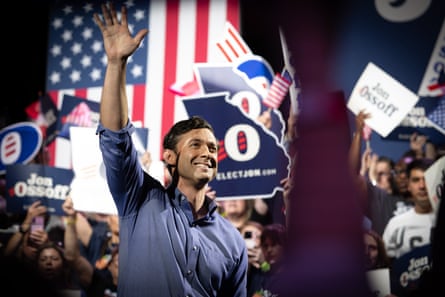
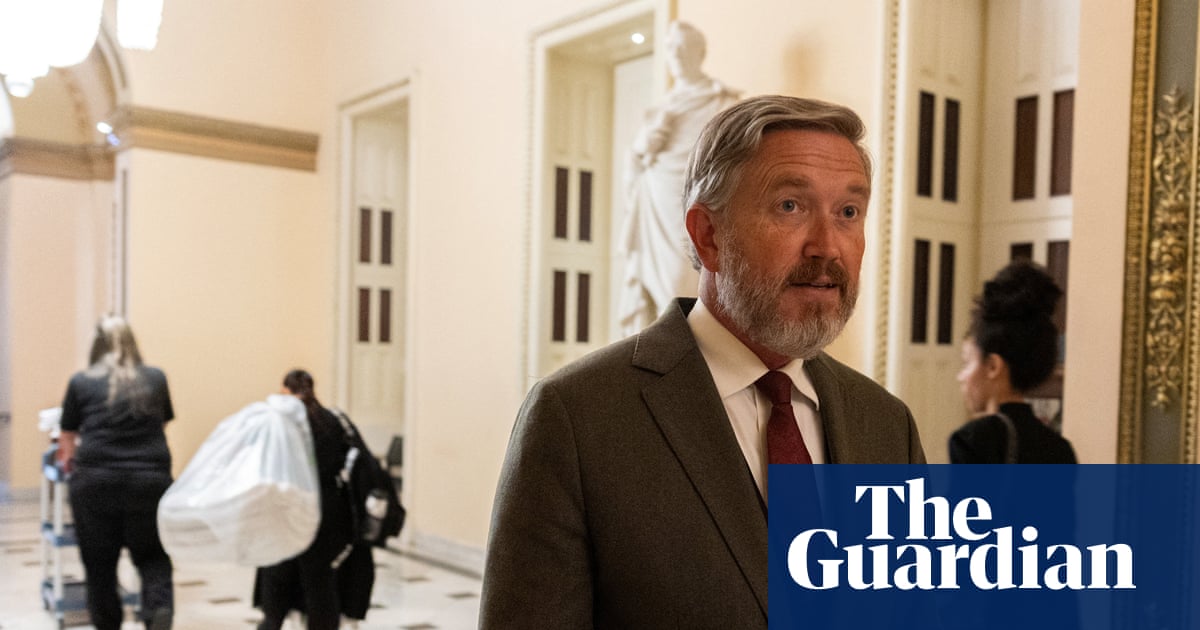
After his remark went viral, stories about Trump’s young, exceptionally devoted, presidential aide Natalie Harp rippled through social and established media. Often enough, they were accompanied by an image of Ossoff, his sharp jawline captured from below as he looks into the middle distance.
This photographic framing has increasingly been referred to as the “Ossoff angle”, perhaps in a disservice to myriad politicians from John F Kennedy to Barack Obama who also employed the technique, snapped at a low angle from a camera pit over the past century.
While the approach is not new, it has helped the senator for Georgia to reach the social media feeds of users far beyond his state.
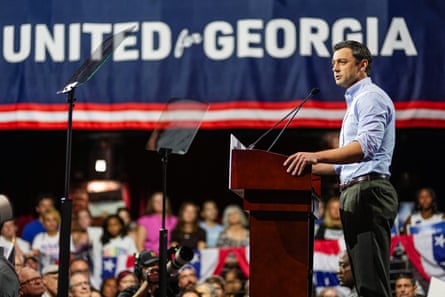
Kathleen Hall Jamieson, professor of communication at Penn’s Annenberg School, likened Ossoff to Kennedy. The first millennial senator has mastered the medium of the moment, she suggested, much as Kennedy was the first president who really understood television.
“How do you communicate that this is a new generation of leadership?,” Jamieson asked. “And how do you do that rhetorically? Because you can’t just stand up and say, ‘This is a new generation of leadership.’
“You have to have people draw that conclusion about you. And part of the way you do that is you master the media of the time, and you demonstrate that in the process you have leadership capacity and that you have the capacity to deal with the old order.”
At 33 years, 11 months and four days, Ossoff was the youngest US senator sworn into the 117th Congress. At 39 today, and ever so slightly gray at the temple, he remains the youngest in a chamber with an average age of 65.
The value of good lighting, a good background and a good angle in a social media post is not lost on a film-maker, as Ossoff was before turning to public office. The former documentarian has a knack for winning the algorithm with plain language, surfacing absurdities in an era of absurdities.
While Trump is also a master of social media, the effect is different. His audience is generationally different.
Trump, who regularly attaches infantile nicknames to his political enemies as a political marketing gimmick, calls Ossoff “Pee-wee Herman”, a tepid sobriquet which hasn’t yet landed.
More recently, the Senate Leadership Fund, a Republican-aligned Super Pac, began running ads about Ossoff’s haircare and makeup regime using AI-generated videos of Ossoff in a salon chair. (Ossoff has spent about $1,200 on hair and makeup this election cycle – a drop in the bucket, given a fundraising haul of $81m up to June, according to Federal Election Commission (FEC) disclosures.)
Georgia elected Ossoff in a nail-biting runoff in January 2021 with control of the Senate on the line, amid the turmoil of Trump’s election dispute. His election, alongside fellow Georgia Democrat Raphael Warnock, secured the Senate majority for Democrats. Rioters stormed the US Capitol the next day.
Since taking office, Ossoff has built a high profile as an opponent of Washington corruption, maladministration and the so-called Epstein class. He grilled CIA director John Ratcliffe after Jeffrey Goldberg, the editor-in-chief of the Atlantic, published a report that senior officials had shared sensitive information about future military strikes on Signal with him. He pressed Russ Vought, Trump’s budget director, after massive cuts to the Centers for Disease Control and Prevention. He questioned former director of national intelligence Tulsi Gabbard on her presence at an FBI raid that seized 2020 ballots in Fulton county.
His questioning of such Trump administration officials have proven as likely to reach wide social media audiences as anything he says on the campaign trail.
Clips circulated of Ossoff repeatedly pressing intelligence director nominee Jay Clayton during a July 2026 hearing to say plainly whether the 2020 election was legitimate. Ossoff’s questions left Clayton sitting in silence at the hearing table, refusing to speak. “Your answers lack credibility,” Ossoff declared. “Your testimony lacks credibility. You’re being evasive and you’re not being candid or forthright. And everybody across the country is going to watch this and know that.”
But outside of the spotlight, Ossoff has held hearings on child welfare and federal prison abuses both in Washington DC and across the state of Georgia. These relatively quiet issues tend to draw little media attention and less financial interest from funders, though they are a vital element of government oversight.
“It is clear that Jon Ossoff believes what he is saying, and people – they get it,” said Charlie Bailey, chairman of Georgia’s Democratic party. “And so it not only matches up with their experience and their their anger and their frustration, they know he’s telling the truth. They know he’s saying what he believes, and that’s why he’s saying it, because he thinks it’s the right thing to do.”









Comments