
 German (DE)
  English (US)
  Spanish (ES)
  French (FR)
  Hindi (IN)
  Italian (IT)
  Russian (RU)
  7 hours ago
Paul Ehrlich opened his 1968 book “The Population Bomb” with a scene recounting returning to his hotel through a crowded Delhi neighborhood on a stifling night in the mid-1960s. He described the physical sensation of overpopulation: people eating, washing, arguing, begging – “people, people, people, people.”
From that visceral opening, he declared that famine, conflict and nuclear war would sweep the globe in the 1970s because of overpopulation. Hundreds of millions of people would starve to death regardless of any crash programs launched to prevent it. Ehrlich argued for population control, chillingly describing population growth as a “cancer” that needed to be cut out.
Ehrlich’s predictions were conspicuously wrong – and experts said so at the time. But his logic resonated through the 1970s and ’80s across the political spectrum. Its shadow is evident in today’s anti-immigration campaigns and White House arguments for mass deportation.
We have followed its long afterlife, as a computational social scientist studying contemporary extremism and as a historian whose book “Building the Population Bomb” analyzed Ehrlich’s impact.
Getting it wrong
Demographers and economists in the decades after World War II rejected the idea that Ehrlich was promoting to millions of readers: that population growth is the primary cause of environmental degradation. Instead, the expert consensus showed how pollution and resource depletion are driven far more by extraction and overconsumption than by head count.
Princeton demographer Ansley Coale told the Population Association of America in 1968, the year “The Population Bomb” was published, that attributing national failures to population growth had become fashionable despite most of the country’s problems having little to do with it.
His colleague and former Population Association of America president Frank Notestein demonstrated at the association’s 1970 meeting that increases in pollution had far outpaced increases in population. Notestein called population control in “developed regions” a distraction from the more immediate need to regulate industry.
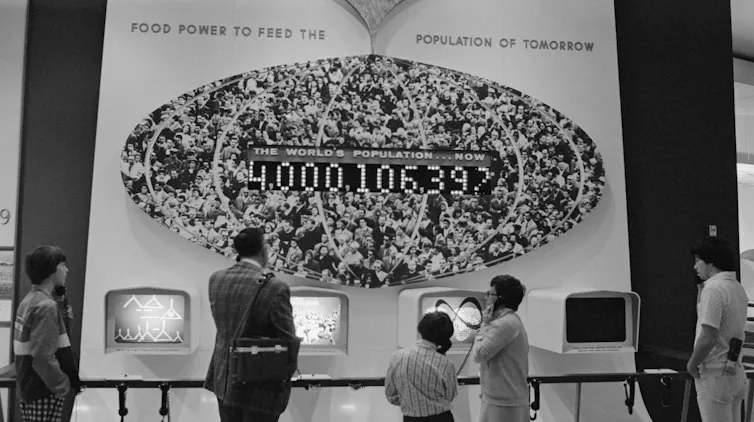
Ecologist Barry Commoner’s 1971 empirical study confirmed that postwar environmental damage had stemmed almost entirely from new production methods and rising per capita consumption, not from the growing number of people. When the economist Julian Simon challenged Ehrlich in 1980 to a wager on changes in commodity prices over the next decade, Ehrlich accepted – and lost.
In a 2009 retrospective, Ehrlich acknowledged some of “The Population Bomb’s” flaws but did not revisit its central claim. The mass famines he predicted had not materialized in the 1970s because he had not anticipated the Green Revolution, a dramatic expansion of agriculture output. He said the book’s catastrophic scenarios were illustrative exercises, not inevitable forecasts. He dismissed his critics as shills for polluters. Ehrlich’s retrospective concluded, “It was thus a successful tract, and we’re proud of it.”
Origins of the ‘population bomb’ analogy
Ehrlich’s arguments resonated with the popular anxieties of the late 1960s. By tying population growth to the environment, the threat of nuclear war and the sexual revolution, Ehrlich generated left-wing support for population control, which had previously been primarily a concern of the political right.
With the publication of “The Population Bomb,” Ehrlich became a celebrity almost overnight. Though his claims about the consequences of population growth were consistently wrong, Ehrlich had an enormous public impact. A butterfly biologist, he was suddenly booking appearances on Johnny Carson’s “Tonight Show.” He influenced dystopian Hollywood productions, such as “ZPG” (1972), “Soylent Green” (1973) and “Logan’s Run” (1976).
The intellectual genealogy behind “The Population Bomb” ran deeper than Ehrlich’s own career. The “bomb” analogy was borrowed from a 1954 pamphlet by Hugh Moore, a businessman whose population anxieties descended from Guy Irving Burch, the anti-immigrant eugenicist who founded the Population Reference Bureau in 1929.
Burch, worried about “alien or negro stock” replacing Europeans, introduced the phrase “population explosion” to American public discourse in the 1930s as part of a campaign for immigration restriction. Moore updated Burch’s framework for the Cold War, warning that population growth in Africa, Asia and Latin America would produce communist expansion and nuclear war.
Ehrlich’s use of ecological carrying capacity – the idea that any environment has a finite number of resources to support a population before collapsing – justified coercive population control initiatives as foreign and domestic environmental policies in the minds of many Americans.
India’s “Emergency” period from 1975-77 subjected an estimated 8 million people to sterilization under conditions ranging from financial inducement to outright coercion. China’s one-child policy was enforced through fines, forced sterilizations and compelled abortions for nearly three decades. Population control programs in some developing countries imposed contraception and sterilization on women without their consent.
California performed sterilizations on some inmates until the 2010s. Hysterectomies on detainees continued in at least one U.S. Immigration and Customs Enforcement detention center until 2019.
Ehrlich tied environment to immigration
Within the United States, Ehrlich co-founded the organization Zero Population Growth, which quickly outlasted its original premise. By 1972, the total fertility rate in the United States was already below the replacement level, and ZPG pivoted to immigration restriction as its primary policy target.
David Brower, the first director of the Sierra Club, authored the famous line “the battle to feed all of humanity is over” in the foreword to “The Population Bomb.” He appointed John Tanton, Ehrlich’s ZPG co-founder, to chair the Sierra Club’s national population committee.
Tanton would go on to build a network of groups that would implement the logic Ehrlich had popularized. This logic linked Ehrlich’s ecological carrying capacity, lifeboat ethics – the idea that wealthy nations risked being swamped by immigration – and reactionary anxieties about demographic change.
Tanton’s anti-immigration network became one of the most influential organizations in late-20th-century American politics. In addition to ZPG, Tanton founded the Federation for American Immigration Reform (FAIR) in 1979, the Center for Immigration Studies in 1985, The Social Contract Press in 1990 and NumbersUSA in 1996.
This network produced policy research and lobbied for drastic reductions in both legal and illegal immigration. It was also instrumental in repackaging nativism into genteel policy briefs for the 1994 Republican revolution, securing the bipartisan passage of the Illegal Immigration Reform and Immigrant Responsibility Act of 1996, and backing anti-immigration efforts that passed in California and Arizona. Ehrlich served on FAIR’s board of advisers until 2002. He died on March 13, 2026.
Ehrlich, Tanton and Brower, as part of Californians for Population Stabilization, tried to push the Sierra Club to adopt immigration restrictions as an official position, but members of the influential environmentalist group resisted. Ballot measures and board elections for the Sierra Club from the late 1990s into the early 2000s exposed the deep ties to anti-immigration activists – and defeated them.
Overpopulation in politics today
Ehrlich’s population anxieties continue to have a long afterlife as political figures build on the idea that immigration constitutes a form of “replacement” of existing populations. Once-fringe grievances suggesting white people were being replaced by people of color have become part of President Donald Trump’s MAGA allies’ “mass deportation now” agenda.
Fifty years separate India’s sterilization camps from today’s ICE detention warehouses, but we believe the logic connecting them is direct: a population defined as excessive, a government apparatus authorized to reduce it, and a scientific vocabulary used by some of the president’s closest allies to justify the means as an ecological necessity. Ehrlich’s contributions to that vocabulary proved far more durable than his predictions.









Comments