
 German (DE)
 English (US)
 Spanish (ES)
 French (FR)
 Hindi (IN)
 Italian (IT)
 Russian (RU)
 1 hour ago
As the US election returns came in throughout the night on Tuesday, there was ebullience at the size of the margin. It was comparable to the significant thumpings over the years. Yet bigger.
In 2006, Americans were exhausted by the war in Iraq (by simply changing the last letter to “n”, we have a similar situation today). But even that big win paled in comparison.
In 1974, there was another big gain by Democrats, after Richard Nixon resigned in disgrace, but the Democrats already held both chambers, so the realignment was not quite as profound.
Democrats have been on the losing end too. In 1994, they lost both chambers, but the reversal did little to dent Bill Clinton’s popularity, and he cruised to re-election two years later. Similarly, Democrats lost both chambers in 1946, after a recession, but Harry Truman was able to tough out re-election in 1948.
There will be no redemption for Donald Trump, who dragged everyone down around him.
His failure will now hang like a millstone around the neck of his vice-president, as they all head toward the ignominious end of this administration. This is a swamp that simply cannot be drained. JD Vance will thrash around in it, like a desperate mastodon, until forced to face an extinction event of his own, sometime in early 2028.
Among other results, the Earthquake of 2026 tees up a Democrat to win the presidency in 2028.
Of course, it’s far from a foregone conclusion. But it will be difficult for a wounded Republican party to limp along with no accomplishments, and then magically produce a winning candidate from the wreckage. Plus, Donald Trump will do all he can to keep any charismatic rival from emerging.
There were hundreds of victory speeches given on Tuesday. Naturally, many expressed the same thoughts – gratitude to long-suffering family members, exhilaration at the size of the blue wave, and a readiness to get to work on behalf of constituents. Specifically, to lower costs – the issue that overwhelmingly drove this surge.
But there was something bigger going on than Democratic exultation.
Many victory speeches looked past the short-term impact of the win and addressed the deep dysfunction within a political system that has fattened lobbyists and special interests, while ignoring the basic needs of the people: healthcare, education, clean air and water. There was a rage against the efforts of the ultra-wealthy to buy the election.
Over time it could easily grow more by carving into Maga, which has been so aggrieved for so long, but put its faith into a snake oil salesman.
This was something beyond partisan talking points; it came from an anger that has been building for years. It was visceral and directed against a system that favors the well-connected and their lobbyists, while attempting to divide and demean the disconnected. There was a lot of people power in these speeches (several quoted the final line of the Gettysburg Address, “of the people, by the people and for the people”).
In Michigan, Abdul El Sayed, simply by saying his name, set off a roar from the crowd, and got another one when he contrasted “this beautiful movement” with “an astroturfed corporate-funded advertising campaign built to deceive and distract”. A sharp line: “To special interests … we are coming for your system of politics.”
While noting the Republicans’ frequent attacks on his name and his faith, he described his belief in an America that is “big enough for all of us” and invested in the needs of its own people, instead of expensive forever wars.
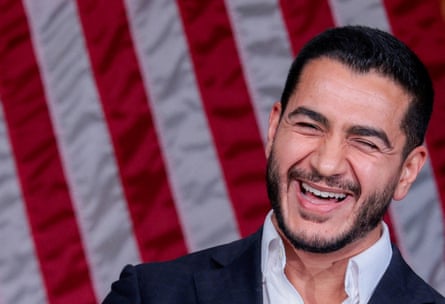
Gleefully, he looked forward to being sworn in by Vance, and got another big cheer when he shouted, referring to Michigan and Ohio university mascots: “Wolverine one, Buckeye zero!”
In Georgia, Jon Ossoff celebrated before a rapturous crowd. He trained some firepower on “the depravity, corruption and incompetence of the failed lame-duck president”. but also offered a vision of the new hope beginning for millions:
“If at times, these last two years, amidst the ceaseless onslaught of brutality and indecency, you doubted whether our republic would survive, let tonight’s results give you courage that the first light of dawn is on the horizon.”
He acknowledged that some “brokenness” remains, even with the victory: “Amidst our celebration tonight, we must acknowledge that the underlying crisis gripping our republic remains, and that therefore our most vital work lies ahead.”
Also in Georgia, Keisha Lance Bottoms spoke boisterously after being introduced by her daughter (it was a good night for moms and daughters – Gina Hinojosa movingly thanked her grandmother).
History was on her mind in several ways – she noted the irony that she comes from the same town as Alexander Stephens, the vice-president of the Confederacy. But a new era is beginning, and she reached out to all the Georgians whom she wanted to serve, including those who have traditionally voted Republican, such as veterans who need access to healthcare, and farmers trying to hold on to family land.
She also cited caregivers “who can’t afford healthcare and need Georgia to finally expand Medicaid”. She offered a resonant promise: “No amount of money will ever … never ever ever! … overcome the power of the people!”
In Texas, Gina Hinojosa called out her abuela, who always taught her: “Know your worth.” She insisted that the night was far more than a win for Democrats. “This victory is so much bigger,” she explained, going through all the ways it will help young people, teachers, parents and other caretakers of future generations.
Education was much on her mind; she expressed her rage against the ways in which Texas had strong-armed local schools and announced (to a huge cheer) her plan to fire the state’s education commissioner. With the focus of a parent, she outlined her hopes for the children of Texas, who cannot even vote, but are nevertheless a part of her broad social compact: “To the children of Texas, your schools will not close. You will be invested in, and you will grow up in a Texas where you are lifted up every single day to reach your God-given potential.”
It is difficult to remember any similar statement coming from the Republican party in recent years – a party so top-heavy, so male, so mean-spirited. Hinojosa had an effective line: state government, in the past, felt like “something that is done to you, not with you, or for you, or by you”.
Also in Texas, James Talarico showed the eloquence that has distinguished his unlikely campaign from the start (in glaring contrast to Ken Paxton’s remarks, so charisma-challenged).
He celebrated “the politics of love” in a language reminiscent of Martin Luther King, identified the “broken political system” that had spent so much to defeat him (he likened Elon Musk to Goliath), and urged his followers to “always bet on the underdog!”
Addressing the constant attacks on him, by AI bots as well as human actors, Talarico called the smear campaign “the final howls of a dying establishment … the death rattle of a status quo that knows its days are numbered”.
He welcomed the former Trump voters who came over to support him, and all the disenfranchised who built his coalition: teachers, nurses, farmers, ranchers, parents trying to put food on the table, young couples trying to find the money to buy a home.
Like Ossoff, he talked about a society that has broken its promises. “There is something broken in America,” he explained. “Our economy is broken, our political system is broken, even our relationships with each other feel broken … and that’s because the most powerful people in the world want it that way.”
Then came a stirring story about his grandfather, a Baptist preacher, who taught him the two main commandments of the New Testament, “love God” and “love neighbor,” because “there is no love of God without love of neighbor.” Following the thought, he reminded his listeners that all human beings are created in the image of their creator.
After so many Republican attacks on our physical and religious differences, it was an arresting thought, again reminiscent of Dr King. Talarico is shaking things up, using scripture deftly toward that end. Talarico insisted the “real fight in this country is not left v right; it is top v bottom.”
Together, the election night speeches are a sign that this is something more than a political victory. It’s an awakening. It’s the dawn of a new political era, dominated by young actors of immense talent, sharp on the details, focused on the American Dream, and destined to be with us for years and years.
-
Ted Widmer, a former White House speechwriter, is the editor of American Speeches, and the recently published The Living Declaration: A Biography of America’s Founding Text, both published by the Library of America












Comments