
 German (DE)
  English (US)
  Spanish (ES)
  French (FR)
  Hindi (IN)
  Italian (IT)
  Russian (RU)
  2 hours ago
When Katie Miller, the wife of Donald Trump’s powerful adviser Stephen Miller, interviewed Pete Hegseth on her podcast last week, she didn’t ask him about whether the war secretary had ordered the US military to kill the shipwrecked survivors of an airstrike. She didn’t ask him about the settlement he paid a woman who accused him of sexually assaulting her. Nor did she ask about allegations of alcohol abuse, or the accusation that he had made his ex-wife so terrified that she hid in a closet.
Instead, when Hegseth and his wife, Jennifer Rauchet, appeared on the Katie Miller Podcast, the titular host asked questions like: “If you could write one Hegseth family rule on that whiteboard, what is that?”
“Obey God,” Rauchet said. Hegseth agreed: “Try to honor God with your conduct each day.” (A US Navy admiral has denied a Washington Post report regarding the Caribbean boat strike that Hegseth gave an order to a “kill them all”. Hegseth has denied allegations of sexual assault and abuse. He also promised to stop drinking in office.)
There is perhaps no media property better positioned to rose-tint the Trump administration’s “family values” agenda than the Katie Miller Podcast – effectively the White House’s unofficial podcast, thanks to the Millers’ extraordinary Rolodex. In interviews with top Republican figures like Vice-President JD Vance, Attorney General Pam Bondi and House Speaker Mike Johnson, Miller serves softball questions that emphasize her guests’ devotion to God, their families and Trump. Not necessarily in that order.
So far, so propaganda. But Miller has a more ambitious objective. “For Maga and President Trump’s legacy to grow long-term, we must talk to conservative women,” Miller told Axios.
She appears to be betting that the best way to do that is through instruction on becoming a Maga-sanctioned wife and mother.
While women can work, the podcast suggests, they need to be obsessive about protecting their families from outside forces – including seed oils, anti-Trump protesters and “transgender ideology”.
“For a while, there was an increasing prevalence among kids who became transgender and entered into a phase of what I will call mental illness,” Miller told Johnson and his wife Kelly Johnson. “How did you raise children that I will say are successful, well-adjusted, share your morals and values?”
In another episode, she bonded with Cheryl Hines, the wife of health and human services secretary Robert F Kennedy Jr, over their skepticism about vaccinating all newborns for hepatitis B and their fears of contaminated baby formula. “That’s what radicalized me, is baby formula,” Miller confessed.
And in another, she echoed Maga talking points against hormonal birth control, claiming that it’s overprescribed. “It was when I was growing up. For anything, for acne, for hormone imbalance – ‘just get on birth control’,” she told wellness advocate Kellyann Petrucci. “And that’s why our birth rate is so low today.”
But if Miller wants to convince women that Maga is offering them a good deal, she’s going to have to work on her sales pitch.
Maga, but make it soft
Katie Miller has been a bit player in Trumpworld since its first administration, when she – then known as Katie Waldman – worked for the Department of Homeland Security (DHS) and Vice-President Mike Pence. In 2020, she married Stephen Miller, the architect of Trump’s extremist immigration policy. But Katie Miller is still probably best known for an infamous brag to a reporter: “DHS sent me to the border to see the separations for myself, to try to make me more compassionate, but it didn’t work.”
When Trump returned to the White House, Stephen became his deputy chief of staff for policy – a title that, insiders say, downplays how “untouchable” he is within the White House, where he has reportedly spearheaded the Immigration and Customs Enforcement (ICE) crackdowns. Katie took a job as Elon Musk’s aide, where she gained a reputation for tenaciously promoting his Department of Government Efficiency (Doge). When the relationship between Musk and Trump imploded, Katie left Musk’s side to launch the Katie Miller Podcast.
In her podcast’s first video, Miller said she wanted to start the podcast because “there isn’t a place for conservative women to gather online”. But there is.
The last year has seen a burgeoning “womanosphere”, the universe of rightwing podcasts, YouTube channels and magazines that lace their coverage of lifestyle, beauty and wellness with antifeminist rhetoric. These media properties tend to frame traditional gender roles as natural and beneficial, casting a salvific glow on Trump administration policies that drive women out of the workplace and into the maternity ward.
Miller’s podcast relies on many of the womanosphere’s most common tropes, including a commitment to the Make America Health Again (Maha) movement, an interest in religion and a tendency to foreground motherhood. (Many of the show’s religious discussions have a Christian bent, given the guests’ backgrounds; the Millers are Jewish.) When Miller interviewed Bondi, the attorney general suggested her journey to becoming the country’s top law enforcement officer was an accident: “I’ve always wanted to be a stay-at-home mom with five kids and have a basketball team of my own, but life doesn’t work out that way.”
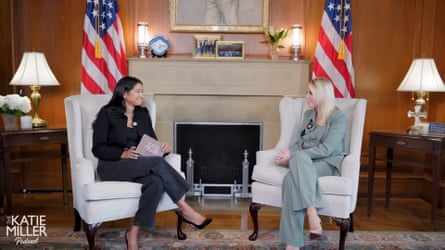
Miller doesn’t apologize for her career; many of her interviewees are successful businesswomen. “For my own self, it’s very important to work and have something outside of just my children, for my own mental health,” she told Kellyanne Conway, a staple official from Trump’s first administration. But in an era when many of the men in Maga’s top echelons – including some of Miller’s interviewees – appear to look down on working women, she seems to need to explain it: “I think it’s a good example for children,” she said.
An empty mission
Unfortunately for Miller’s grand ambitions, her podcast has a fatal flaw.
Interview shows run on chemistry, charisma and the sense that the listener has been transported to a Room Where It Happens. The Katie Miller Podcast, by contrast, is aggressively vibeless.
Its project is fundamentally tedious: she can’t ask too much about the unique elements of her powerful interviewees’ lives – the backroom negotiations, the moments of doubt and revelation – because her questions seem designed to make them appear generic. When Miller interviewed Vance, a man who is a heartbeat away from the presidency, she asked questions like, “What’s your superpower as a dad?” and, “What age would you let your kids watch Lord of the Rings?” Watching his answers was about as interesting as watching a stranger describe last night’s dreams.
Ronnee Schreiber, a San Diego State University political science professor who studies conservative women, sees the Trump administration’s use of women as spokespeople as an attempt to undercut accusations of misogyny.
“We have this entire Trump administration that is callous,” Schreiber said. “It is helpful for members of the Trump administration, particularly women, to try to soften the callous nature of what the policies are and who the men are.”
The podcast’s banality is exacerbated by Miller’s highly staged, pristinely neutral outfits and studio. They look straight out of a Christian Girl Autumn meme – an aesthetic that is years past its-sell by date. Since the pandemic and the outbreak of TikTok, the internet has trended towards idolizing figures who project a more laissez-faire, personalized look. Sure, the couches on Call Her Daddy are millennial pink. But host Alex Cooper undercuts the professionalism of her own set by dressing in sweats and instructing guests like Hailey Bieber: “Walk me through, step by step, your sex with Justin Bieber.”
In comparison, when Hines seemed like she might, possibly, be on the verge of making a distant allusion to sex, Miller veered away from the topic by asking her about what kind of chips she eats. (“Potato chips with ridges,” in case you’re curious, which you’re not.)
In her book The Women of the Far Right: Social Media Influencers and Online Radicalization, researcher Eviane Leidig suggests that the performance of authenticity is particularly essential for far-right influencers’ success, because it normalizes them. “What makes these women so appealing is how they present as relatable to viewers,” she writes. “They may be energetic, charming and self-confident, but they are also remarkably down to earth and empathetic.” When they broadcast from their bedrooms, the line between the ordinary and the extreme vanishes.
Top womanosphere influencer Brett Cooper likes to film from her house, use erratic graphics and sing Sabrina Carpenter songs (as she defends ICE). She is acting, in a word, cute. Her recent videos have garnered hundreds of thousands of views; Miller is lucky if hers crack 20,000. (Her recent interview with Musk is an exception. As of this writing, it has been viewed more than 400,000 times.)
That Katie Miller can’t project that kind of rambunctious appeal is not necessarily a surprise. But it is a growing issue for the Maga movement, which has yet to find a leader who can replicate Trump’s viral charm – or even lay out its principles beyond whatever policy Trump is promoting that day.
In its attempt to entice conservative women into Maga, Miller’s podcast runs up against the same problem: it’s hard to convince people to circle the wagons when there’s nothing in the center.















Comments