
 German (DE)
  English (US)
  Spanish (ES)
  French (FR)
  Hindi (IN)
  Italian (IT)
  Russian (RU)
  1 hour ago
Shifting goals, unclear timelines and a flimsy pretext: at times, the US-Israel campaign against Iran carries curious parallels of Vladimir Putin’s invasion of Ukraine.
The comparison is far from exact. In 2022, Putin sent a massive army across Ukraine’s borders in an unprovoked invasion of a democratic state, a campaign that quickly resulted in heavy losses. The United States has so far largely limited its involvement to airstrikes against Iran’s authoritarian regime.
Yet the echoes are hard to ignore.
In both wars, the aims of the campaign have been framed differently at different moments, while the legal justification, scholars say, is nonexistent.
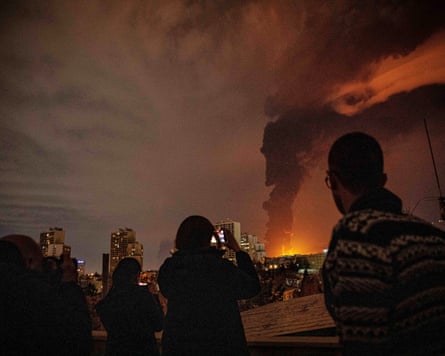
Early US statements framed the strikes as a response to an effort to prevent Iran from acquiring nuclear weapons. Officials have also emphasised degrading Iran’s missile capabilities and weakening the military infrastructure that supports its regional proxy network. But the goals have increasingly become more maximalist.
Donald Trump has said that Iran’s leadership should be replaced, openly raising the prospect of regime change, and more recently called for Tehran’s “unconditional surrender”.
In Russia’s war in Ukraine, the Kremlin has also repeatedly shifted its stated objectives.
When Putin launched the invasion in February 2022, he said the goal was the “demilitarisation and denazification” of Ukraine – language widely interpreted as a push for regime change in Kyiv. As the war dragged on, the Kremlin increasingly presented the conflict as one about protecting Russian speakers in eastern Ukraine and securing control over territories Moscow later moved to annex.
The similarities seep into language, too.
Both sides have portrayed their actions as defensive, citing what experts say are at best dubious claims that they were acting to prevent an imminent threat.
Last week, the US defence secretary, Pete Hegseth, said the US “didn’t start this war, but under President Trump, we are finishing it”.
Throughout his own war, Putin used strikingly similar language. “We didn’t start the so-called war in Ukraine,” he said in February 2022. “We are trying to finish it.”
Neither leader expected to be drawn into a prolonged conflict. Putin appeared to believe the full-scale war in Ukraine would last mere weeks and that he could repeat the swift seizure of Crimea in 2014.
Trump, meanwhile, came into the confrontation buoyed up by the apparent success of the US operation earlier this year that captured Venezuela’s president, Nicolás Maduro.
Tellingly, some American officials and the Kremlin avoided describing their actions as acts of war, suggesting they expected the conflict to be brief.
Four years into its invasion, Putin still avoids the term “war”, insisting on calling the invasion a “special military operation” – language enforced at home through strict censorship laws that have sent critics to jail.
Some in Washington have also been reluctant to use the word. Asked last week if US actions amounted to war, the House speaker Mike Johnson replied: “I think it’s a limited operation.”
The New Yorker was quick to quip, posting an image of Tolstoy’s classic War and Peace, with “War” replaced by “Limited Combat Operation”. In Russia, the same jokes were made four years ago.
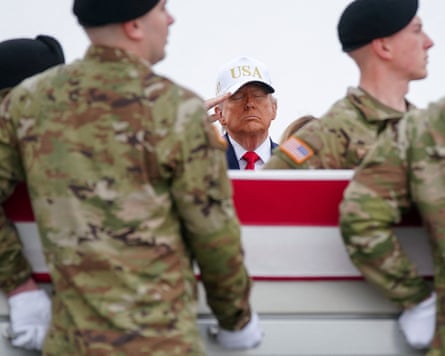
And then there was the reaction of the political and media elites. Much of the Russian establishment, initially horrified by the invasion of Ukraine, ultimately fell into line behind the war, arguing that Putin should finish what he had started.
Some figures in Russia’s exiled anti-war movement were quick to point out the parallels in the reaction to the latest conflict, noting how US commentators who had strongly criticised Russia’s invasion were themselves struggling to maintain the same clarity when their own country went to war.
“Once our presidents make a decision to go to war, even when I disagree with the decision and process – as is the case with our current war with Iran – I still want our armed forces to win,” wrote Michael McFaul on X, the former US ambassador to Moscow under Barack Obama and a frequent critic of Trump.
The question now is whether the US can avoid the pitfalls that ensnared Russia in Ukraine – and whether more parallels will emerge.
According to media reports, Trump has recently raised the possibility of sending elite troops into Iran to secure the country’s stockpiles of enriched uranium.
In the early days of its invasion of Ukraine, Russia deployed elite airborne forces to seize a key airport near Kyiv, a risky operation that ended in heavy losses.
Commenting on the US-Israel campaign, Danny Citrinowicz, a non-resident fellow at the Atlantic Council, cautioned on Friday that “when strategic goals become too ambitious or unrealistic, even a successful military campaign can gradually slide into a war of attrition”.
“To avoid that outcome, it is essential to define clear, realistic objectives – ones that can be measured and that provide a clear point at which the campaign can end,” he added in a post on X.
Vladimir Frolov, a retired Russian diplomat, responded drily: “Sounds familiar.”








Comments