
 German (DE)
 English (US)
 Spanish (ES)
 French (FR)
 Hindi (IN)
 Italian (IT)
 Russian (RU)
 1 hour ago
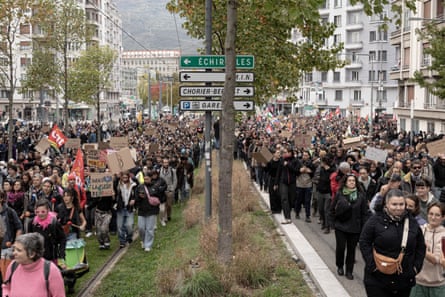
Since mid-September, students in metropolitan France have been mobilizing against poor conditions in public high schools. The mouvement lycéen has spread from a single campus in a Parisian suburb to include high schoolers and university students nationwide, with public sector workers, climate activists, labor unions and everyday people joining in solidarity. The unifying concerns have largely centered on the climbing costs of daily life, shrinking funds for social services and general anxiety about the future.
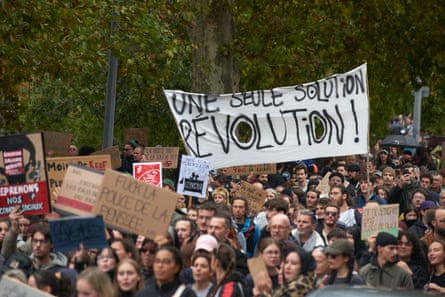
For two weekends running, France has seen hundreds of thousands of people take to the streets: first on 17 October, when a day of largely peaceful gatherings ended in looting and vandalism; then on 24 October, as the state met the movement with aggressive policing and protest bans intended to keep people at home.
But curfews, teargas and sweeping arrests have not been enough to deter the students. On Monday, they won their first government concessions: $4.45bn in government loans for the renovation of rundown buildings, more university spaces, more teachers and other administrative changes.
Protesters remain unsatisfied. Calling these “crumbs”, a spokesperson for the l’Union Étudiante, a national university student union, vowed to keep fighting. More actions are scheduled for 31 October, with a national strike called for 5 November.
Their resolve highlights how ingrained protest culture is in France. “There’s this idea, very deeply rooted in France, that expressing yourself by demonstrating is a democratic right,” said Quentin Deluermoz, a historian at the University of Cambridge and Université Paris Cité who studies social movements. “When something truly problematic is felt on a large scale, people will demonstrate to make their voices heard and demand a change or adjustment in policy.”
While fundamental structural differences between France and the US complicate easy comparisons, the French student movement is nonetheless a useful reminder of what makes demonstrations powerful on both sides of the Atlantic.
Strong organizing infrastructure and strong labor protections
The mouvement lycéen has been bolstered by a strong network of unions across French society. In France, unions provide organizing power within the public sector, responsible for calling strikes and filing the paperwork that makes them legal, in addition to consolidating worker demands and negotiating with the state.
But the right to strike, enshrined in the constitution, belongs to individuals: once a work stoppage is called, anyone can join it, whether they’re unionized or not. As long as they obey protocol, workers generally can’t be fired for walking off the job (though they do lose pay).
Not so in the US, where “going on strike is a very risky activity”, said Eric Blanc, assistant professor of labor studies at Rutgers and author of the Labor Politics Substack. “If you have to pay rent and make sure your kids have food next week, you’re going to think twice about taking action even if you know it could benefit you.”
Still, the US has seen what an effective action can look like, namely the 2018 teachers’ strikes that spread from West Virginia to Kentucky and Arizona. By walking out of their classrooms for more than a week, public school educators “created a crisis” that forced politicians to pay attention, Blanc said, and they did so knowing it would spark anger at either the state or the teachers.
To head off the latter outcome, teachers “were really conscious about winning over parents and community members”, Blanc said. They rallied bus drivers, custodians and other support staff. They coordinated childcare at local community centers and food donations for families affected by missed school meals. The West Virginia strike also “broke with the rules and practice and went straight to the [state] capitol to demand more money”, Blanc noted, ultimately winning a 5% pay raise for all public sector employees in the state.
A broad coalition puts power behind the students’ cause
So far, the French student protests have drawn a broad coalition without diluting demonstrators’ demands. That owes in part to the unions and activist groups that have piled onto the cause: the gilets jaunes, or yellow vests, a leaderless movement that came together in 2018 to protest fuel-tax increases and eventually the cost of living, set the date for the 17 October action in early September. After the student movement took off, it put out a call on their website inviting “Gen Z, Indignés [anti-austerity activists], farmers, firefighters, workers, teachers, healthcare workers, climate activists, residents of disadvantaged neighborhoods and retirees” to join them. The unions then called for protests on the same day.
On 24 October in Paris, the situation went further: multiple groups merged into one march, along one route. “It wasn’t just the numbers that mattered – it’s that we had a single demonstration with everyone,” explained Robi Morder, a jurist and political scientist specializing in student movements.
That solidarity is important for the students because it lends legitimacy to a more vulnerable group, and because workers have leverage high schoolers lack. While high school and university students do have their own unions, which represent them in talks with the government, their walkouts don’t have the legal standing that workers’ do. After all, when the lycéens boycott their classes, it “doesn’t bother anyone except the high school students, since stopping work isn’t like in a factory”, Morder said. Teachers’ unions have already organized walkouts in support of the students, and a general strike is coming next week.
To get the government’s attention, Morder said, “we have to be very strong and very numerous, that’s the idea: strength in unity”.
That idea has taken hold at the local level in the US, too: in Minneapolis this winter, unions, community leaders, mutual aid networks and everyday people pulled together to push back ICE; and in Cascade Locks, Oregon, voters banded together to recall their elected officials and cancel plans for the construction of a datacenter.
Clear, actionable demands
Earlier this month, the students drew up a list of 10 emergency measures they’d like to see implemented, including the need for “clean and functional sanitary facilities”, staffed classrooms and buildings adapted to extreme heat and cold.
For many workers in France, those complaints are reasonable and relatable. “What’s happening in the high schools is the same situation as in the hospitals and in all the public services,” said Deluermoz.
According to Blanc, mobilizing around grievances that are “really widely and deeply felt” tends to be a productive avenue for organizing. “One of the exciting things about the French movement is that it’s focusing on these core issues of economic redistribution,” he said. “It’s oriented not just to making the point, but towards winning something” – which “necessarily obliges a higher degree of sustained participation”.
In the US, recent large-scale protests at the national level have often been less about making demands and more about voicing dissent. No Kings, for example, may mobilize parts of the population not previously involved in activism, but its most immediate impact is showing that many people are upset about a certain thing – in this case, authoritarianism.
Dana R Fisher, professor and director of the Center for Environment, Community and Equity at American University, said that the US protests generating immediate effects tend to revolve around specific community threats at the state and local levels. Often, these efforts are catalyzed by “a moral shock”, she said: “Someone murdered by ICE, families being targeted at schools by immigration agents.”
More or less since the lycéen movement began, law enforcement has responded with a heavy hand, using military-grade weapons that have cost teenagers eyes, hands and teeth. Online, Deluermoz now sees a “war of images”: protesters and some media have circulated “shocking scenes of police violence inflicted on people under 18, with very childlike faces”. The government has countered by advancing the narrative “of the casseur, of looters, to give the impression of anarchy and justify a use of force that legal experts … consider disproportionate”, Deluermoz said.
While photos of shattered Parisian storefronts and Limoges’s flaming city hall may have consumed international headlines, the local story has unfolded a bit differently on social media. The teens have filmed themselves doing viral dances and “aura battles” (a trend in which two people face off in competing displays of charisma) in front of the police. The injection of meme culture into the manifs draws a line under the inherent absurdity of riot police facing off against kids who are asking for more chairs in their classrooms; it also reflects a gen Z-specific sense of humor that translates across borders.
Take the now-viral phrase “bismillah, c’est les ténèbres”, which entered the lexicon in early October when a screenshot from Snapchat circulated online, apparently showing a request to access an organizer group. “Hi, in the name of God, it’s the darkness. When’s the blockade, wallah, bro?” the message said, followed by a string of Algerian flag emojis, according to Al Jazeera. Students quickly blamed undercover cops, reading the nonsensical mashup of Arabic and French slang as an example of racial stereotyping by police. They co-opted the line as a slogan, which has now popped up on protest signs in France as well as Belgium and Italy.
While several experts said organizing via social media can prove difficult and ephemeral in the long term, it undeniably catalyzes people to get out into the street. In the US, arguably the clearest example is the Black Lives Matter movement, which sprang from a Facebook post in 2013 after George Zimmerman was acquitted in the shooting death of Trayvon Martin, a Black teenager in Florida, and has leveraged social media as an organizing tool ever since. In May 2020, footage of George Floyd’s murder shared on social media triggered protests against racially motivated police brutality all around the world.
In France and now beyond, the footage of young people in the streets has created “solidarity among young people”, as Morder put it. “They recognize each other; they face more or less the same problems.”
None of this guarantees the students will get their way – France faces a dire budget crisis and is poised to elect a new president next spring, meaning candidates on both sides of the political spectrum are spinning the protests to serve their own agendas. But the movement has nonetheless surfaced popular concerns that apply not only across France but around the world, putting a point on what people want from their governments.
“There’s something deeper at play here,” Morder said. “It’s seeping into society. We see reactions here from adults, parents, grandparents, employees, who say: ‘We’re very proud of the young people, because they’re moving, they’re acting.’”














Comments