
 German (DE)
  English (US)
  Spanish (ES)
  French (FR)
  Hindi (IN)
  Italian (IT)
  Russian (RU)
  7 hours ago
Less than 30 days ahead of the 2026 midterms and almost nobody I talk to in Philadelphia is excited. Not my neighbors. Not my students or colleagues at Temple University, where I research and teach political communication and public opinion. Not even my politically engaged friends.
This mirrors the national mood in recent years: In a Pew Research Center survey, just 4% of Americans said they feel excited about politics; 65% said they feel exhausted.
“There are many factors that go into voter apathy,” explains Temple University political communications professor Bruce Hardy, “barriers to participation, lack of trust, cynicism, sense of disenfranchisement and powerlessness, political fatigue, and so on.”
Voter malaise and campaign fatigue aren’t new, but something feels different to me this time.
Lauren Cristella, president and CEO of the Committee of Seventy, a nonpartisan organization established to improve the voting process and engage Philadelphia citizens in the democratic process, agrees. She points to election integrity fears being hotly debated in the national media as part of the problem.
“We are sitting on the back side of a big decline in voter enthusiasm,” she said, “And yes, we need to start giving voters something to be excited about. However, what we are seeing in the commonwealth is a lot of confusion and fear around election integrity.”
This tension, in my view, is the real story of the 2026 midterms. Voters still care. The stakes are higher than ever. But the question on many voters’ minds is: Will my vote even count?
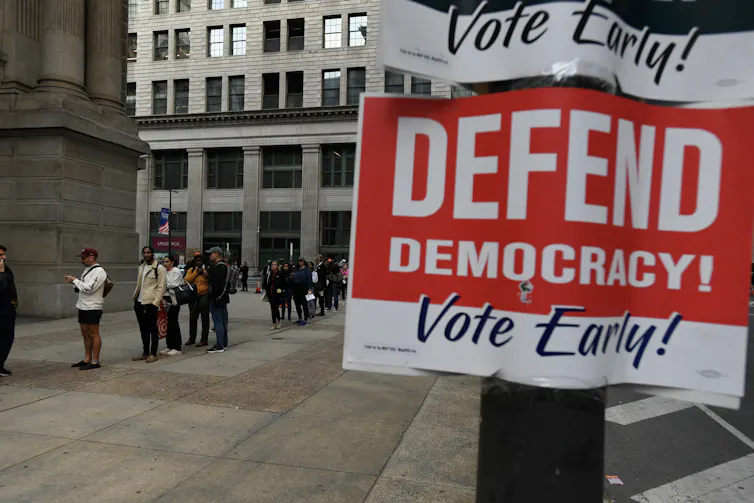
Election integrity fears are widespread
This is not just a Philadelphia problem. A July 2026 Gallup survey of more than 23,000 adults found that 2 in 3 Americans were concerned about political leaders pressuring election officials to change outcomes. Half worried that their own ballot would not be counted.
Voter confidence is sliding. In a 2026 University of California San Diego survey, 49% of Americans said they expect the midterms to be free and fair, while 51% expect unfair elections or aren’t sure.
A 2026 Pew survey similarly found that barely half of Americans are confident that November’s midterm elections will be conducted fairly and accurately. This represents a 10-point drop in national voter confidence from 61% in the 2024 elections.
Gap between democratic attitudes and voting behavior
Social and behavioral scientists have long understood the tension between one’s beliefs and attitudes about voting: For example, many people say they believe voting is an important democratic behavior, but then don’t actually vote themselves.
Efforts to close the gap between people’s intentions to vote and getting them to actually vote are where issues like mail-in voting, polling locations, time off work and voter ID laws make a difference.
Voting by mail has been a flash point since the 2020 presidential election when Philadelphia and Pennsylvania sat at the center of controversy. However, this should not be an issue for Philadelphians – or Pennsylvanians – in the upcoming midterms. The U.S. Supreme Court recently blocked a federal attempt to impose new Postal Service rules limiting mail-in voting.
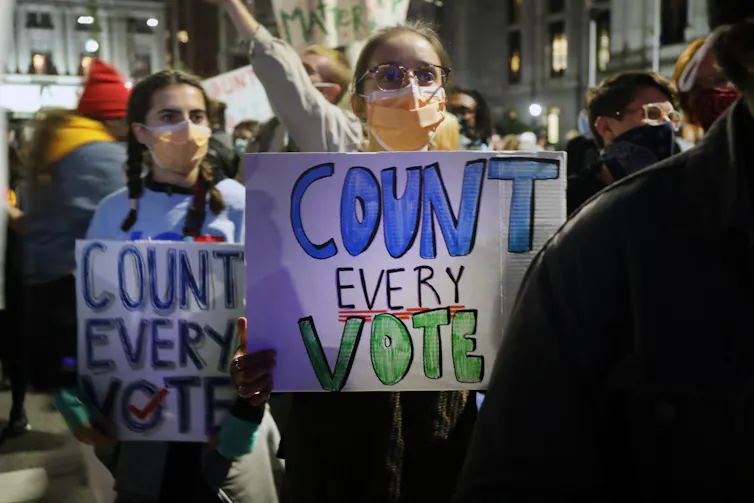
Cristella told me that mail-in voting is “the safest and most secure of any time in the commonwealth’s history.” Every ballot can be tracked.
So why are Pennsylvania voters not convinced?
‘What’s the point?’ is a rational response
A 2021 article that cites experts at Tufts University explains how pushing myths like the “election was stolen” or “the election wasn’t fair” – presumably to explain away Donald Trump’s loss in 2020 and create mobilization for his 2024 presidential run – can boomerang and end up lowering confidence in future elections.
If people don’t believe their vote will count, then it becomes completely rational to simultaneously hold the opinion that voting is generally good for democracy, while also lacking any faith that their own vote will even be counted.
Framing theory explains how the presentation of information in the media influences the way people process and interpret it.
Hardy attributes much of the current state of voter apathy to the media’s focus on fraud and voter integrity. He says that “much of this comes from political discourse and media focusing on national political conflict, a seemingly endless election cycle, and a constant reinforcement of political in-groups and out-groups.”
Even though our elections are safe and secure in Philadelphia, he explains, “All of this negative national media coverage can overshadow the importance of local elections and leave people feeling disengaged from the politics closest to home.”
Cristella agrees that media framing is a significant part of the problem.
“Issues surrounding election fraud and vote integrity get amplified and muddied,” she said. When isolated issues in other states occur, even if proved untrue, the intense and repeated national media attention on them shakes voter confidence here at home.
What this means for Philly
The 2026 midterms will be an important election for Pennsylvania, as the election will determine the state’s next governor and lieutenant governor, as well as members of the U.S. House of Representatives and the state Legislature.
Philadelphians have a lot on the line.
Economic concerns, in particular, are a major issue this election. A recent Gallup poll indicates that confidence in the economy is at its weakest level since 2022. And the voters are feeling the pinch.
While the 2026 Philadelphia primary had a low 22% turnout, Cristella believes issues like affordability will lead to a strong turnout in November.
As a longtime Philadelphian who believes strongly in our democracy, I am staying hopeful.
Pennsylvania has 40,000 poll workers for each election. To become a poll worker, visit vote.phila.gov or vote.pa.gov.
Read more of our stories about Philadelphia and Pennsylvania, or sign up for our Philadelphia newsletter on Substack.








Comments