
 German (DE)
  English (US)
  Spanish (ES)
  French (FR)
  Hindi (IN)
  Italian (IT)
  Russian (RU)
  2 hours ago
Martha Gellhorn stowed away on a hospital ship to become the only woman journalist to land on Normandy Beach on D-Day. She carried stretchers before writing her harrowing account of the invasion.
The New Yorker’s famously epicurean writer A.J. Liebling subsisted on military rations and came under fire during World War II to describe what it was like for the soldiers and sailors at war.
Syndicated columnist Ernie Pyle died, in a helmet and Army fatigues, among some of the troops whose names and hometowns he carefully included in his dispatches. “At this spot, the 77th Infantry lost a buddy,” read the makeshift sign posted at the place where a Japanese machine gun bullet felled him.
Those reporters told stories of war in all its gore and its glory, its exhilaration and its ennui. Others have laid bare the anxiety and doubts.
Veteran Vietnam correspondent Neil Sheehan broke the story of the Pentagon Papers, which showed how government officials deceived the public about the Vietnam war. Sheehan won a Pulitzer Prize for his book, “A Bright Shining Lie,” which chronicled the war’s impact on idealists who once believed in it, through the story of his relationship with an inside source.
Well before bombs started dropping on Iran and President Donald Trump began to tease the notion of a ground invasion, his defense secretary, Pete Hegseth, began putting obstacles in the way of the reporters with the most experience covering the nation’s military. While Hegseth’s moves haven’t stopped the reporters from doing their jobs, it has made it harder for them to keep the public informed.
As someone who worked as a Washington correspondent for decades, I worry that these obstacles could limit the number of reporters who have the experience with – and trust of – key sources to do the kind of in-depth, nuanced journalism that a war, with its price in lives and resources, deserves.

Corralling the watchdogs
Generally, war correspondents need the cooperation of the military they are covering to get to the front. For the U.S. press, that requires relationships and credibility at the Pentagon.
Early in 2025, Hegseth ordered major news organizations to give up their desks in the Pentagon press room to MAGA favorites. NPR’s desk went to Breitbart News. Roaming the hallways, where reporters sometimes found sources who would deviate from the company line, became verboten.
Eventually, the area in the Pentagon where reporters were allowed was circumscribed to a single corridor outside the press room – even though the public affairs officers who worked most closely with reporters were in an office on the other side of the 6½-million-square-foot building.
Then Hegseth conditioned the issuance of press credentials on reporters, effectively giving military brass the right to censor or sanitize their reports.
As a result, almost the entire Pentagon press corps, which included outlets ranging from The Associated Press to The New York Times to Fox News and USNI News, which covers the Navy, moved out of the building in October 2025. Some have been invited back for the press briefings Hegseth and Gen. Dan Caine, chairman of the Joint Chiefs of Staff, have begun to give on progress of the battle in Iran.
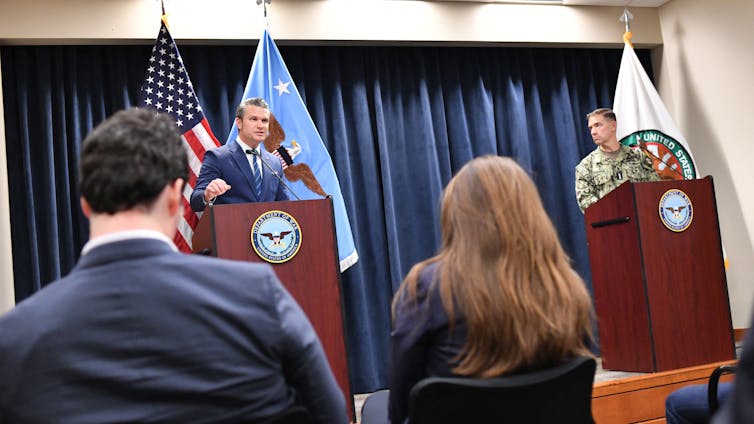
But after the first of these briefings, the Pentagon abruptly banned photographers from attending, reportedly because Hegseth’s staff found some of their images of him to be unflattering.
Secretary on defense
Gone are the off-camera “background” briefings where Department of Defense brass could give trusted reporters greater context and nuance for battlefield decisions. Gone are the impromptu hallway meetings where reporters have, with luck or persistence, picked up information that deviates from an administration’s agreed-upon script.
Also not in evidence, at least not so far: the deployment of the kind of journalistic embed program that the Pentagon used during the Iraq war to give the American people an up-close look at troops in the conflict zone.
How might that affect what you, the public, gets to know? It was a combination of an anonymous tip and insider access that led the legendary investigative reporter Seymour Hersh to break the devastating story of My Lai, the American soldiers’ massacre of civilians during the Vietnam War.
At the made-for-TV briefings he does hold, Hegseth devotes most of the session to questions from outlets such as the Epoch Times, The Daily Caller and LindellTV – owned by Mike Lindell, the head of the well-known pillow company.
At one recent briefing, one of the favored new cadre tossed Hegseth a shameless softball. Referring to American troops in the Middle East, the questioner asked: “What is your prayer for them?”
Yet as hostilities drag on, even some among Hegseth’s chosen press corps have begun to ask irksome questions about the war. The normally Trump-friendly Daily Caller ran a less-than-flattering piece about the president berating a reporter for asking about troop deployments.
On March 4, 2026, Hegseth accused journalists of focusing on war casualties to make “the president look bad.” On March 13, Hegseth castigated as “more fake news” CNN’s report that the Trump administration had underestimated the impact of the war on shipping traffic in the Strait of Hormuz.
“The sooner David Ellison takes over that network, the better,” Hegseth concluded, adding fuel to the speculation that a Trump supporter who won a bidding war for CNN’s corporate parent is going to turn the network into a more administration-friendly outlet.
Soon after, Federal Communications Commission chairman Brendan Carr threatened network broadcast licenses over coverage critical of the administration’s conduct of the war. Echoing Carr’s threats the next day: the president himself.
‘Be a Marine’
The Trump administration is not alone in its disdain for a free press: Israel has long been notorious for restricting press access from areas where it is conducting military operations.
Leaders of the theocratic Iranian regime are even worse; the country is cited by press freedom advocate Reporters Without Borders as “one of the world’s most repressive countries in terms of press freedom.”
But the United States has historically distinguished itself by making freedom its calling card, even – or perhaps especially – in wartime.
“The news may be good, or bad. We shall tell you the truth,” Voice of America, a U.S. government-launched radio network, promised – in German – in its very first broadcast to Nazi Germany in 1942.
Now, however, the Trump administration, is busy trying to undermine the editorial independence of Voice of America, which broadcasts news to countries that don’t have a free press.
Pentagon reporters are continuing to find ways to get around the propaganda. NPR’s Tom Bowman told me that he takes inspiration from a pep talk he overheard a military source deliver to another reporter crestfallen over the lack of access.
“Quit whining and be a Marine,” the official said. “Go over, under or around the obstacle. Find a way to do it.”
Most reporters and their organizations are doing just that, finding sources outside the administration, like the ones in Congress who told The Hill how much money the war is costing taxpayers per day. And they’re continuing to get information from sources on the inside, like the ones who told The Wall Street Journal that Trump’s military advisers warned him that Iran might block the Gulf of Hormuz, but that he opted for war anyway.
So far, neither Hegseth’s obstacle course nor threats from the White House and the FCC have stopped the press from reporting stories or asking questions that the administration would rather not see or hear.
But restrictions on press freedom have a corrosive effect. We already have seen how Trump, using lawsuits and licensing threats, has used his power to make corporate media owners think twice about pursuing news he doesn’t like.
Seasoned Pentagon reporters will still find ways to get to sources they already have. But Hegseth’s tactic of blocking press access to the military keeps reporters from developing new sources and keeps new reporters from building the relationships they need to become seasoned Pentagon reporters.
Americans have long been able to understand the triumphs and tribulations of American troops at war, and to make intelligent decisions about whether they approve of a war’s cost, because a free press has been able to tell the story – good or bad. That tradition is now at risk.







Comments