
 German (DE)
  English (US)
  Spanish (ES)
  French (FR)
  Hindi (IN)
  Italian (IT)
  Russian (RU)
  2 hours ago
Nearly one-third of U.S. children reported missing are Black, even though Black people constitute roughly 14% of the U.S. population.
To address one dimension of this problem, Pennsylvania and a few other states, including Alabama and Massachusetts, have in recent years proposed legislation to reform missing child alert systems. Not all missing children cases trigger an Amber Alert – the nationwide emergency alert system for missing children – but those that do receive greater public and media attention. These states suggest implementing an “Ebony Alert” that focuses on children of color.
Pennsylvania state Rep. Gina Curry introduced a bill “specifically tailored to finding missing Black and Brown youth” in June 2024 and reintroduced it in January 2025. It is currently sitting in the Children and Youth Committee.
Pennsylvania and the other states where these laws are pending are taking a cue from California, which started its statewide Ebony Alert program in January 2024. California’s system aims to guarantee that cases of missing Black youth are treated fairly by law enforcement agencies and the public is alerted in similar fashion and through the same venues offered under Amber Alerts.
I am a law professor who studies victimization and inequalities in the criminal legal system. In a recent legal paper, attorney Tanisha Brown and I examined how Ebony-like laws might save more Black children who go missing.
Our study focuses specifically on Black children, though we recognize that the disproportionate number of missing children from Native American and other marginalized communities also deserve attention and further inquiry.
The crisis of missing Black children
Our original data analysis suggests that the probability of Black children going missing is three times that of white children.
The May 2025 Minority and Missing Report – a collaborative effort among leading law enforcement and various civil society groups – also highlighted the disproportionate number of missing Black, American Indian and Alaska Native children.
These disparities extend beyond reporting rates for missing children.
Black children are also more vulnerable to trafficking and exploitation than white children. Structural inequalities, such as poverty, housing instability and overrepresentation in the foster care system, compound their risks.
Amber’s role in the disparities
The Amber Alert system was adopted in the early 2000s. Amber stands for America’s Missing: Broadcast Emergency Response. It is a powerful and comprehensive alert infrastructure that distributes information about a missing child through radio, television, text messages, highway signs, email notifications and major online platforms, including Google and Facebook.
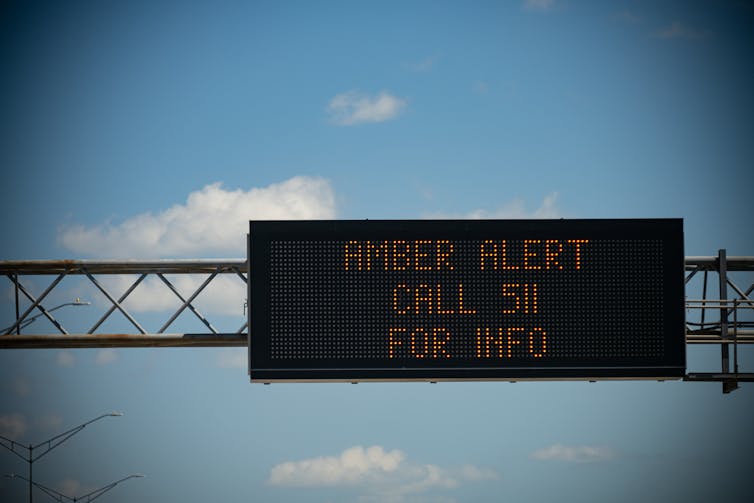
Many of the kids who go missing are victims of crime – abducted from their neighborhoods, homes and schools, subjected to physical and psychological abuse, and, in some tragic cases, killed. Amber Alerts mobilize communities to assist in the search process.
To issue an Amber Alert, law enforcement must determine that specific statutory conditions are met, including the age of the child, law enforcement’s belief in imminent danger of serious injury or death, and the sufficiency of existing information to assist in recovery. Crucially, children who are categorized as “runaways” are excluded from Amber eligibility.
Advocacy groups for missing children argue that for a host of reasons, including implicit and explicit racial bias, Black children who go missing are disproportionately labeled as runaways. This excludes them from the protections of the Amber system and reduces the likelihood of them being found.
Even when an Amber Alert is initiated, some data suggests that Black children are less likely to be recovered than white children.
States respond with Ebony Alerts
California’s Ebony Alert system ensures that all cases involving missing Black youth receive public notification comparable in scope and visibility to Amber Alerts. It offers different criteria for the initiation of the alerts. For example, an Ebony Alert may be issued when law enforcement determines that an individual went missing under “unexplained and suspicious circumstances.”
The Pennsylvania proposal generally follows California’s provisions, while stating that it is intended for “young people of color.”
These efforts publicly acknowledge and attempt to address the disproportionate impact of missing-child crises on Black communities. They also shine light on the limitations of formally colorblind frameworks like Amber, as Amber’s race-neutral design has, in practice, produced racially disparate outcomes – with potential life-or-death consequences.
Addressing Amber’s structural flaws
In order to fix the Amber Alert system in states without Ebony Alert legislation, we propose three reforms that would reduce flaws in its design.
1. A more holistic evaluation of missing child cases: Currently, all Amber factors must be present to initiate an alert. Our approach suggests that no single factor should stop an alert from being issued. Doing so will require law enforcement agents to approach each case with more complexity and nuance, including recognizing particular community needs.
2. A broader spectrum of “at risk” conditions: Law enforcement can issue alerts in cases beyond the most typical cases of “serious risk to bodily integrity or death.” This might include “unexplained and suspicious circumstances” or recognizing that the missing person might be subject to trafficking.
3. Shift the burden within law enforcement decision-making: To mitigate bias in alert initiation, we propose that law enforcement bear the burden of explaining why not to initiate an alert – instead of why to – when they cannot explain circumstances behind a child going missing.
Together, these reforms could significantly address existing problems within the Amber system itself.
Equal protection challenges
The design of Ebony Alert laws, however, raises a constitutional question: Can such laws withstand equal protection challenges?
Under current doctrine, Ebony Alert laws would likely be considered a racial classification subject to strict scrutiny, an almost impassable legal hurdle. The 2020 Students for Fair Admissions Inc. v. President and Fellows of Harvard College, in which the Supreme Court ruled that several race-conscious admission programs at Harvard and the University of North Carolina violated the equal protection clause, might have further challenged this type of legislation.
To pass strict scrutiny, laws must be narrowly tailored interventions that serve a compelling state interest.
As Brown and I argue, the interests and context of Ebony Alert laws differ meaningfully from those in the Students for Fair Admission case. Ebony is law-enforcement legislation aimed at protecting children who are victims of crime. Courts have long recognized that “safeguarding the physical and psychological well-being of a minor” is a compelling interest.
Ebony Alert laws also address documented racial disparities in the Amber system that undermine equal protection and public safety. According to case law, race-conscious measures may be deemed compelling when “essential to accomplishing criminal system objectives within a community served,” including maintaining trust and perceptions of fairness. These points are developed more fully in our paper.
To be sure, Ebony Alerts are not a panacea. As the Minority and Missing Report emphasizes, there are broader issues, such as inconsistent reporting protocols, inadequate training and strained relations between marginalized communities and police.
Nonetheless, Ebony Alert proposals invite a broader reckoning with how race-neutral systems can produce racially unequal outcomes. Carefully designed race-conscious remedies may be necessary to fulfill the criminal legal system’s most basic promise: protecting children’s lives.
Read more of our stories about Philadelphia and Pennsylvania, or sign up for our Philadelphia newsletter on Substack.
















Comments