
 German (DE)
  English (US)
  Spanish (ES)
  French (FR)
  Hindi (IN)
  Italian (IT)
  Russian (RU)
  2 hours ago
Donald Trump’s aggressive drive to boost fossil fuels, including dirty coal, coupled with his administration’s moves to roll back wind and solar power, face mounting fire from courts, scholars and Democrats for raising the cost of electricity and worsening the climate crisis.
Four judges, including a Trump appointee, in recent weeks have issued temporary injunctions against interior department moves to halt work on five offshore wind projects in Virginia, New York and New England, which have cost billions of dollars and are far along in development.
Meanwhile, Trump energy officials last year issued emergency orders to keep open five ageing coal plants that were slated to close in Washington, Michigan and three other states; repairs on some of the coal plants are expected to be costly and time consuming, and some states are challenging the federal actions.
“Trump’s decisions make no sense from either the perspective of environmental protection or the cost of energy,” Naomi Oreskes, a Harvard University science historian and professor of earth and planetary sciences, said.
“By blocking wind projects that are just about ready to go on line, and reviving dangerous and uneconomic coal-powered plants, this administration is raising both the direct costs of energy for the American people, and the indirect costs we suffer through polluted air and climate damage.”
Further, the Trump administration has pushed to increase liquefied natural gas (LNG) exports, which have also helped raise domestic electricity costs, say experts and several Senate Democrats who last December introduced a bill to sharply curb LNG exports with an eye to lowering electricity bills.
Overall, US households spent an extra $12bnon natural gas between January and September last year versus the prior year, which coincided with a 22% jump in LNG exports backed by the Trump administration, according to federal data analyzed by Public Citizen.
Chris Wright, the US energy secretary and a former oil and gas CEO, last fall went to Europe to press the EU for ways to boost LNG exports by cutting or delaying their rules that curb methane. Increasing LNG exports has also been championed by an industry group, the Domestic Energy Producers Alliance that was cofounded in 2008 by multibillionaire fracking mogul Harold Hamm, a major Trump donor and fundraiser, and other industry leaders
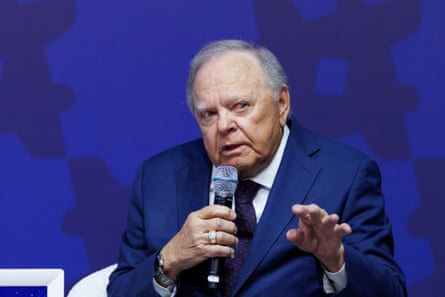
In April 2024, Hamm helped organize an elite energy industry dinner at Mar-a-Lago where Trump pitched the CEOs including Wright on donating $1bn for his campaign and pledged a sweeping pro-fossil fuel agenda. Ultimately, fossil fuel interests donated about $75m, including $2m from Hamm, to help Trump win.
The administration’s strong pro-fossil fuel policies seem to have helped spur higher electricity prices which have been outpacing overall inflation rates, creating headaches for consumers, say energy experts and some congressional Democrats.
Electricity prices rose 5.1% between September 2024 and September 2025, a much higher increase than the overall 3% inflation rate for goods and services in the period, according to consumer price index data,
Trump officials have said that their energy policies have been dictated by rising energy demands, including from the growth of huge energy consuming datacenters, and to avoid blackouts.
For his part, Trump has long rhapsodized about “beautiful clean coal”, a major driver of global warming, while denigrating wind energy as the “scam of the century.” Further, Trump’s One Big Beautiful Bill Act included sharp cuts in tax credits for solar energy.
Experts decry ‘ideologically driven’ cuts
Energy scholars say that Trump’s intense ideological and donor-driven push for more fossil fuel usage while curbing wind and solar projects, looks dangerous and short-sighted, as voters voice more concerns about pocketbook issues including electricity costs.
“If you want to lower electricity prices, you don’t halt wind and solar projects that are already under construction,” said Michael Gerrard, who heads the Sabin Center for climate change law at Columbia Law School.
“Many of Trump’s ideologically driven actions are on a collision course with his stated goals. The fastest and cheapest way to add generating capacity today is large-scale wind and solar. Trump is doing everything he can to stop these projects.”
Similarly, other legal energy analysts voice strong critiques of how Trump’s strategy to boost coal usage is shortsighted and harmful.
“Federal and state utility regulators determined that these [coal] plants could close,” said Ari Peskoe, director of the electricity law initiative at Harvard Law School. “By law, utility regulators must consider affordability and reliability. [The energy department] is pre-empting the utility regulators’ assessments that these plants cost too much and were not needed for reliability. [The energy department] is imposing hundreds of millions of dollars on consumers at least without any demonstration that the benefits outweigh the costs.”
Oreskes stressed further that: “There’s no way to understand this except as ideologically driven, combined with cronyism. People often think we have to choose between environmental protection and saving money – which is not actually true – but in this case, Trump ’s policies will throw environmental protection under the bus and raise the price at the same time. It’s a lose-lose proposition, and the losers are the American people.”
Trump and his top energy officials seem to have intensified the drive for more fossil fuel usage, including coal, since last April when Trump signed executive orders to boost coal production in part by easing environmental regulations.
In contrast, Trump’s attacks on wind power have expanded in various ways including cancelling $679m in federal funding last August for ports to support the offshore wind industry.
“My goal is to not let any windmill be built. They’re losers,” Trump told an elite group of oil executives, including Hamm, at a White House meeting in January after the capture of Venezuelan strongman Nicolás Maduro to discuss options for tapping its vast oil resources.
Moreover, energy secretary Wright signaled more help to restore coal at a January meeting of the National Coal Council, a group with top industry leaders that has gained new influence since Trump took office again in 2025 and the council was revived.
“The goal is to stop the political closure of coal plants,” Wright told the council meeting which drew dozens of coal industry leaders including Joe Craft, the billionaire CEO of Alliance Resource Partners and a top donor and fundraiser for Trump and Republicans.
Craft, in tandem with his wife, Kelly, ran a major donor program for the Republican National Committee, dubbed the Presidential Trust, that raised millions of dollars in the 2024 election cycle.
Trump officials have indicated they want to keep open other old plants in the next few years too, even though coal has been a declining industry for years with many plants over 50 years old and needing costly repairs.
In contrast, Trump officials have stepped up their attacks on wind energy projects using legal challenges and other tools.
In December 2025, the interior department paused leases for five large offshore wind operations on the east coast which have been under construction by raising unspecified national security issues.
The companies building the offshore wind projects quickly sued to halt the stop-work orders from the interior department, stressing that billions of dollars had been invested, and urged the courts to respond fast which they did with January rulings blocking Interior’s actions.
One Trump appointee, Carl Nichols, faulted administration lawyers for not responding to some key arguments from New York’s Empire Wind developers, noting that the government’s unspecified national security concerns didn’t outweigh the damage to the project.
Top Democrats too have voiced strong criticism of Trump administration attacks on wind power.
Democrat Sheldon Whitehouse, a Rhode Island senator, said that the administration’s plans to block wind projects and push more coal amounted to a “massive transfer of money from ratepayers for their higher electricity costs to donors and to plants that otherwise would not be running. It’s a corrupt enterprise and a scam”.
On another politically contentious energy front, Public Citizen and some top Democrats in Congress say that rising LNG exports have helped spur electricity price hikes that are hurting consumers.
“Trump’s decision to expedite LNG exports with no protections for price increases for American consumers is a key contributor to the energy affordability crisis,” said Tyson Slocum, who is the energy program director with Public Citizen which released its study on the issue in late 2025.
“American families are paying more than $12bn in higher natural gas prices under Trump, with record LNG exports a primary cause. Trump explicitly campaigned on a promise to slash every Americans’ utility bill in half within a year, and he obviously failed that pledge.
“Trump’s prioritization of LNG exports over domestic natural gas affordability is evidenced from his day one actions, including ending Biden’s pause on pending export application review and refusing to prioritize domestic price increases as part of the administration’s required public interest review of LNG exports,” Slocum added.
Edward Markey, a Massachusetts Democratic senator, and several other Senate and House Democrats introduced a bill in December, dubbed the Lowering American Energy Costs Act, to sharply curb LNG exports which it linked to rising energy costs. A similar law was passed years ago, but repealed in 2015.
In a statement when the bill was introduced Markey said: “Fossil fuel billionaires aren’t just harming our health by polluting our air, land, and water – they’re busting our budgets every month through massive exports of fossil fuels that drive higher prices on the international market and create sky-high prices for us at home.”
Despite Trump’s strong advocacy for more fossil fuels, about 93% of new generation capacity came from solar, wind and batteries in 2025, according to figures from the Department of Energy, “because they are the cheapest”, said Joe Romm, a senior research fellow at the University of Pennsylvania.
Looking ahead, Romm added: “Trump’s policies will cause electricity rates for consumers to keep soaring. Trump wants to enrich his fossil-fuel donors at the expense of consumers by forcing people to pay higher rates to revive dirty coal plants that are uneconomic, and by exporting more of our natural gas to other countries thereby raising costs for US consumers.”
















Comments