
 German (DE)
 English (US)
 Spanish (ES)
 French (FR)
 Hindi (IN)
 Italian (IT)
 Russian (RU)
 2 hours ago
On Tuesday, with just one week until the election, Scott Colom’s headquarters was buzzing. Volunteers arrived for phone-banking, while staffers prepared for another day of campaigning. Colom, a Democrat who is challenging incumbent Republican Cindy Hyde-Smith for US Senate, had just held a press conference in Corinth, Mississippi.
Trump campaigned for Hyde-Smith in Corinth, a small city near the Tennessee border that typically leans Republican on Tuesday, too. He told attendees that he was there “because Cindy’s doing great, but I just got to make sure. I can’t take a chance.”
Other prominent Republicans in the state attended and spoke at the rally, including the governor, Tate Reeves, who told attendees in the nearly full arena that “this is the most important election of our lives”.
But the fact that Republicans viewed it necessary to call in Trump has been seen by many as an admission of their vulnerability: Mississippi, one of the country’s most reliably Republican states, may be in play in next week’s midterm elections, which will determine which party controls Congress for the last two years of the president’s term. The race has attracted national attention in recent weeks as national Democrats suddenly have poured new money into a seat that had seemed out of reach. In August, the Democratic Senatorial Campaign Committee, the fundraising arm of the Senate Democrats, left Colom out of a $40m investment into battleground states. Since October, many national Democrats have stumped across the state in support of Colom.
But that wasn’t always the case. “The Democrats just basically conceded the state,” Colom said, describing the previous view of national Democrats towards Mississippi. In doing so, he said, the party was signaling indifference to loyal Black and white Democrats in the state who continued to support the party even if the relationship did not seem reciprocal: “For too long, we weren’t willing to challenge that. For me, I’m ready to challenge. I want to show the people I have courage. And that’s what it takes in this moment. We cannot be afraid to call out the lies. We cannot be afraid to call out the betrayal.”
Colom’s press conference in Corinth attracted about 100 attendees, despite the short notice. He also spoke to people who had lined up outside Crossroads Arena to see Trump.
“[Trump voters] are getting betrayed,” he said. “They voted for America first. They’re getting Mississippi last. They were voting for lower grocery prices on day one. Well, the only thing that happened on day one is we got the greatest increase in sales tax in decades. They voted for no more endless wars. We’re back at war with no end in sight. They voted for the release of the Epstein files.
“I wanted to make sure I go to the lines there and listen to what matters to them. And tell them: ‘I’m just trying to make sure you get what you voted for. I agree with you. We need lower grocery prices. I agree with you. We need to get out of stupid wars. And I agree with you that we can’t protect pedophiles without a prosecutor.’”
Mississippi has not elected a Democrat to the Senate since 1982. It’s been much longer – not since 1875 – that the state elected a Black person to that office. Without the party label, Colom’s bonafides might make him a shoo-in for a win: in 2015, he unseated a nearly 30-year incumbent when he was elected the first Black district attorney for the 16th circuit. As district attorney, he had a 94% success rate for convictions. He’s a seventh-generation Mississippian, whose father was a longtime Republican who campaigned for Ronald Reagan and was friends with Thad Cochran, a longtime state politician.
Yet Colom is fighting an uphill battle to unseat Hyde-Smith, a senator for eight years who has not sponsored any legislation during her tenure (she has co-sponsored 32 bills that became law).
When Colom walked back into his office the morning after Trump’s visit, volunteers were exuberant. They hugged and offered words of encouragement and support.
“We’re going to make history together, with people like you,” he told them.
‘Mississippi matters’
Barack Obama campaigned in Mississippi in 2008, speaking at Jackson State University. But neither Hillary Clinton nor Kamala Harris visited during their presidential campaigns. Bernie Sanders had a scheduled appearance in the state in 2020, but canceled it at the last minute to go to Michigan instead.
The state has largely been ceded to Republicans, said Marvin King, an associate professor of political science and African American studies at the University of Mississippi.
“National Democrats do historically ignore Mississippi. They ignore plenty of red states, so Mississippi’s not alone,” he said. “The problem for Mississippi Democrats is that their voter base, the base that they rely on for votes, is quite frankly a lower income base, so it’s hard for Democrats here to raise the money internally.’”
The walls of Colom’s office are adorned with photos of him at campaign stops, him with volunteers, supporters and staffers. At his first town hall in Jackson, Colom said, he had four people show up. He knew he had to build his own momentum, doing town halls and going to festivals, housing projects and homecomings.
Bennie Thompson, currently Mississippi’s lone Black and only Democratic congressional representative, told him that he’d have to campaign all across the state.
“I put these pictures up to remind myself of the joy in it,” Colom said. “It takes a lot of endurance, but these photos remind me of why I’m doing it. It feels like the people of Mississippi are finally getting the attention they deserve. The potential of our state is getting the recognition it deserves and I’m proud to be fighting for the people in this moment.”
Also prominent in the office are signs that bear one of the main mottos of the campaign: “Mississippi matters.” It’s a guiding light for the campaign, and something that Democrats are starting to consider on a national level, too.
On 14 October, Georgia senator Raphael Warnock, a Democrat, campaigned in Jackson for Colom. He raised more than $500,000 for Colom’s campaign committee, according to Politico.
“I am here because I am tired of the South being overlooked or diminished in terms of its electoral importance,” Warnock told the Gulf States Newsroom. “We ignore the South at our own peril. Democrats are investing here. I would like to see more, for the sake of the country.”
Colom said that senators Lisa Blunt Rochester and Angela Alsobrooks were all early national supporters of his campaign. Other notable Democrats – Cory Booker, Pete Buttigieg and Harris – have also recently visited the state to stump for Colom. Barack Obama released an advertisement in support of Colom, telling voters: “Mississippi, it’s time for a change.”
“If I’m Colom, I’m only upset that the Democrats waited so late,” King said. “If the national Democrats had entered this race in June or July, it’s a very different story.”
Mississippi has the largest percentage of Black voters, a voting bloc that largely votes Democratic. To win, Colom will need both Black voter turnout and to win about a quarter of the white – otherwise Republican – vote. In 2018, Mike Espy, Mississippi’s first Black congressman since Reconstruction and a former US agriculture secretary, lost a special election to Hyde-Smith by just seven points. But Reeves won his 2023 re-election bid by just a three percentage-point margin and finished less than one percentage point above the majority threshold required to avoid a runoff.
Mikel Bolden, executive director of the Mississippi Democratic party, said that the voters themselves are why national Democrats are taking notice of the state.
“You cannot take voters for granted simply because of how they voted in the past,” she said. “People are paying attention. Voters are speaking out a little bit more. Nationals really sees that not only are we pushing for them, but the voters are pushing for them.”
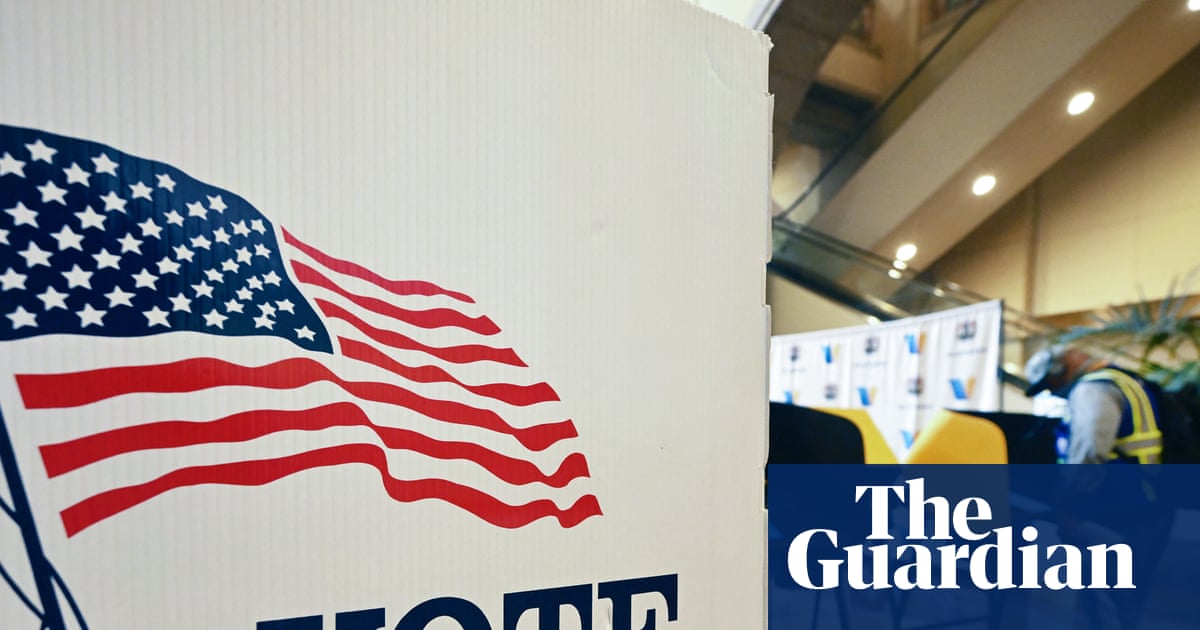
Though Mississippi doesn’t have early voting, the state does offer absentee voting to older adults and those with qualifying excuses. As of 27 October, more than 56,000 absentee ballots were cast in Mississippi, up from 22,221 in 2022. During the last midterm election, however, the Senate race was not on the ballot. The number is lower from where it was during the 2024 presidential election.
“I feel like I need to do everything I can to represent the values and vision of the people of Mississippi,” Colom said. “For too long, Mississippi hasn’t been a lost cause, it’s been a betrayed cause.”













Comments