
 German (DE)
  English (US)
  Spanish (ES)
  French (FR)
  Hindi (IN)
  Italian (IT)
  Russian (RU)
  2 hours ago
Even before he in effect endorsed Hungary’s Viktor Orbán before of a crucial parliamentary election, Marco Rubio’s itinerary for Europe promised to be provocative. After meeting with US allies at the Munich Security Conference during a particularly tense moment in transatlantic relations, the US secretary of state departed for Slovakia and Hungary – the two EU states most dependent on Russian energy and sceptical of the bloc’s support for Ukraine.
In what bordered on an explicit political endorsement, Rubio told Orbán that relations between Hungary and the US had entered a “golden age” – and would stay like that for as long as Orban remains in power.
“If you face financial struggles, if you face things that are impediments to growth, if you face things that threaten the stability of your country, I know that President Trump will be very interested … to finding ways to provide assistance if that moment ever were to arise, and obviously with regards to finances and the like,” Rubio said.
The offer of financial support – and a nod toward extending Hungary’s exemption from sanctions on purchasing Russian oil and gas – came just two months before Orbán’s Fidesz party faces a punishing parliamentary election that marks the greatest threat to his control of Hungary in 16 years.
It also recalled offers made by the White House to other US rightwing allies abroad, including a $20bn bailout for Argentina’s Javier Milei that is credited with helping his party win crucial midterm elections by stabilising the country’s economy and currency.
“Especially as long as you’re the prime minister and the leader of this country, it’s in our national interest that Hungary be successful,” Rubio told Orbán.
In Brussels, Rubio’s visit to Hungary was guaranteed to reinforce fears that the US was seeking to promote chaos and disunity among its allies as tensions grow over topics from Ukraine and Greenland to trade deals and defence spending. And his remarks looked a lot like an effort to sway an election in the heart of Europe, said analysts.
“It’s an ‘eff you’ to the EU,” said Theresa Fallon, the director of the Brussels-based Centre for Russia, Europe, Asia Studies. “It was really clear.”
It has been a bruising few months in transatlantic relations, with Donald Trump demanding the Netherlands cede Greenland to the US on the grounds of national security. Adding insult to injury, Trump told reporters that Denmark was unable to protect the semiautonomous territory from an attack from Russia or China and that “their defence is two dog sleds”. He backed down on a threat to impose tariffs after Nato agreed to the framework of a future deal on the Arctic.
And last year at the same conference last year, JD Vance accused European leaders of censoring their citizens using “ugly Soviet-era words like ‘misinformation’ and ‘disinformation’” because they feared that voters might “express a different opinion, or – God forbid – vote a different way”. The EU’s top diplomat at the time said it seemed that the US was “trying to pick a fight with us”.
European diplomats in Washington DC welcomed the dispatch of Rubio rather than Vance because he is seen as a more traditional Republican who had – until recently – backed a more conventional US foreign policy. In a Trump administration where personalities so often dictate policy, Rubio’s continued presence has been seen as a rare bright spot. “He is much preferred to Vance, but they still both work for Trump,” said one European diplomat.
Rubio’s speech in Munich was more restrained than the vice-president’s a year earlier, and was met with a standing ovation by many of the European officials present. He presented a case for revitalising, rather than scrapping, the Nato alliance, which was a key fear among European officials after Trump’s re-election.
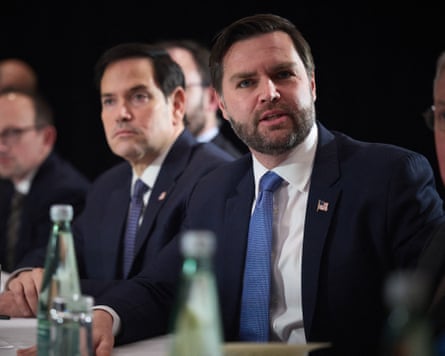
Matthew Kroenig, the vice-president and senior director of the Scowcroft Center for Strategy and Security at the Atlantic Council, wrote that Rubio “did not repudiate anything in Vice President JD Vance’s more pugnacious speech last year, but he presented the same themes in a more positive light, focusing on shared challenges facing both Europe and the United States and how allies can work together to address them”.
Fallon said: “Everybody wanted to hear something positive. And when they slept on it, they realised, oh my gosh, no, it’s the same thing, just packaged a little better.”
But as one diplomat put it: “The message coming from both [Rubio and Vance] is clear: you are on your own.”




Comments