
 German (DE)
  English (US)
  Spanish (ES)
  French (FR)
  Hindi (IN)
  Italian (IT)
  Russian (RU)
  3 hours ago
At 6.15am, Jac Kovarik revs up their SUV and snakes through the iced-over streets of south Minneapolis, eyes scanning for federal immigration agents.
The neighborhood where Renee Good was killed by a federal officer has been eerily quiet. The bus stops are depleted of early shift workers.
By 7am, a contingency of parents is walking their kids to kindergarten and elementary school – down from its usual bustling size to just one or two parents who are now escorting not just their own children, but also those of their immigrant neighbors and friends too afraid to leave the house.
As the sun rises, there are volunteers on nearly every corner of the neighborhood, clutching bright orange whistles. They blow them all in unison when they spot what looks like an Immigration and Customs Enforcement vehicle.
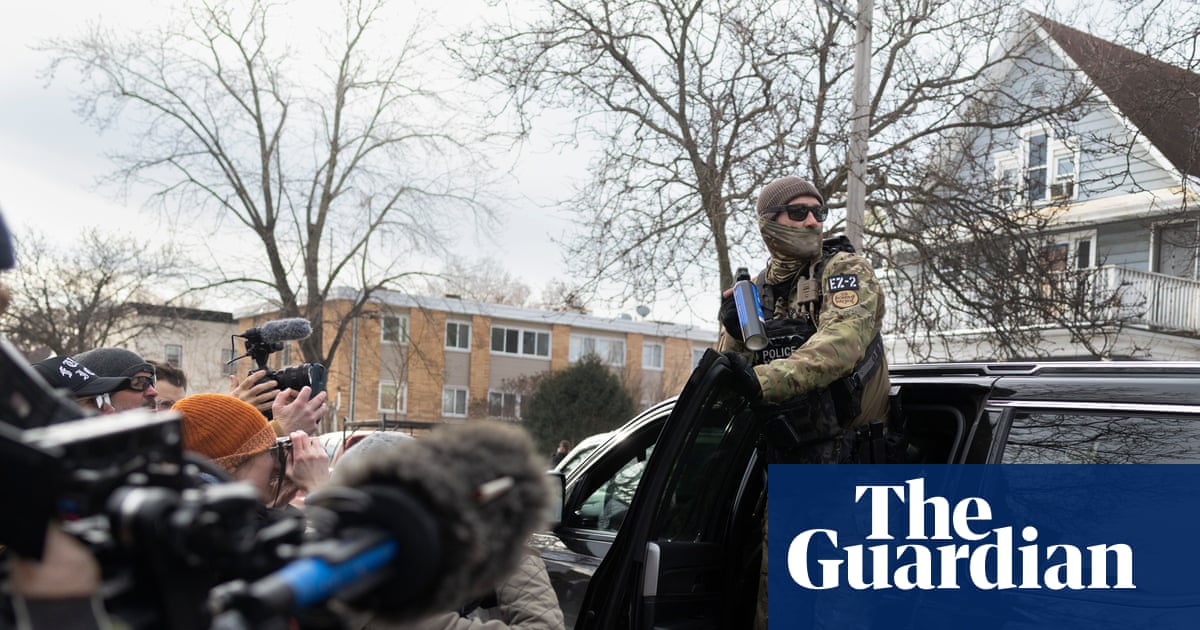
The Trump administration in recent weeks has mobilized 3,000 federal agents to the state of Minnesota – a force that now outnumbers the Minneapolis police force five to one. Armed, masked agents have been arresting people on their morning commutes, at grocery stores and outside churches. The Department of Homeland Security has called the operation the largest in the agency’s history.
“Make no mistake, this is an occupation,” said Angela Conley, a commissioner for Hennepin county, which includes Minneapolis.
Their presence has transformed the Twin Cities. “It’s affecting every aspect of daily life,” said Ryan Pérez, the organizing director of Copal, a nonprofit group that supports Latine families in Minnesota.
He was late to his meeting with the Guardian because ICE had been outside his organization’s office on Tuesday. Two immigrants and an observer were taken.
Some federal agents have been operating here since early December. Many others deployed in January, as the Trump administration fixated on Minnesota as it grappled with several high-profile cases of fraud of social services. Even more have mobilized in the past week, following the killing of Renee Good, a US citizen, by an ICE agent in Minneapolis.
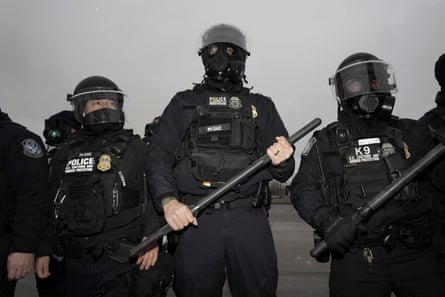
Good’s killing spurred protests throughout the state. In response, Donald Trump this week threatened the Insurrection Act in Minnesota on Thursday, raising the prospect of sending US troops into Minneapolis and St Paul to subdue demonstrators. On Friday, the administration upped the ante, with the Department of Justice announcing it had opened an investigation into Minnesota officials, including governor Tim Walz and Minneapolis mayor Jacob Frey, over an alleged conspiracy to impede federal immigration agents.
Along with law enforcement, rightwing influencers and content creators have also descended on the city, amplifying the president’s xenophobic messages about Somalis, and in several instances harassing Somali businesses, non-profits and childcare centers they accused of fraud but are not connected to the federal fraud investigation.
Federal agents, who have said they are seeking to arrest undocumented immigrants with criminal and dangerous backgrounds, have been using escalating, aggressive tactics to detain US and tribal citizens, as well as legal residents, refugees and longtime Minnesotans without any criminal record. The American Civil Liberties Union has filed a class-action lawsuit on behalf of Minnesotans who allege racial and ethnic profiling.
“We are living in a nightmare,” said Kate, a teacher at Minnesota Public Schools. “It’s dystopian.” The Guardian is not using her full name to protect her students.
Garrison Gibson, a Liberian man, was arrested after agents used a battering ram to bust into his home last weekend. A federal judge ordered ICE to release Gibson on Thursday, which it did, only to arrest him again on Friday. He was then released again.
“I’m just scared to go outside. I’m scared of them,” said Daisy Martinez, whose husband Tomas Martinez Gregorio was arrested on New Year’s Eve in the suburb of Brooklyn Park. The couple had been pulled over by agents while driving their six-year-old son to the hospital for a tonsillectomy. While her son was in the backseat, multiple agents pinned her to the car and took Tomas. “It’s almost as if he was kidnapped,” she said.
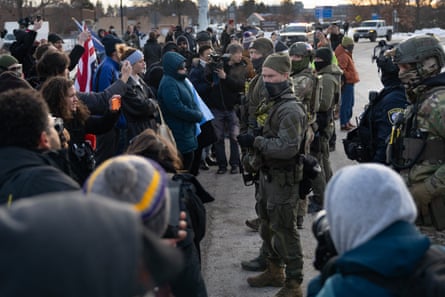
Now Martinez said she’s unsure every day what to tell her son – who has started to see a therapist to help him cope in the aftermath of what he’s witnessed. “He does tell me that he doesn’t want to go to school,” Martinez said. “He doesn’t want me to be taken away too.”
After federal immigration agents came to Roosevelt high school in Minneapolis last week, used chemical irritants outside the campus and detained a staffer, all Minneapolis public schools closed for two days. This week, parents are being offered a choice between sending their children to class in person, or online.
Kate, an early childhood educator who works with mostly Spanish-speaking children and their families, now works alone, in an empty classroom.
Her room has now become a sort of distribution center for supplies. Piles of diapers are stacked to the side. At her desk, she has set up a system using sticky notes – color-coded by neighborhood – to keep track of which families need what supplies when. She forgot to fish the pink stickies out of her pockets before running the laundry this week – so many of her clothes have since been tinted rose.
Some of Kate’s students have parents who are pregnant – too afraid to attend prenatal appointments. In local Facebook groups, neighbors have made callouts for midwives and doulas who could help attend to expecting mothers at home.
ICE agents have been inside the Hennepin county medical center for a week, according to the county commissioner Angela Conley. Healthcare workers at the hospital told Sahan Journal agents at one point shackled the patient’s feet. The county is working to figure out how it can get them to leave and assessing its policies, she said.
As Kovarik surveyed for ICE on Tuesday morning, Lake Street, an immigrant-heavy corridor, was especially quiet. When Kovarik spots an agent, they usually try to follow them, alert residents to ICE’s presence using whistles and car horns, and document what the agents are doing. They also work to verify which vehicles ICE agents is driving for others on patrol.
As federal law enforcement has surged, so has the response. “If we really have patrollers on every corner, it’s going to be really hard for ICE to do what they’re trying to do,” said Kovarik.
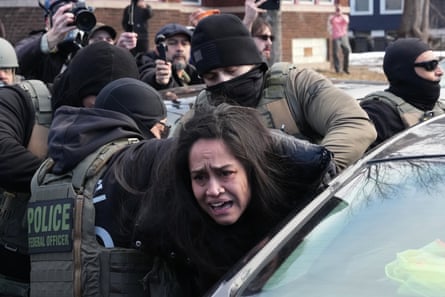
Later that morning, a massive group of agents confronted a larger group of neighbors at 34th and Park at about 9.40am. Agents pulled a woman who said she was on her way to a doctor’s appointment from her car and carried her through the street and into their vehicle, video of which spread widely.
“The people of the Twin Cities are extremely determined,” Kovarik said. “We just are more and more determined as they send more and more agents. And at the end of the day, there’s way more of us than them.”
In past days, agents have increasingly spread into the suburbs and more rural parts of the state, where rapid response networks aren’t as robust, picking people up at shopping centers and restaurants. In the small town of Willmar, ICE agents reportedly dined at a Mexican restaurant earlier in the day, then arrested workers at the same restaurant later that day, the Star Tribune reported.
Only a smattering of patrons are trickling into the coffee shops, many of which are plastered with signs saying “Federal agents are not permitted” and “Fuck ICE”. At the Pow Wow Grounds cafe, a second sign signalling that the doors will remain locked throughout the day, and customers should knock and wait to be let in.
At lunchtime, one of the only restaurants open on East Lake was an American diner. At least four Mexican restaurants in that block had been shut, indefinitely.
Approximately 80% of immigrant-run businesses in Minneapolis and St Paul had been closed this week amid the ICE crackdown, and sales at these businesses had plummeted since late December. The Minneapolis city council now wants the state to install an eviction moratorium – hoping to relieve the people risking their safety to work and pay the rent.
On Sunday, federal agents Nimco Omar – a US citizen who is Somali – was walking toward a Somali shopping center in the late morning when four ICE agents got out of a car and and repeatedly asked her to verify her citizenship, telling her they were doing an “immigration check”. In a video of the encounter that has gone viral in the city and beyond, she responds: “I am a US citizen. I don’t need to carry around an ID in my home.”
Omar told the Guardian she saw no reason to hand over personal information to “a masked person walking around my neighborhood”. No law, she said, required her to prove her citizenship in that moment.
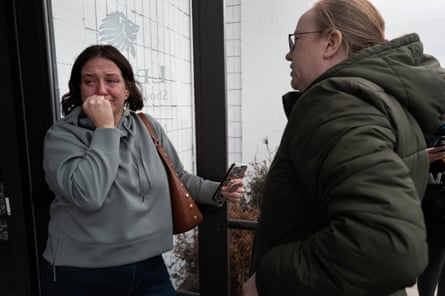
“People come to this country to feel safe, to work hard, and to raise their families with dignity. Instead, many of us are now living in fear,” she said. “It feels like our own country has turned against its people, and that is heartbreaking.”
The mall where Omar had been headed – the 24 Somali Mall in central Minneapolis – has been hollowed out in recent weeks. Patrons and vendors alike carry their passports, just in case.
About 84,000 people of Somali descent live in Minnesota, and most of them are US citizens or legal residents. In December, after a cabinet meeting, Donald Trump called Somali immigrants “garbage” and denounced a fraud scandal in Minneapolis involving social services run by Somalis. Subsequently, he said his administration intended to strip some naturalized Somali Americans of their US citizenship.
“We are really at a point of existential crisis,” said Julie Decker, a policy director at the Immigrant Law Center of Minnesota. “We have to be honest with people, and tell them, ‘You may be detained regardless of your status.’”
In the afternoons, Juan Leon – who owns Leo’s Tow in West St Paul – said he has been fielding an overwhelming number of calls to help move cars that have been abandoned after ICE agents arrest the drivers.
In mid-December, the company spent hours digging out a car that had been left for days, with its windows open, during one of the first big cold snaps of the season. “We had to wrench it out of the snow,” he said. Normally he’d charge at least $300 for a job like that. But Leon has been offering free towing in his neighborhood and a $100 discount to people in surrounding areas.
The demand has been high. Sometimes, families call him. Other times, he said, families aren’t even immediately aware that their loved ones have been taken by ICE. So observers and witnesses call him, asking if he can tow cars to a safe place until someone can come forward to claim them. Other times, families don’t know where their cars have been left, so Leon and his girlfriend have to embark on an investigative mission.
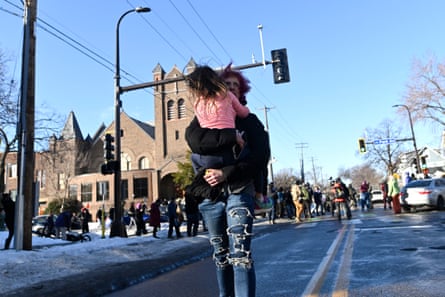
Leon only launched his company a couple of months ago, and is now raising funds so he can keep the service going. “We’ve often got observers who are paying for [strangers’] tows,” he said. “It’s just such a beautiful thing to see everybody coming together. I wish it was under better circumstances.”
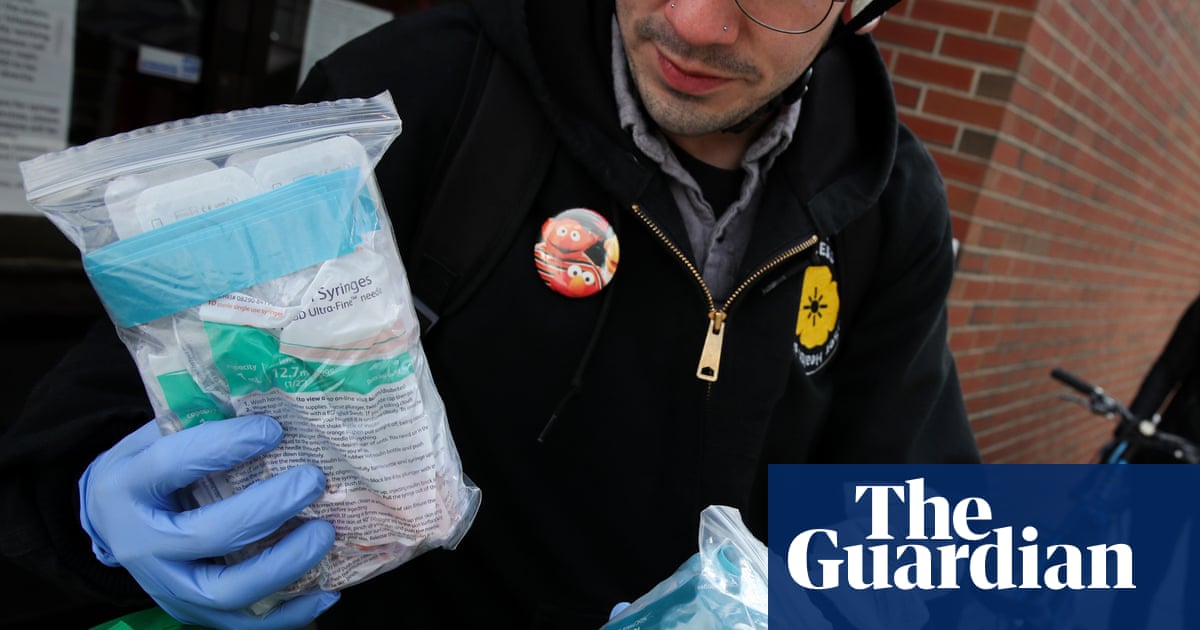
Ad hoc mutual aid centers had popped up all around the city. In Uptown Minneapolis, the sex shop Smitten Kitten has transformed into a donation center, stacked with piles of canned food and toilet paper. Volunteers stand guard outside as a steady stream of neighbors pop in to drop off food and other supplies.
In the Franklin Avenue East Cultural District – the city’s Native American cultural hub – an art gallery has become a resource center, stocked up with free groceries, hot soup and fry bread. At the coffee shop in front of the gallery, the barista collects donations via Venmo or cash, and offers free coffee for anyone who needs it. Teams of legal observers pop in throughout the day to grab hand warmers, as well as goggles and respirators to shield themselves against the chemical irritants that federal agents have been using against observers and protesters.
The Rev Ashley Horan, vice-president for programs and ministries at the Unitarian Universalist Association, lives a block from where Renee Good was killed. She has brought in donations from $5 to $500 from well-meaning people around the country and estimates she’s moved about $20-25,000 in cash to people in her network – for rent, for food and gas, for supplies like whistles and hand warmers for observers.
“Minneapolis could be and will be anywhere else in the country,” Horan said. “I want other communities around the country to be doing the prep work so that when it happens in your town, you’re ready.”
The sun goes down early here, before 5pm – it’s the middle of winter. Teachers head back home in pairs or groups after class.
Lately, parents and coaches have been rethinking evening sports events. The Southside Red Bears – a co-ed youth basketball team in Minneapolis’s south side –cancelled their game in the north side this weekend. “That’s too far away for our kids’ to be, in case something happens,” said Jolene Jones, at the Native American Community Development Institute, which helped launch the team. “Our children are all brown or black.”
On Monday, Elliott Payne, the president of the city council, was himself shoved by an ICE agent. He was on Central Avenue observing and saw ICE harassing a resident. He said he was keeping his distance when an ICE agent pushed him from behind while Payne was watching another ICE agent point his taser at people. He had introduced himself at the scene as the council president and tried to start a conversation.
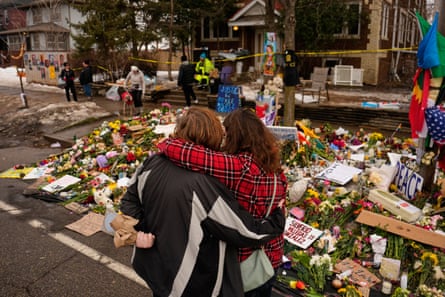
“This is the type of reckless behavior that is unfolding in our city,” he said at a press conference Wednesday. “Even when the council president is present and aware, they’re still assaulting us.”
On Wednesday night, agents shot Julio Cesar Sosa-Celis in the leg in north Minneapolis, drawing people out to document the aftermath and protest against agents’ actions. One family loaded up their car with their six children and tried to leave the neighborhood amid the unrest, but ICE set off teargas and flash-bangs around the vehicle. The youngest child in the car was six months old.
The next night, outside the Graduate hotel, near the University of Minnesota – a crowd, including many students – trashed electric guitars, blew whistles, played trombones and banged on all manner of drums, pots, pans and paint cans.
They wanted to make sure that any ICE agents staying at the hotel wouldn’t be able to sleep.

















Comments