
 German (DE)
  English (US)
  Spanish (ES)
  French (FR)
  Hindi (IN)
  Italian (IT)
  Russian (RU)
  2 hours ago
They had just settled down for breakfast when the noise came. Some paused in the eating of their slow-cooked beans – cambuulo – spooked by the haunting high-pitched hum. Others pressed their faces against windows, scanning skywards. Farmers in nearby maize fields watched the objects circling above Jamaame, a town in southern Somalia.
Shortly after 9am on 15 November 2025, Jamaame shuddered from a series of explosions.
The home of Abdullahi Mohamed Abo Sheikh Ali, who was out tending his fields that day, was among those obliterated. His grandfather Mohamed raced towards the rubble.
“Clothes and books were scattered on the ground, but I couldn’t focus on them. I was in shock, standing before the bodies of my grandchildren. They were ripped to pieces.”
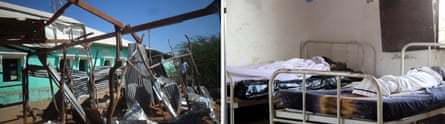
Images were published by Shahada news agency, affiliated with al-Shabaab, but have been examined for authenticity and do not show signs of digital alteration. Photograph: Shahada agency news
Scrabbling among the debris, Mohamed found the body of Safiyo Hassan Abukar, his daughter-in-law. She had been heavily pregnant.
Beside her were the remains of Abdifatah, her eldest child. It was little surprise the 10-year-old was found so close to his mother.
“Abdifatah never left her side, always helping with chores. When he was around, she needed no one else,” says Mohamed.
Seven-year-old Abdinasir, lay dead nearby. Abdinasir had doted on his grandfather. “He always asked me to pray so he could memorise the Qur’an. Sometimes I called him my ‘prayer seeker’ and he would smile.”
The bodies of two more brothers – Hussein, six and Abdurahman, four – were among the debris.
The family were killed during a US airstrike in Somalia. According to a Guardian investigation, at least 12 civilians, including eight children, died during the attack.
It is the deadliest US operation for civilians in Somalia during either Trump administration. The US had not killed so many innocent people in a single incident in the east African country for 18 years. The previous highest confirmed toll was the bloody, botched US military operation in the capital, Mogadishu, that became known as the 1993 Black Hawk Down incident.
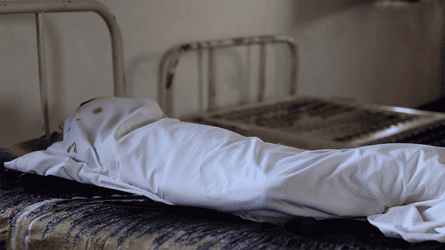
Despite the scale, no investigation appears to have been launched into the attack on Jamaame six months ago. No one has been held accountable for the deaths – the US refused to admit that a single civilian died in the town that day.
Using photographs, video footage, and X-rays of children’s shrapnel injuries, alongside witness testimony, the Guardian has pieced together the first detailed account of themassacre.
The killings raise questions not only about US intelligence, but Washington’s intensifying campaign in the Horn of Africa. Hundreds of strikes have been carried out by the Trump administration in a legally ambiguous, secret war with no apparent accountability for civilian deaths.
Who signed off the attack on a densely populated family neighbourhood? Why and who, if anyone, was the intended target? Testimony indicates that it is highly probable the US drone teams knew children were in the vicinity.
More broadly, Jamaame invites scrutiny over how the US military values the lives of ordinary Somalis. The commander-in-chief of the US armed forces – Donald Trump – has repeatedly attacked Somalis, labelling them “stupid”, “low IQ” and their country as “disgusting”.
Did presidential disdain imply to senior officials they could get away with killing civilians?
The US drones moved closer. A short while earlier, they had most likely taken off from Camp Simba, a military base farther south on the Kenyan coast. From the drones’ lofty vantage point, Somalia would have looked stunning: vast unspoilt sand beaches framed by white surf. Five miles (8km) inland, perched on a curve of the Jubba River, is Jamaame.
Full-motion video, or FMV, as live feeds from drones are called, relayed life inside Jamaame to a team of pilots and analysts in extraordinary detail. “You can read licence plates,” says Brett Velicovich, a former US army special operations intelligence analyst.
In Jamaame, people saw the aircraft above. Although the US would not comment on the weaponry used in the attack, they were probably MQ-9 Reaper “hunter killer” drones armed with Hellfire missiles.
In the Burburka neighbourhood, Marian Haji Abdi Guled remembers the door of her home swinging open to reveal her three grinning children, returning from Qur’an school.
But Guled felt uneasy, spooked by the “very loud” noise overhead. Her home shuddered, and the children ran outside to see what had happened.
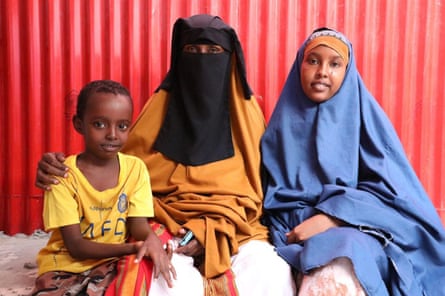
Suddenly, another missile screamed down from the sky and Guled also ran outside. “All my children were lying on the ground covered in blood. When I tried to tend to them, shells began falling everywhere. Every direction you turned, there were shells and missiles raining everywhere.”
Nearby, Maryan Nur Buruji’s pregnant stepdaughter had fled to take shelter at the Qur’an school, her two-year-old tied to her back.
About 9.30am, witnesses described two missiles striking the school. Buruji’s stepdaughter was killed. The toddler, still clinging to her dead mother, somehow survived.
Amid the pandemonium, Mohamed Hassan Abdulle ran to a friend’s house to borrow a motorcycle to ferry his family from danger.
“He told me he’s going to help his family flee first and then come back for my family,” says a neighbour.
But Abdulle was too late. His home was already flattened. Under the remains was the bodies of his 26-year-old wife, Farhiyo Hassan Nuur, and daughter, Layla Mohamed Hassan. Layla was 10 months old.
He stood beside his destroyed home, the entire neighbourhood ablaze. “I couldn’t even find anyone to help carry the bodies of my wife and daughter,” he says.
Outside Jamaame, Gedow Ibrahim had been tending his sesame crops when he received a panicked call from his wife, Nuurto Hussein Abukar, 30.
“There was a lot of fear in town because drones were hovering above. I told her to remain indoors.”
At about 10am he received another call, this time from a neighbour, urging him to return home immediately. His house had been destroyed.
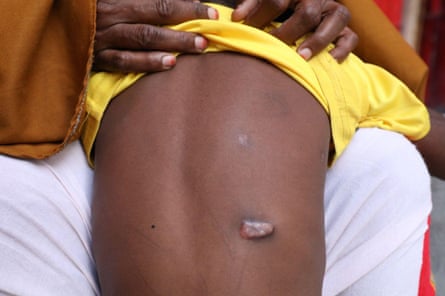
In its wreckage his daughters, Maryan, nine, and Farhiyo, seven, were dead.
“I saw the lifeless bodies of my children. One of them had their left arm torn off. The other one had shrapnel in their back, which came out of their chest.” His daughter Amin, eight, was peppered with shrapnel: metal shards speared her shoulder, thigh, hips and calf.
Also summoned home from his crops was Abdullahi Mohamed Abo Sheikh Ali, farmer and grandson of Mohamed. He, too would be confronted with a scene of terrible devastation and discover his family had been wiped out.
Abdullahi, unable to process his wife and four children’s deaths, went into immediate shock. “He’s never been the same,” says Mohamed.
Others were also dead, including a revered imam.
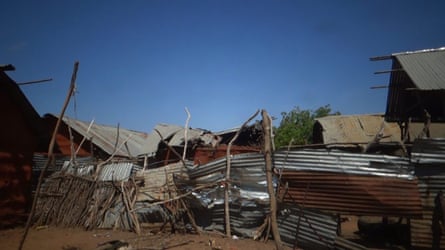
Although the precise chronology of the strikes is difficult to verify, witnesses counted at least 15 explosions. Mohamed says at least 18 homes were destroyed. The school was reduced to a shell. Guled counted nine strikes in the Burburka neighbourhood alone.
Abdullahi, struggling to comprehend his loss, finds clarity when it comes to naming the culprit. “The Americans bombed us,” he says. “Children, women and elders were bombed. They spared nothing.”
When Trump began his second term, analysts wondered how Somalia would fit into his foreign policy. On his first overseas trip – in February 2025 – Trump’s defence secretary, Pete Hegseth, met senior officers from the US Africa command headquarters, Africom, in Germany.
Omitted from the press statement was Hegseth’s signing of a directive implementing a change that would have profound repercussions for the Jamaame families nine months later.
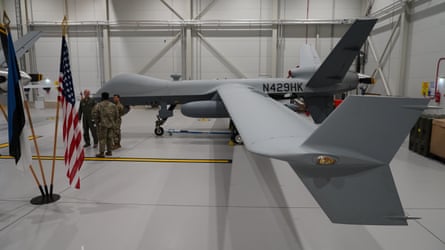
Safeguards governing drone strikes were dismantled. Restrictions imposed by the Biden administration – requiring White House approval for drone strikes in Somalia – were overturned.
Now, Africom generals could unilaterally decide whether to sanction a strike.
“They got the green light for high-tempo operations with minimal oversight,” says Jethro Norman, of the Danish Institute for International Studies (DIIS).
The loosened rules of engagement started a dramatic escalation of US operations in Somalia. Acled, which monitors global conflict, recorded 123 airstrikes by the US last year – more than six times as many as the year before and double the previous record, set in 2019. This year the tempo has quickened further to unprecedented levels: by April, 49 attacks had been documented – averaging an airstrike almost every other day.
But what instigated the attack on Jamaame?
The US military has never contested its involvement in the strikes. The day after, an Africom statement said it had conducted airstrikes in that area on 15 November.
Referring to the Somali Islamist militant movement that emerged in the 2000s, it added that Jamaame was attacked as part of “action to degrade al-Shabaab’s ability to threaten the US homeland, our forces and our citizens abroad”.
While Jamaame falls within territory broadly controlled by al-Shabaab, every witness interviewed by the Guardian stated that the group was not present in the town. In fact, all testified that the militants had never set foot there, preferring rural hideouts.
“There was no al-Shabaab presence in our town, only women, children and elders. Before the airstrikes, the situation in Jamaame was calm and peaceful,” says Guled.
Buruji adds: “The only people [here] are livestock herders and farmers.”
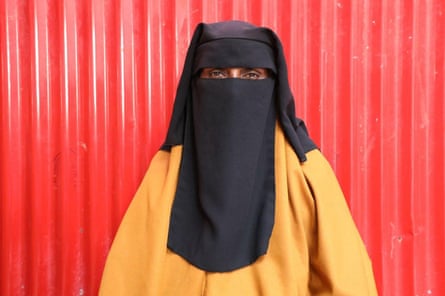
Their accounts raise questions about US intelligence: who were the strike team trying to kill, and how detailed was their “target development” in the weeks before the attack?
Drones, as Velicovich says, allow “precision-guided munitions” to be targeted at identified individuals.
When conducting his own drone strikes in Somalia, Velicovich meticulously studied his target’s daily routines: who they met, when and where: “Not sleeping for three days, watching these guys over and over.”
However the dead in Jamaame were mostly children and their mothers. The Qur’anic school, crammed with children shortly before the attack, was hit alongside residential buildings belonging to families who had lived there for decades. Guled had lived in the same home for her entire 42 years until it was destroyed. There seemed no obvious reason why her house would be targeted.
Perhaps there was no target development. Some airstrikes, says Norman, who has extensive knowledge of the workings of military operations in Somalia, could be notably hasty.
Africom, he says, sometimes requests permission from Somali government officials almost as the strikes are under way. “Sometimes they’ll call an hour before and say: ‘We’re going to hit this target, please sign this piece of paper.’”
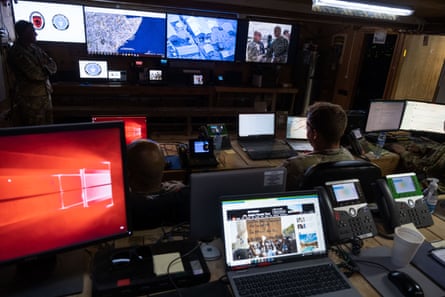
Another theory is that the Jamaame intelligence was deliberately misleading. US officials are vulnerable to being spoonfed false information, according to Norman.
“The Americans don’t really have a knowledge of what’s going on at the hyper-local level. It’s quite easy for certain Somalis to bump off clan or political rivals by feeding information,” he says.
Regardless of intelligence flaws, US drone operators should have a potent safeguard: they can see everything on the ground in real time. The MQ-9 Reaper, for instance, has exceptionally high-quality, multispectral cameras.
The drones’ live feeds allow operators to clearly distinguish between adults and children, and operators are trained to distinguish fighting-age men.
And children were outdoors in Jamaame which should have halted an operation. Guled’s two sons – aged 16 and seven, and her 14-year-old daughter were in the street when the attack was launched.
“A lot of money is spent on cameras and information to verify that the bad guy is the bad guy; part of that is for precision and for not making mistakes,” says Velicovich.
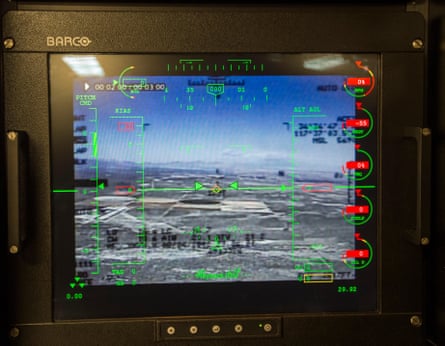
After children had been killed, missiles were described as continuing to hit nearby homes. The US Department of War would not comment on why a decision to keep firing was made.
Even under the current relaxed rules of engagement, US officials should ensure the safety of civilian bystanders.
Perhaps the attack was based on “signature strike” patterns – observed activity that seems suspicious and therefore makes the people targets. “But you’re basically killing people without confirming who they are,” says Norman, and those killed in Jamaame could hardly have looked less like militants.
The strikes become even more perplexing with the altitude of the drones. Multiple witnesses described the propellers as “extremely loud”, suggesting they were relatively low. Velicovich confirmed that the lower drones fly, the sharper their live-feed images.
So, who were the people analysing the images? How experienced was the drone strike team? Had they served in Somalia and could they understand what they saw? The US would not comment.
Some suspect the strikes suggest something darker than faulty intelligence and come back to the US commander-in-chief’s contempt for Somalia.
Trump has characterising the country as “totally broken and crime-infested” in a 2017 diatribe against the congresswoman Ilhan Omar.
Seventeen days after the Jamaame killings the president castigated Somali immigrants as unfit for US residency. In March, against the backdrop of increasing drone strikes, Trump dismissed Somalis as “low IQ” people from a “crooked country”.
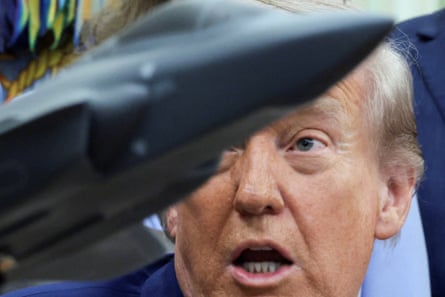
Norman says the Trump’s anti-Somali sentiment is notable in the context of civilian deaths. “The escalation of this rhetoric, the way it’s promulgated by Trump himself, gives a tacit green light to the military commanders that Somalis are now dehumanised. They’re being sent the message: ‘Go ahead, these lives don’t matter.’”
When the White House was approached for a response to the Jamaame strikes, the deputy press secretary Anna Kelly asked if the Guardian would also focus on “fraud committed by Somalis in the United States?”
Kelly added: “Describing enforcing the law and bombing terrorists as ‘racist’ is the kind of moronic take one can only expect from the Guardian.”
The official US account of the airstrike is brief and opaque. Africom’s statement makes no mention of any civilians killed. Asked to provide its casualty assessment of the attack, US officials refused to comment. Neither would it share the identities of individuals targeted or killed.
The dearth of information applies to strikes across Somalia. Last May, Africom “temporarily” stopped releasing casualty figures from the country. A year on, the self-imposed censorship remains.
Refusing to recognise civilian deaths makes it impossible for families to find answers. Acled’s Jalale Getachew Birru says: “There is no transparency, no justice when civilians are killed.”
The Jamaame airstrikes were supported by Somali ground forces, raising the possibility that some of the damage could have been inflicted by those troops. US officials would not answer questions over Somali forces’ role in the attack on Jamaame.
But corroborating witness accounts indicates that the drones’ missiles – not ground troops or mortar fire – killed the civilians. Guled says there was “no way” the explosions were from mortars.
Buruji says: “My stepdaughter didn’t die from fighting but from a missile that came from the sky. The shrapnel from a missile struck her breast and neck. It’s how she died.”
None of the bereaved families have yet been contacted by US officials or the Somali government.
An apology appears improbable, despite the seeming failure to adequately distinguish civilians being a violation of international law. Compensation seems unlikely. The US maintains a $3m (£2.2m) annual budget to compensate civilians for drone deaths but nothing has been paid out to Somali families.
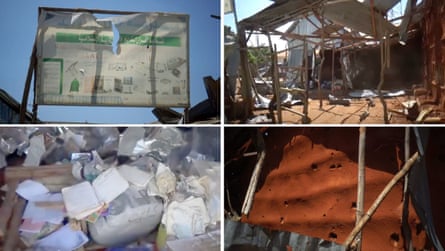
“I’m requesting compensation for the atrocity that was inflicted upon our family. I don’t even have anything to eat,” says Buruji.
Ibrahim wants answers before reparations. “I need to know why my children were bombed as they returned from Qur’an school.”
Guled adds: “I’m urging the Americans for justice and compensation for what has happened to my children.”
Some residents left Jamaame after the strikes. But the drones remained for months in the skies above the town, monitoring empty streets. Their constant presence, and the fear they bring, have made life intolerable.
“We can’t sleep because of the loud noise from the drone engines. Every night they hover over us. When we try to sleep, we fear we’ll be killed,” says Mohamed.
Across southern Somalia, the US operations against al-Shabaab appears to have had little impact. The threat from the group has intensified. Its forces have reached 20 miles from the capital.
“If the objective is to destroy al-Shabaab, it’s pretty clear that they [drones] are not particularly effective,” says David Sterman, an analyst at the New America thinktank.
Some warn that Trump’s Somalia strategy might actually be a potent recruiting agent for al-Shabaab.
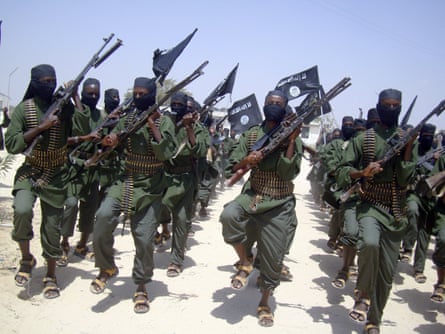
For Mohamed, he is left to constantly replay in his mind the terrible moments spent searching for the body parts of his four grandchildren.
They were too slippery, he says, and kept sliding from his grasp. “There was no place to grip because they were ripped to pieces.”
He describes his body as “burning”, slipping between rage and grief. “I don’t know if it’s pain or anger. So I cry.
“My grandchildren just loved learning the Qur’an. On their last day, they didn’t even get a chance to eat breakfast.”

















Comments