
 German (DE)
  English (US)
  Spanish (ES)
  French (FR)
  Hindi (IN)
  Italian (IT)
  Russian (RU)
  2 hours ago
When JD Vance became Roman Catholic, he wondered what his dead grandmother would think.
His grandmother Mamaw did not have anything against them, but growing up in Ohio he had sometimes heard that Catholics were servants of the antichrist. And although the people he knew as a child professed personal relationships with Jesus, most rarely went to church. The Church of Rome – with its rituals and costumes, foreign leadership, veneration of Mary and the saints – seemed exotic, even alien, to his family from Appalachia.
Yet he has said he was consoled, on the day in 2019 that he was received into Catholicism, by a sudden sense that his grandmother was urging him on from the grave. He heard one of her favorite phrases in his ear: “Time to shit or get off the pot.”
So, about five years before he was elected the vice-president of the United States with a running mate, Donald Trump, whom he once described as unworthy of Christians’ support, Vance had his baptism and first communion in a small ceremony conducted by the Dominican friars who first encouraged his interest in Catholicism.
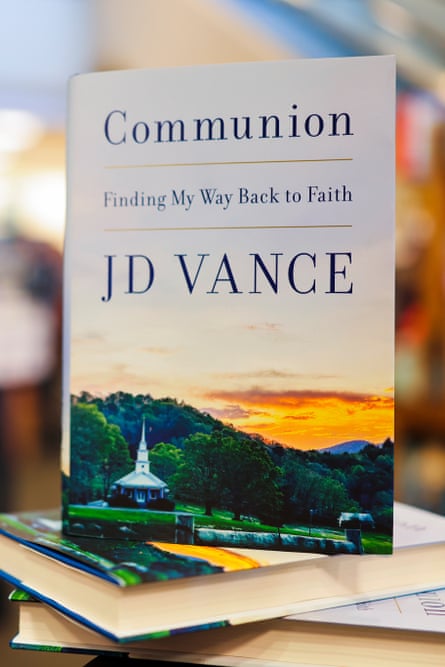
This week Vance released his memoir on religion, Communion: Finding My Way Back to Faith. It recounts his evolution through the casual and unchurched Christianity of his grandmother, the militant fervor of his father’s Pentecostalism, and the atheism of his college years to an orthodox – if not quite “trad” – Catholicism. The book also argues that a Catholic-influenced third way, neither strictly rightwing or leftwing, could help fix an America that Vance views as politically, economically and culturally deteriorating.
The book arrives at an unusual time for the Catholic church in the US.
In converting, Vance has joined a number of observant Catholics among the leadership of the American right. Although a minority faith in a historically Protestant country – and despite the public perception of a Christian right dominated by southern evangelicals – Catholicism has long had an outsized influence on American conservatism.
William F Buckley Jr, often considered the intellectual architect of the modern right, was a devout Catholic, as are many of the writers, activists, politicians and jurists who have driven that movement. Only about 20% of American adults identify as Catholic, and for many years leaned Democratic. Yet six of the nine current US supreme court justices, including nearly all the court’s conservatives, are Catholic.
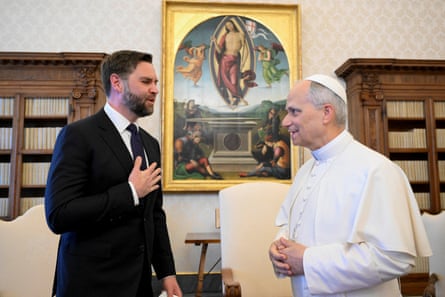
Vance has also become the country’s most prominent avatar of a revitalized conservative Catholicism whose alliance with the Maga movement has led to headline-grabbing clashes with the Vatican. Those spats have shocked many Catholic Americans and put Vance – who tangled with Pope Francis over immigration policy and earlier this year took issue with Pope Leo’s anti-war stances – in an embarrassing position between Trump and the Holy Father of his newly adopted faith.
Outside US centers of power, American Catholicism is in flux. Despite lingering distrust of the church over its shattering sexual abuse scandals, and despite the decades-long secularization of national life, some Catholic parishes in the US have recently reported a boom in new converts, often young adults disillusioned by the emptiness of modern life. Though this modest resurgence is unlikely to arrest the church’s ongoing decline in membership, it may contribute to Catholicism’s survival in a leaner and more fervent form.
In converting, Vance has become, as he puts it in Communion, “the most senior Catholic in the United States government”. He is also a probable 2028 presidential candidate who, if he wins, would be only the third Catholic president – and the first to hold office as a Republican.
Against that backdrop, his new book is an opportunity to try to understand what Catholicism means to Vance – and what he, and converts like him, mean to the church.
Vance’s first book, the 2016 memoir Hillbilly Elegy, described how he was raised by his grandparents while his mother grappled with substance abuse and a series of ill-fated relationships. His father waived his parental rights when Vance was six, though they later reconnected.
In a 2016 interview, Vance described his childhood as “pretty chaotic and hopeless”. Faith, he said, “gave me the belief that there was somebody looking out for me, that there was a hopeful future on the other side”.
Yet he also disputed the liberal perception that poor and rural areas of the US are heavily religious. In his experience, he said, churchgoing was “relatively confined to upper-income, well-educated people”. Although many people he knew back home were ostensibly religious, they tended to treat Christianity as “a cultural tchotchke” or “identifier”.
Communion adds to the portrait of Vance as someone whose chaotic childhood might make the structure and order of Catholicism attractive. (The book itself also expands on a 6,700-word essay, cheekily entitled How I Joined the Resistance, that he published in a Catholic intellectual journal, the Lamp, in 2020.)
Mamaw was a woman of deep but unstructured faith who loved watching televangelists, he writes, even though she suspected them of thievery and fraud. Interestingly, he also says that she believed abortion was “an individual moral matter and should remain legal”.
When he reconnected with his father, now a born-again “holy roller”, Vance experienced what initially seemed like a more satisfying and disciplined Christianity. He took up the evangelical Pentecostalism of his father’s church, where he was discouraged from reading Harry Potter and taught that the Earth was 6,000 years old.
“The Christian faith I’d developed by the time I was fifteen was adversarial: disengaged from mainstream culture, even terrified of it,” he writes.
Yet Vance became disillusioned. He found the environment anti-intellectual and apocalyptic. He was especially frustrated by evangelicals’ intense investment in the famous case of Terri Schiavo, the woman in a vegetative state whose husband wanted to take her off life support, which Vance saw as a distraction from problems closer to home.
After high school, in the US Marine Corps, Vance drifted further away. By the end of his deployment in Iraq in 2006, he writes, “I was no longer, in any real sense, a Christian.” By the end of college, he was an “angry atheist”, upset at the disappointments of his childhood faith and persuaded by the arguments of Christopher Hitchens and the popular anti-religion writers of the 2000s.
At Yale Law School, he was swept up in a race for achievement and a secular culture of “credentialism”. But he felt a lack in his life, he writes, and wondered if he had been too quick to turn his back on Christianity.
Vance was impressed by an encounter with the venture capitalist Peter Thiel (who later helped him run for the US Senate in 2022), because Thiel, “possibly the smartest person I’d ever met”, also “identified very openly as a Christian. He defied the very simple social template I had constructed – that dumb people were religious and smart people were atheists.”
By the time he married Usha Vance and they began to discuss having children, Vance was “Christian curious” and found Catholicism intellectually intriguing. He worried that his new zest for religion might feel like an imposition on his Hindu-raised wife, though he says she felt that faith was good for him after his emotionally difficult early life. (Usha Vance is not known to have joined Vance in converting, and the book is circumspect about her religiosity, if she has any.)
Two Dominican friars, Fr Dominic Legge and Fr Henry Stephan, helped guide Vance’s conversion. Vance was drawn to them, he writes, because both were academic achievers – Legge in law, Stephan in political philosophy – who had walked away from promising secular careers to join the holy order. Stephan gave Vance private instruction.
An order dedicated to preaching, the Dominicans have a reputation as intellectual – and conservative. The Dominican church in Cincinnati where Vance received his instruction hosts an event, the New York Times noted in 2024, where volunteers hammer crosses into a lawn to memorialize “innocents” not born due to abortion.
When Vance became Catholic in 2019, he chose as his patron saint the early Christian philosopher and polemicist Augustine of Hippo. Augustine’s treatise The City of God, which Vance cites as an influence in his conversion, argues that the history of civilization is best understood as a spiritual struggle between human forces aligned with God and human forces aligned, by their selfishness and materialism, with Satan.
It is hard to say to what extent Vance’s religious views have influenced his rhetorical and policy choices as vice-president. He has defended hardline stances on immigration and law enforcement, spread a false rumor that Haitian migrants were eating pets, and seemed at times less interested in representing the 340 million inhabitants of the United States, in its vast complexity, than in impressing online Christian culture warriors whose coin is macho ideological one-upmanship.
The book does walk back some of Vance’s more controversial remarks. He refers to his notorious 2021 aside about “childless cat ladies”, which haunted a Trump-Vance campaign that many women already distrusted, as “a boneheaded comment, intentionally (and successfully) provocative rather than illuminating”.
At the same time, his book gestures at the idea that Vance views himself as less a culture warrior than a civilizational one, like Augustine, who tells hard truths to a decadent and corrupt western society. “My big fear isn’t death,” he writes, “but that we inherited a great civilization and are slowly letting it fall into disrepair.”
The Dominicans’ orthodoxy may be more representative of the drift of American Catholicism than, say, the liberalism of the Jesuits. A 2025 survey found an astounding change in the political and theological makeup of Catholic clergy: 40% of priests ordained in the US between 1980 and 1989 identified as liberal – but only 11% of priests since 2020.
Similarly, white Catholics in the US were evenly split between Democrats and Republicans as recently as 2009. They now tilt Republican. Hispanic Catholics are far more likely to vote Democratic, but have also shifted right.
When the US was a more pious country, the fact that someone worshiped regularly, or was part of a particular denomination, was not a useful indicator of their politics compared with other factors like class, geography or ethnic background, said Ryan Burge, a political scientist, former Baptist minister and the author of this year’s The Vanishing Church: How the Hollowing Out of Moderate Congregations Is Hurting Democracy, Faith, and Us.
As society has become more secular, and as polarization has led to a perception that religion is “rightwing”, the result is a selection effect. Most Catholics in the US, statistically, are “cradle” or “cultural” Catholics who were born into the faith but rarely attend church, Burge said. They are more likely to be liberal, and more likely to fall away. Converts, reverts and highly dedicated churchgoers are almost always more conservative.
Some younger Catholics view themselves as leading a counterrevolution against a “baby boomer Catholicism” or “church of nice” that traded core Christian theology, with its discomfiting but powerful message about sin and redemption, for a therapeutic and vague deism that deemphasized controversial doctrines, took a lax approach to liturgy and sacraments, and replaced the aesthetic beauty of traditional Catholicism with a bland modernism.
This may point to a certain cyclicality: boomers, who grew up with national prosperity and a more conservative order, sought to liberate themselves from what they felt to be stifling rules and duties. Now millennials and gen-Zers – or at least some of them – are hungry for the structure that their parents or grandparents rejected.
Similarly, some observers of religion have written of a cultural phenomenon of “re-enchantment”. In a secular age defined by the inhuman logics of technology and the market, some Americans yearn for a return of the mysterious and magical.
The writer Leah Libresco Sargeant, a 36-year-old former atheist who converted to Catholicism in 2012, believes that an orthodox Catholicism that refuses to bend to ideological currents will prove more enduring than a church eager to accommodate the cultural or political moment.
“When people are seeking a church,” she said, “but the one they encounter is very flexible, or doesn’t ask things of them, or doesn’t mark them out as distinct from the culture as a whole, I feel like they’re less likely to come or to stay.”
Speaking by phone from a monastery in northern Italy, Massimo Faggioli, a professor of theology at Trinity College Dublin, noted that American converts, such as Vance, tend to have a conservative and totalizing view that rests uncomfortably within a heterogenous and global church.
At times it can be a “challenge”, he said, “for these conservatives to accept the idea that they are part of a church which is made of very different kinds of people – conservatives, liberals and so on. So it’s one thing to become a Catholic via baptism; it’s a little different to become part of the church in a way that accepts the messiness of Catholicism.”
The pews at the buzzy Church of St Joseph in the West Village, in Manhattan, were so packed on a recent Sunday that there were men and women sitting on the floor. Two dozen more were standing in the vestibule, straining to hear the service through glass doors. The average age looked to be about 25.
In recent years, Catholicism has enjoyed a certain chic in some corners of New York’s otherwise leftwing arts and intellectual scenes. Young Catholic influencers have also worked hard, on Instagram and TikTok, to make church cool again.
Kate DePetro, 27, co-organizes a weekly event in which young adults gather at a pizzeria and then walk to an evening mass at St Joseph’s together. Footage on social media, she said, continues to attract people.
“I think our generation is realizing that they want that sense of purpose, want that sense of community, want to have faith, want to have hope in something,” she said.
A new book by the journalist Melanie McDonagh, Converts: From Oscar Wilde to Muriel Spark, Why So Many Became Catholic in the 20th Century, charts the number of British writers, intellectuals and artists who converted at a time when that was viewed as a shocking decision by the Protestant (and often functionally agnostic) British elite.
Those converts cited a number of justifications, but a commonality was a sense that Catholicism had a universality, mysticism and absolutism that staid Protestantism lacked – an ineffable weirdness, in the eyes of an outsider, that made it feel authentic.
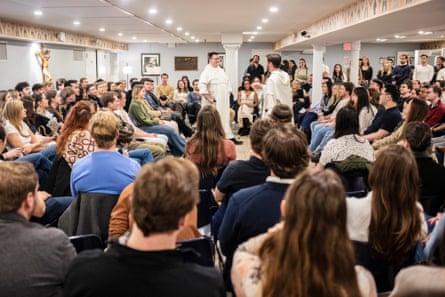
Most of the young people at St Joseph’s did not necessarily look like latter-day Oscar Wildes or heady intellectuals eager to discuss the finer points of fifth-century theology. Rather than converts, most seemed to be clean-cut Catholic kids, perhaps recently moved to the big city, who were relieved to discover, via social media, that they weren’t alone.
Attracting any young adults to church is an achievement in a busy and secular age – one when many young people, particularly women, regard religion’s conservative and patriarchal inclinations with wariness. And when it comes to older and more powerful people, organizations such as the arch-conservative Opus Dei have a track record of persuading rightwing politicians, businesspeople and intellectuals to open their souls to what American elites once regarded as suspicious popery.
The problem for a church eager for new blood, however, is that Vance “is, statistically, a weirdo,” Burge, the political scientist, said. Only a tiny percentage of Catholics are converts, and people leave the faith at a far higher rate than the church gains new members. Despite the attention that high-profile conversions draw, he said, the Catholic church isn’t actually very good at converting people.
Burge is also skeptical of the idea, sometimes advanced by conservative Catholics, that the liberalizing reforms of Vatican II “made church too easy” and contributed to declining membership. Almost every institutional Christian church in the US has been shrinking for decades, he said, and the trend defies theological or political lines.
Although liberal denominations such as the mainline Episcopalians, Presbyterians and Methodists are often perceived as having suffered the worst falls in size and cultural relevance, the Catholic church and conservative evangelical groups such as the Southern Baptist Convention are experiencing the same declines. The only parts of American Christianity that are growing, he said, are nondenominational, charismatic and Pentecostal churches that emphasize the emotional experience of worship.
“If there’s a revival in the Catholic church, it’s a bougie revival,” Burge said. “It’s people with college degrees, people who want an intellectualized faith, want 2,000 years of Catholic theology to dig in to. But the average American doesn’t want that … They want to sing praise songs and clap and not think about all the problems they’re facing for 45 minutes.”
He said that there is a similar gap between Catholic converts, who are often attracted to “traditionalist” streams of the faith, and Catholics in aggregate. Converts “read the encyclicals and stuff, and the average cradle Catholic is like, ‘What’s an encyclical?’”
If he runs for president in 2028, Vance will no doubt face questions about what his new faith means in the political realm. At times, Communion feels like an attempt to thread a difficult needle: arguing for that faith – and defending the idea of mixing faith with politics – while also trying to get ahead of any notion that he is a theocrat.
Catholic doctrines do not map easily on to either major US political party. The church’s views on abortion and gay marriage are associated with conservatives, while its views on the death penalty, social welfare and immigration are often associated with liberals.
As vice-president, Vance has been inconsistent in his embrace of the more controversial Catholic social doctrines – at times seeming like a zealous foe of abortion rights, for example, and at others backpedaling when the Trump administration realizes that its anti-abortion policies are unpopular. (Last year, Vance said that the administration would not restrict access to the abortion pill.)
“Prudence is the better part of virtue,” he writes. “If your political argument on the abortion question – or any other – fails to persuade your fellow Americans, you have to make a better argument.”
Although Vance does not use the word, the final section of his book is an extended argument that seems inspired by “integralism”, a political theory that Catholic morality should influence government.
Integralists believe that governments aligned with Catholic teaching must protect the public from social and economic ills, even if that means infringing on citizens’ freedom (by, say, restricting abortion) or the freedom of the market (by, say, making companies pay workers better).
In Vance’s telling, this is a pragmatic approach to governing, not a radical one. Whether the American people want this – especially when the Trump administration’s messy and authoritarian rightwing populism might be seen as a failed experiment in poor man’s integralism – remains to be seen. Either way, Vance, if he does make it to the Oval Office, will be seen by many Americans to represent American Catholicism of the century to come.










Comments