
 German (DE)
  English (US)
  Spanish (ES)
  French (FR)
  Hindi (IN)
  Italian (IT)
  Russian (RU)
  2 hours ago
Maryellen Lewicki meets once a week for Bible study with a group of Catholic women in Decatur, Georgia, in a space they try to keep clear of politics. But Donald Trump’s name arises nonetheless.
“We have one person that we pray for during the course of the week,” she said. “What my friend said is that she prays for the president every day, that God will remove that hard heart of his and replace it with a softer one that has love.”
Lewicki attends St Thomas More in an affluent suburb of Atlanta. Most of the congregation at the Jesuit church and school are politically progressive, befitting the community around it. An image of Trump as Christ healing the sick, posted and withdrawn by Trump on his social media page this week, changes few minds about the president here.
An age of political outrage has eroded Americans’ capacity for shock. But the response by Trump and other Republican leaders and supporters to criticism from Pope Leo XIV against the war in Iran has tested that proposition.
The pope has been broadly and consistently critical of war, but pointedly critical of the American attacks in Iran. On Palm Sunday, the pope, who is an American, condemned the use of religion to justify violence. God “does not listen to the prayers of those who wage war”, he said at mass in St Peter’s Square.
His comments follow months of papal criticism about the treatment of refugees in the United States, and a statement by American archbishops in February in opposition to the administration’s actions on refugee and immigration policy – unusually forceful by the church’s historic standards.
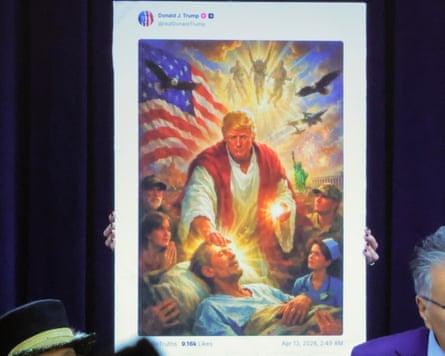
Trump’s comments in reaction to the Palm Sunday homily described Leo as “weak on crime” and suggested that Leo’s papacy is due to Trump has been polarizing.
“If you’re an American, you don’t want to see your president having a feud with the pope,” said Taylor Marshall, an outspoken Catholic conservative with a considerable YouTube following. “And if you’re Catholic, it’s kind of hard. If you voted for Trump three times and you want to be a Catholic and you want to be faithful and submit to the Holy Father, the bishop of Rome, the pope, the vicar of Christ, it’s kind of a tough situation to see the leader of your nation feuding with the leader on Earth of the Catholic church. It is for me.”
Marshall ascribed Trump’s conduct this week to the president’s fundamental difficulty processing the soft power of an American pope, and the challenge that poses to Trump’s sense of self as the most powerful person in the world.
The pope “is in charge of 1.4 billion – not million, billion – people and he has the nerve to interject his moral authority into the activity of President Trump? I really think that is the origin story. It’s a philosophical conundrum that President Trump was never prepared for and I think he’s still trying to figure out how to navigate it.”
About 53 million Americans are Catholic, forming the largest Christian denomination in the United States, according to research from the Pew center and others. About one in five voters is Catholic. Catholic voters have split their vote between the parties over the years, relative to other American Christians, with no presidential candidate earning as much as 60% of the Catholic vote in the last 50 years. A majority of Catholic voters have sided with the winner of the presidency in the last six contests.
Trump won 52% of the Catholic vote in 2016 and 55% in 2024, a 12-point margin over Kamala Harris. But 52% of Catholic voters chose Joe Biden, who became the second Catholic president in American history.
White Catholics and Hispanic Catholic voters diverge sharply in their voting patterns. White Catholics have steadily aligned themselves more frequently with Republicans over the last decade. So have Hispanic Catholics, but the shift has been less rapid. More than 60% of Hispanic Catholics vote with Democrats. About 40% of Catholics are Hispanic, according to Pew.
The papacy has grown more critical of American policy since the end of Benedict’s leadership of the church, with Francis making the treatment of immigrants and refugees central to church teachings. And yet, about half of Catholics still chose to vote for Trump.
“For the better part of the last hundred years, there have been Catholics at the heart of every conservative revolution that has kind of unfolded in this country,” said Matthew J Cressler, a Catholic historian whose forthcoming book Catholics and the Making of MAGA: How an Immigrant Church Became America’s Law and Order Faith is set to be published next year.
“The fact that it was clear that Pope Francis stood on one side of certain justice issues that Trump was on the other side of didn’t drive Catholics away from Trump, clearly,” Cressler added.
The question is whether Trump’s commentary may be the last straw for some.
According to a poll conducted between 20 and 23 March by Shaw & Company Research and Beacon Research, Trump had been losing support from Catholic voters even before his explosive comments about Leo or posting an AI image of himself as Christ on social media. Support had fallen to 48%, with 52% expressing disapproval. The poll also noted sharp divisions within the faith on Trump, with 40% of Catholic voters expressing strong disapproval and 23% expressing approval.
At the time of the poll, that was still seven points higher than public support overall. Support for the war – and Trump – has steadily eroded in polls since the US began attacking Iran and petroleum prices spiked after the closure of the strait of Hormuz in response.
A trio of Catholic cardinals criticized the conflict on CBS’s 60 Minutes last week. Trump’s lieutenants have framed the Iran war as a holy war at times, despite a chorus of theologians arguing that the war fails tests of moral justice under Christian religious doctrine.
“The path of the righteous man is beset on all sides by the inequities of the selfish and the tyranny of evil men,” said Pete Hegseth, the defense secretary, quoting from the Book of Tarantino, in a sermon delivered on Wednesday at the Pentagon.
Hegseth’s credulous recitation of a made-up Bible quote from the movie Pulp Fiction may be the more venal of sins compared with Trump’s depiction of himself as Christ.
The pope’s comments in Cameroon after Trump’s posting indicated no interest in withdrawing his criticisms.
“Blessed are the peacemakers!” he said. “But woe to those who manipulate religion and the very name of God for their own military, economic and political gain, dragging that which is sacred into darkness and filth.”
The response by the administration itself and its supporters in government to the pope’s criticism has done little to shore up Catholic support.
Vice-President JD Vance, a recent Catholic convert, told the pope on Tuesday to “be careful” when discussing theology. Mike Johnson, the House speaker, subsequently suggested that the pontiff did not understand “just war” moral philosophy, despite the pope being a religious scholar of Saint Augustine, the fourth-century theologian who first articulated the idea in Christian theology.
Leo began “right out of the gate of his papacy speaking to this time and age, saying ‘I get your politics; that’s not what this is,’” said Michael Steele, former lieutenant governor of Maryland and RNC chairman, on a podcast hosted by Catholic Charities. Steele is a Catholic seminarian trained in the Augustinian order.
“This is about your responsibility to live out the gospel, which has no political orientation, which has no ideological roots,” Steele said. “It is grounded in the word of God himself, and if you can’t do that, then maybe you need to sit in your room a little while longer and figure it out before you go out into the world and mess things up for the rest of us.”
Reaction from Trump supporters has often been to criticize the pope for failing to treat Islamist terrorism and the repression of dissent within Iran with the same moral condemnation as that of American militarism. Even that message meets a mixed response among politically conservative Catholics.
“The pope now is being criticized for supposedly going soft on Islamic terror. This is an op,” said Michael Knowles, another prominent Catholic conservative commentator, referring to a political operation. “This is an anti-Catholic and coincidentally anti-Trump op to try to split the Catholics from the president and the president from the Catholics.”











Comments