
 German (DE)
 English (US)
 Spanish (ES)
 French (FR)
 Hindi (IN)
 Italian (IT)
 Russian (RU)
 3 hours ago
What purportedly modern, world-class city has an airport where millions of visitors step off their planes, glide their bags on to the sidewalk and are greeted by a terrifying scrum of bumper-to-bumper traffic?
Welcome to Los Angeles.
A journey to the Los Angeles international airport (LAX) is notorious for its dreaded gridlock, the result of an outdated horseshoe street design that offers only one way in and out of one of the busiest airports in the world.
“You have to really love somebody to drive them to LAX,” said Eli Lipmen, executive director of Move LA, a local non-profit coalition that organizes for improved transit and housing.
Enter the people mover: a long-awaited rail line of less than 2.5 miles (4km) that would offer congestion relief by finally providing a direct rail connection between terminals, a ride-share zone, a new transit center and a car rental hub.
The project, officially named SkyLink, broke ground in 2019 under then mayor Eric Garcetti. Since then, the city has been through a lot. A global pandemic. #FreeBritney. A pair of devastating fires. The Dodgers winning the World Series thrice. Trump 2.0’s immigration raids and the massive protests in response. Two mayors and a new one on the way.
And in those nearly eight years, the LAX people mover’s elevated track has gone up and its train cars are rolling between stations, but they’re moving precisely zero people. It’s also gone more than $1bn over budget, and is expected to overshoot its intended 2023 opening date by four years (and counting).
The project – part of a $30bn plan to modernize LAX – has been hampered by disputes between the contractor hired to execute it and the city, along with a litany of technical issues.
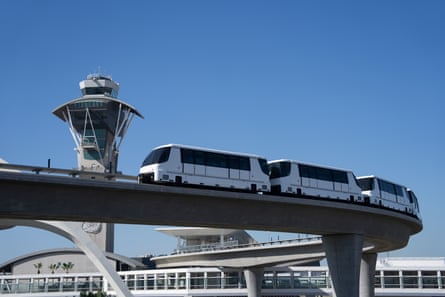
Officials report the project is 99% complete, but the final testing phase, which requires at least 30 consecutive days of uninterrupted operation, has stretched more than 200 days. An estimated opening has been pushed back multiple times, and is now slated for 2027. More public scrutiny came after a video circulated on local media showing an electrical explosion on the track, for which city officials have not explained a cause. In September, the credit agency Fitch Ratings downgraded the project’s debt to a B-, just shy of deeming it a substantial credit risk.
Similar people mover systems are running in dozens of airports and cities in the US and around the world. It all raises the question: how did a seemingly straightforward project get so wildly off track?
The city’s push for a rail renaissance
Los Angeles county, which has long been far behind other global cities when it comes to public transit, is attempting to bring about a rail renaissance.
The region is extending existing lines and working to build new ones, thanks in large part to voter-approved tax measures that boost transit funding. The goal is to transform local train and bus networks into a more feasible option for the most populated metropolitan region in the US – where having a car is often both the most practical and the most aggravating way to get around.
What better way to advertise LA’s transit-rich future than for millions of people arriving at LAX each year to be greeted by an electric, automated train that whisks them away from soul-crushing traffic and connects them to a state-of-the-art regional transit center?
“The promise of this project was to dramatically reduce [congestion] and provide a real alternative to driving to LAX – not just for visitors, but for Angelenos themselves,” Lipmen said. “We really want to change how people see LAX and the value of this world-class airport.”
LA missed a huge opportunity to do that this summer when the World Cup came to town. Questions arose about whether it would be ready in time for the city to host the Super Bowl at the nearby SoFi stadium in February. This season’s holiday travelers arriving to or departing from LAX will see the people mover rolling by their terminals, but cannot ride it. And with the 2028 Olympics around the corner, the pressure is mounting.
The 11-acre LAX/Metro Transit Center, a separate project the people mover will stop at on its journey to connect airport travelers to and from light rail and bus service, broke ground more than two years after the people mover did and opened in June 2025.
What began as an exciting step in LA’s rail revitalization has morphed into “a boondoggle”, Lipmen said.
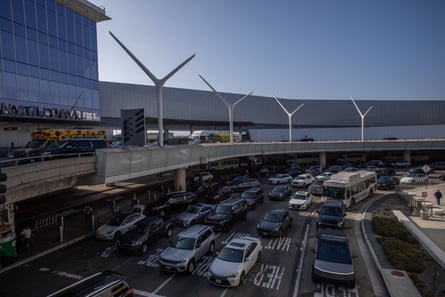
“Now this project is an embarrassment,” he added. “I am very concerned at this moment that we will have a $3bn distressed asset on our hands.”
There’s been a fair amount of finger pointing, though details about the myriad technical issues and delays have been murky, since neither city officials nor the contracting group have been willing to share much on the record.
But in Lipmen’s view, the cause is straightforward: “a lack of good governance and poor oversight” by LA’s mayor, Karen Bass, and the airport commissioners she appointed to hold accountable for “this Frankenstein of a conglomerate that was formed to deliver the project and can’t deliver the project”.
The work is being overseen by Los Angeles World Airports (Lawa), the governing body created by the city to manage LAX. It signed a contract with LAX Integrated Express Solutions, or Linxs, to design, construct, operate and maintain SkyLink for 30 years. Linxs is a consortium of engineering and construction firms that joined together specifically to take on this project. Its website no longer works.
A working relationship frays
This public-private partnership was pitched as a cost-effective model that could set the bar for future transit projects. When the people mover project broke ground nearly eight years ago, Lawa’s leaders said they were “committed to creating a world-class airport for Los Angeles, delivered in an innovative, efficient and fiscally responsible manner”.
But the working relationship between city and contractor rapidly frayed. Disputes arose over design codes and Linxs submitted hundreds of change orders – alterations to the initial scope of work and costs laid out in the contract. That culminated in a settlement with the city that granted Linxs an additional $550m over the initial $1.9bn price tag. Eventually, costs ballooned to nearly $3bn as the competition date was pushed back year after year.
A Los Angeles county civil grand jury investigated the project, seeking to understand what was behind the years of delays and hundreds of millions in additional payments to Linxs. In California, civil grand juries can act as a government watchdog, separate from criminal indictment grand juries.
It released its report last year, fashioned as a sort of amateur Hollywood screenplay and loaded with movie references such as “if you build it, he will come” to punch up “a very dry and boring” saga.
According to the grand jury, Linxs essentially took LA’s airport authority for a $880m ride because city officials did a bad job writing up its contract. The contractor “leveraged the intricacies” in the agreement, the grand jury wrote, by barraging city departments with change orders, then delaying work because city staff could not respond to its deluge in the contractually obliged timeframe.
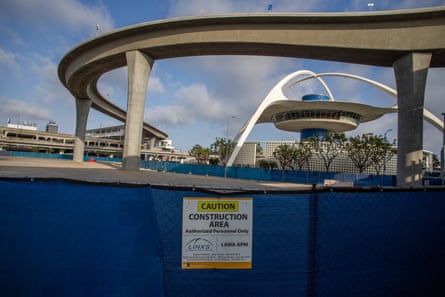
“The slowdown tactic of Linxs is not nefarious,” the report states. “It’s good business from the contractor’s point of view to force Lawa to agree to claims, which from Lawa’s perspective are not justified.”
The grand jury also believed that Linxs leveraged the political pressure on city leaders to open the project in time for major sporting events “by implicitly holding out the threat of prolonged litigation”.
In July, Linxs sued the city, claiming several breaches of contract that hampered the project. That included faulty electrical equipment that the contractor said delayed key testing by more than 140 days. Linxs says it is still waiting on Lawa to finalize an agreement with LA’s department of water and power to provide a solar energy system to power the trains, resulting in more delays.
In a statement, the city’s airport officials said the solar issue is one “of many false legal assertions that Linxs has made to distract from their failure to meet their contractual obligations”.
“Litigation and disputes are not holding up the progress on the train,” the statement continues. “The primary factor in the delay is Linxs’ inability to complete required system demonstration testing to ensure the reliability and safety of the train.”
Juan Matute, deputy director of the Institute of Transportation Studies at UCLA, intends to study the plight of the people mover to better understand how this public-private partnership between the city and Linxs derailed.
“It seems pretty obvious to anybody who cares about public sector finance that mistakes were made,” he said.
“It’s important to have outside groups overseeing what Metro and Los Angeles World Airports are doing and having some financial literacy to pressure elected and appointed officials not to make these types of mistakes in the future.”
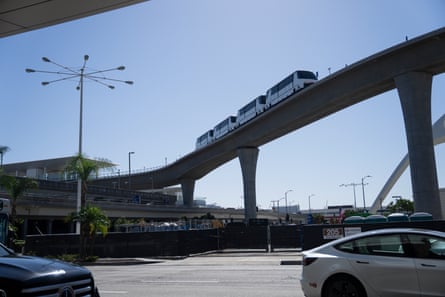
Under the settlement terms for Linxs to be paid that $550m, it must deliver a system ready for passengers by 8 December of this year. If Linxs misses that date, which it appears likely to do, it could throw the project into further disarray.
Airport officials have not been too forthcoming about a speedy end date. “No opening date can be confirmed until Linxs … completes their final testing,” Lawa said in a statement. “Any dates released by other parties are not confirmed dates but simply estimates.”
In a statement, representatives from Linxs said its contracting group “remains committed to working with Lawa to successfully deliver the automated people mover and provide a world-class transportation system for the Los Angeles region”.
The SkyLink saga became a flashpoint in this year’s LA mayoral race. Nithya Raman, the democratic socialist city council member who defeated Bass, the incumbent mayor, held up the project as a symbol of the dysfunction at city hall she would work to solve.
“The contract was in place before Mayor Bass took office, but she has been mayor now for four years. She inherited the project [and] the responsibility for getting it finished,” Raman said. “Angelenos don’t need another explanation of why it’s complicated or why it’s not her fault – they need a mayor who can manage something complicated.”
Bass’s office provided a statement that echoed much of Lawa’s previous statement. The mayor’s office pointed to Linxs as the “main reason” for the delay, because it had not completed testing. “Mayor Bass has not stopped in ensuring Angelenos will have access to a people mover that is safe and reliable,” the statement reads.
Raman, who holds a master’s degree in urban planning from MIT, has called for a full investigation into the project and said she would refer any alleged evidence of criminal wrongdoing “to the appropriate authorities”. When she’s sworn in as mayor next month, LAX’s train troubles will become her responsibility.
And the goalposts keep shifting. Last week, Linxs moved the people mover’s projected opening back again, now to March 2027. Never mind, Super Bowl travelers.




















Comments