
 German (DE)
  English (US)
  Spanish (ES)
  French (FR)
  Hindi (IN)
  Italian (IT)
  Russian (RU)
  2 hours ago
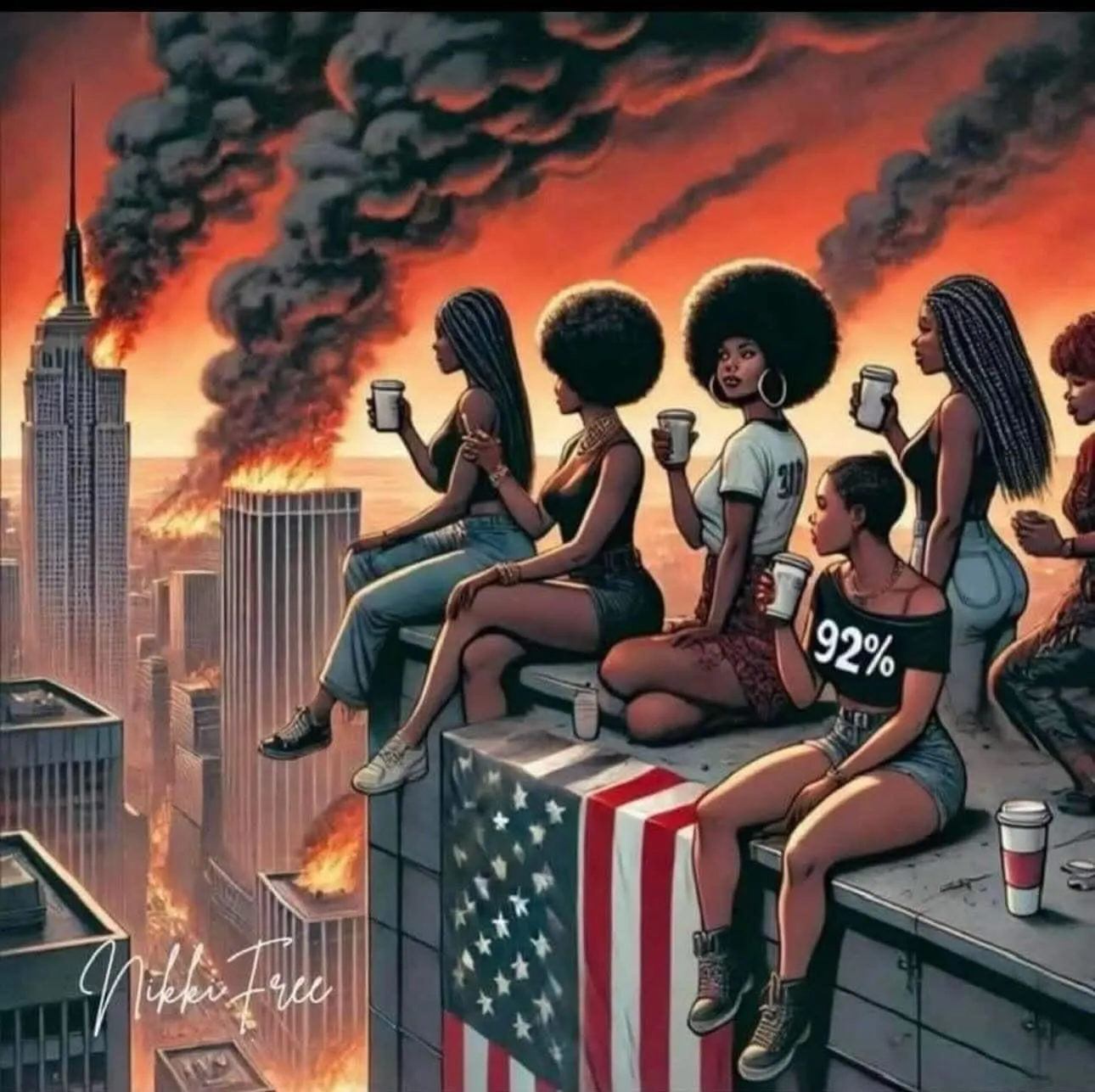
Not soon after Donald Trump’s 2025 inauguration, there emerged a viral illustration of four Black women sitting at the top of a building while watching the world burn at a distance. They are observing with coffee cups in hand. An American flag hangs over the edge. If that exhaustion hadn’t been made clear enough, Black people, particularly across TikTok and Threads, have urged one another to “not give them a reaction”.
The “them” is white people who find Black rage exciting and lucrative for their own personal gain. We’re not allowing our anger to become spectacle. We’re not shouting any more. What is most important is to stay alive, take care of one another, and to allow ourselves to step to the forefront for the rights that they have taken for granted as we’ve risked our lives to protect them. There is an old African American proverb: “If you can’t hear, then you must feel.”
We had been sounding the alarm on Trump for a decade and now the rest of America had to feel its consequences without our involvement.
The 250th anniversary is arriving among Black communities as a whisper instead of a roar. We know freedom is different for us. Even before the colonists rebelled against the British crown, Black, enslaved South Carolinians shouted “Liberty!” and carried banners as they marched down a road near the Stono River in St Paul’s parish.
The Stono Revolt of 1739 was the largest slave rebellion in the British mainland colonies before the American Revolution. That same language for “liberty” would be echoed in the Declaration of Independence. Thomas Jefferson would draft an 168-word passage condemning the institution of slavery yet his words would never make it to the final version. Slavery, after all, was big business for the north and south.
So much so that the Mansfield Judgment of 1772, when a court declared that a master could not force deportation of an enslaved person in England to be sold, it solidified colonists’ opposition to the British crown. The ruling, in which the Lord Mansfield, chief justice of the King’s Bench, called slavery “odious”, sparked colonists’ fear that said crown would ultimately upend the institution of slavery in the colonies altogether. It is this throughline that historian Gerald Horne argues that the American Revolution in of itself was to preserve slavery.
Many of us know about the Declaration of Independence. Many of us do not know about the Stono Revolt of 1739. Its story was passed through oral tradition, and high school textbooks previously excluded such a rebellion in its documentation of history, similar to the Trump administration’s erasure attempts of Black history now. But the Stono Revolt’s influence has been interwoven throughout how Black communities uplift and shield one another.
Rebels communicated with one another through music and dance. The white colonists banned “drums, horns and other loud instruments” to impede coordination, but such sound technology has persisted in the rebels’ descendants.
We can hear rallying cries through the songs of Mahalia Jackson and Nina Simone, the signifying through the ring shout and the later Negro spirituals, the thunderous orations of Dr Martin Luther King Jr and Fannie Lou Hamer, and the slogans of the Black Panther party and the SNCC. All of these iterations are to reinforce our solidarity, strength and resistance to white tyranny.
In the digital age, Black Americans are still communicating with each other. Although we’re not shouting “Liberty!”, we’re saying nothing at all. The tactic has been to remind us all to remain grounded and that the best suffocator of provocation or depressing news in general of the Trump presidency is to deprive it of attention.
“Our energy is powerful,” Juju Bae, a Brooklyn-based spiritual practitioner and working priestess, told me in an interview. “Animism – everything has a spirit, everything has an energy to it. These things that are meant to stir us, that is matter. You know, that is a force.”
We know our power to participate as well as to withhold, so much so that leading publications have wondered about our absences at anti-Trump protests and the beginning of a four-year break to see how much our rest can shift culture.
We have seen the upset when our rage is like catnip to white nationalists.
You can look at pardoned January 6 rioter Jake Lang holding up signs such as “Black parents are failures” at the 2026 BET awards. A Maga debate group setting up an unauthorized table on an Tennessee State University, Michelle Obama is once again masculinized by the right.
We live in an anti-DEI world now where many have abandoned us in spite of our labor being the backbone of this nation.
The fight from here on out looks much different because Black people will not carry water for anyone else any more. Instead, we’ll drink it ourselves.
-
Morgan Jerkins is a senior writer, race and equity, at the Guardian US








Comments