
 German (DE)
  English (US)
  Spanish (ES)
  French (FR)
  Hindi (IN)
  Italian (IT)
  Russian (RU)
  2 hours ago
When Francesca Hong ran for the Wisconsin state assembly in 2020, childcare was not front and center in her campaign. Now, the Democratic representative, restaurateur and mother is running for governor. And she has said that a universal childcare bill would be among the first measures she would like to sign into law if she becomes her state’s chief executive.
“We’re in a childcare catastrophe. We haven’t invested enough in this infrastructure,” Hong said in an interview with the Guardian. “Universal childcare meets the moment of the crisis we’re in, with the speed and scale to spread across the state.”
Hong is hardly alone: in recent months, Democrats running for office around the country – from the Georgia gubernatorial candidate Jason Esteves to Maine congressional candidate Jordan Wood to Washington DC mayoral candidate Janeese Lewis George – have taken up the universal childcare mantle.
In fact, nearly all wings of the Democratic party have now embraced universal childcare as a goal. In November, the strategist and Clinton White House veteran James Carville wrote in a New York Times op-ed: “When 70 percent of Americans say raising children is too expensive, we should not fear making universal child care a public good.” Then earlier this month, David Plouffe, former campaign manager for Barack Obama’s 2008 run and an adviser to Kamala Harris, asserted in the same pages that “establish[ing] universal child care” should be part of the party’s 2028 platform. And democratic socialists like Bernie Sanders have long called for such an approach.
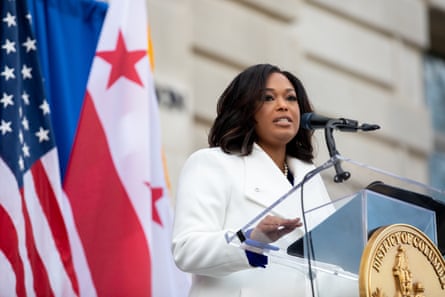
The shift is not merely rhetorical: since last fall, New Mexico has removed income limits on its free childcare policy, New York has announced a pathway to universal free childcare, and San Francisco has extended free childcare to families of four making under $230,000 a year.
Yet the emerging consensus on universal childcare is a notable departure from the Democratic party’s traditional stances. Barack Obama’s early childhood policy focused mainly on pre-kindergarten rather than universal childcare. For the past nine years, the dominant Democratic childcare proposal has been the Child Care For Working Families Act, currently co-sponsored by 43 members of the US Senate Democratic caucus. That legislation would substantially increase government support of childcare, but aid is delivered on a somewhat arbitrary sliding scale, and early iterations capped household eligibility at 150% of state median income. When the House passed its version of the Build Back Better legislation in late 2021, it used a similar non-universal model that capped eligibility at 250% of state median income.
Even getting to that point, however, was an accomplishment: the Child Care For Working Families Act was novel and bold when first introduced in 2017 by the Washington state senator Patty Murray and Virginia representative Bobby Scott. “It was exciting to have the leaders of the [Senate health, education, labor and pensions and House education and workforce] committees committed to this vision and to really going bigger than anyone had gone in a long time,” said Julie Kashen, senior fellow at the Century Foundation and one of the architects of the plan.
Understanding the evolution of the Democratic position on childcare requires a brief history lesson. In 1971, a Democratically controlled Congress passed a bipartisan law known as the Comprehensive Child Development Act, which included the line: “Comprehensive child development programs … should be available as a matter of right to all children regardless of economic, social, and family background.” President Richard Nixon, however, was concerned about shoring up his right flank and vetoed it with extremely strong language, saying that passing the law – which would have begun funding a locally run network of childcare programs parents could choose to access – would commit “the vast moral authority of the national Government to the side of communal approaches to child-rearing over [and] against the family-centered approach”.
By the time a watered-down version of the bill came back up in 1975, opposition was so fierce that Walter Mondale, the lead Senate sponsor, was forced to hire additional staffers just to handle the volume of opposing mail. A widely circulated pamphlet claimed that the bill would forbid parents from making children take out the trash or go to church. The kerfuffle sparked national headlines, including one in the Washington Star that read, Even Nonexistent Parts of Child Care Bill Draw Fire.

The bruising episodes of the 70s scarred Democratic politicians for generations. Historian Kimberly J Morgan wrote: “At the national and local levels, the right captured the issue of universal public day care and made it so politically toxic that few legislators would come near it.” Childcare proponents, too, largely stopped asking for universal policies: by the 1980s, the entire liberal approach to childcare shifted to one that focused on welfare-style aid for poor families and incentives for employers to help middle-class families. This philosophy held sway well into the 21st century.
Then, in February 2019, Senator Elizabeth Warren made waves when she introduced a major childcare plan as part of her presidential campaign. The proposal would have made childcare free for families under 200% of the federal poverty line (currently $66,000 for a family of four) and extended at least some benefits to all households. Around the same time, New Mexico’s governor, Michelle Lujan Grisham, took office and rapidly prioritized a pathway to universal childcare in the state.
Advocates and grassroots organizers were pushing behind the scenes to make this happen, with much of the energy coming from historically disenfranchised groups like Latino parents and childcare educators. In places such as New Mexico and New York, “the work really started years and years ago,” said Andrea Paluso, co-director of the Child Care For Every Family Network, a coalition of state-based community organizing groups. In the case of New Mexico, groups such as Olé spent more than a decade “organizing providers and organizing parents around the need for a public solution and for public investment” before securing significant victories.
Multiple experts consulted for this story pointed to the Covid-19 pandemic as a key pivot point when the childcare crisis landed on so many Americans’ doorsteps. Unpublished data from New America’s Better Life Lab shows that media mentions of childcare more than doubled starting in 2020 (I am a fellow at the Better Life Lab, but not involved with this research). The content of stories changed, too: a group of researchers found that whereas local news coverage about childcare in the pre-pandemic years tended to focus on scandals, the pandemic caused a major increase in stories about policy. The veteran Democratic pollster Celinda Lake explained that after the pandemic, “small businesses care about it, employers care about it, grandparents care about it, and even parents with older children care about it, because people realize that you can’t have a functioning economy without a childcare system.”
A springboard, then, was set. In the fall of 2025 – when Lujan Grisham garnered glowing headlines for her state’s shift to universal free childcare and Zohran Mamdani successfully made it a centerpiece of his New York mayoral campaign – a bigger window opened. And it seems the party has jumped through head-first. Childcare is now, Lake said, “front and center in the affordability agenda”. Warren shared a similar sentiment, writing in an emailed statement: “It’s about time Democrats realize that you can’t have affordability without universal childcare. If Democrats are serious about winning in 2026 and beyond, there’s no choice but to run on and deliver on high quality, affordable childcare.” Francesca Hong, the Wisconsin gubernatorial candidate, agreed, saying: “It’s universal policies that will establish permanent affordability.”
Childcare has also been increasingly framed as a service where government comes alongside families regardless of their income, much like public schools or roads. Jason Esteves, the Georgia gubernatorial candidate and former Atlanta school board chair, offered: “Childcare is unaffordable, parents can’t go to work, and kids aren’t getting the building blocks that they need to,” and that childcare was an issue “not just for a certain group of working families, it’s for folks across the board”.
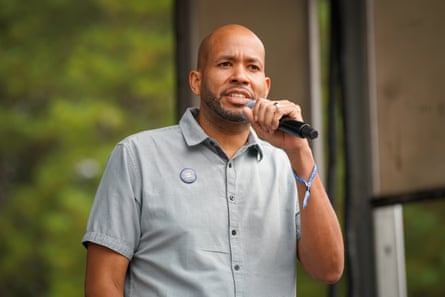
Significant questions remain unanswered: first and foremost, what exactly counts as universal childcare? “This is becoming a reality and an important political issue,” Paluso said, “and we have to be careful to define what a win is.” The New Mexico policy, for example, excludes most families in which all available parents aren’t either working or in school, with some exceptions.
The form which universal childcare takes is also up for debate: in New York, there are active conversations over how to best include home-based childcare providers in the expanding system. Similarly, there are still divides between more moderate and progressive wings of the party with regards to how swiftly a universal vision should be achieved, whether care should be truly free across the board, and how to finance a universal system. The new Virginia governor, Abigail Spanberger, for instance, spoke more during her campaign about clearing existing waitlists for childcare aid than expanding who is eligible.
That said, certain shared principles are emerging, such as free care for most, if not all, families and the need to invest in an underpaid workforce in order to ensure enough supply and high-quality offerings. Lake noted that Democratic lawmakers and advocates have also become “much more inclusive of family options than they once were”. New Mexico’s policy offers grandparents and other relatives of eligible children $750 a month for providing primary childcare.
It is fair to say that universal childcare is now a mainstream position within the Democratic party. That does not mean childcare will automatically become as polarized as other issues. Childcare scarcity cuts across partisan lines and multiple bipartisan childcare bills have been introduced even in the current rancorous Congress. This evolution does suggest, however, that the days of childcare stuck in a welfare framework may have come to an end. As Kashen concluded: “Ultimately, having universal childcare as the goal is something that not only serves the families directly who will benefit from it, but it really serves everyone.”


















Comments